Measuring Visibility in AI Search: Metrics Beyond Traditional Rankings

The Measurement Problem
For years, SEO success was easy to define.
You tracked rankings.
You watched organic traffic grow.
You attributed conversions to search.
And if all three were moving in the right direction, things were working.
AI search breaks that model.
Tools like ChatGPT, Claude, Perplexity, and Google’s AI Overviews don’t behave like search engines. They answer questions directly. They summarize, compare, and recommend, often without sending a single click to your website.
Which creates a new problem for founders and marketing teams:
Are we visible where decisions actually happen?
This article introduces a practical framework for measuring AI search visibility, going beyond rankings and traffic to understand citations, influence, and brand presence inside AI-generated answers.
You will learn:
- Why traditional SEO metrics fail in AI search
- The new metrics that actually matter
- How to track them realistically
- What “good” performance looks like in 2026
Why Traditional Metrics Don’t Tell the Full Story
The Rankings Problem
Traditional SEO logic
- Rank #1 = success
- Track positions over time
- Optimize pages to move up
Why does this break in AI search
- AI tools don’t have fixed rankings
- Your brand either appears in an answer or it doesn’t
- The order of mentions changes constantly
- Responses vary by user, context, and timing
Ask ChatGPT “best email marketing tools” today, and you might be cited second.
Ask tomorrow, and you might not appear at all.
Ask from another account, and you might be third.
There is no stable position to track.
The new question isn’t “What position do we rank?”
It’s “How often are we cited?”
This shift is already visible in practitioner data. In one widely discussed SEO analysis, nearly 28% of pages most frequently cited by ChatGPT had little to no traditional Google rankings at all, reinforcing that AI systems evaluate usefulness very differently than ranking algorithms.
28% of ChatGPT’s most-cited pages have ZERO Google visibility
byu/RadioActive_niffuM inDIYSEO
The Traffic Problem
Traditional SEO logic
- More organic traffic = better performance
- Track sessions and landing pages
- Optimize for click-through
Why does this break in AI search
- AI answers reduce clicks
- Zero-click responses are the norm
- Brand awareness happens without traffic
- Influence happens before measurement
Example:
A user asks Claude:
“Which CRM is best for small teams?”
Claude explains the options and mentions your product with context.
The user doesn’t click, but remembers your brand.
Later, they Google your brand name directly.
That influence never shows up as AI traffic.
This disconnect is becoming a common frustration. In multiple AI search discussions, marketers have pointed out that AI-driven awareness often leaves no direct analytics trail, even though it clearly shapes buying behavior.
The new question isn’t “How much traffic?”
It’s “How much influence?”
The Conversion Problem
Traditional SEO logic
- Attribute conversions by channel
- Calculate ROI per source
- Optimize conversion paths
Why does this break in AI search
- AI introduces awareness
- Google or direct captures conversion
- Brand search masks AI influence
- Attribution models miss early touchpoints
AI search assists. It rarely converts directly.
Traditional attribution simply doesn’t see that contribution.
The New Measurement Framework
1. Citation Frequency: Are You Getting Mentioned?
What it measures:
How often do AI tools cite or mention your brand for relevant queries?
Why it matters
- Binary visibility signal (cited vs ignored)
- Core success metric for AI search
- Strong predictor of downstream brand growth
How to Measure Citation Frequency
Step 1: Build a test query list (20-50 queries)
Include:
- Category questions
- Problem-based queries
- Comparison queries
- Implementation questions
Example (B2B SaaS CRM):
Category
- “What is the best CRM for small businesses?”
- “Which CRM should startups use?”
Problem
- “How do I manage customer relationships as my business grows?”
Comparison
- “HubSpot vs Salesforce for small teams”
- “Best alternatives to [competitor]”
Implementation
- “How to set up a CRM system.”
- “CRM implementation best practices”
Step 2: Test across platforms
- ChatGPT
- Claude
- Perplexity
- Google AI Overviews
- Bing Copilot
Step 3: Document results
- Mentioned (Yes / No)
- Context
- Position
- Quality
- Link included
Step 4: Calculate citation rate
Citation Rate = (Mentions ÷ Total Tests) × 100
Benchmarks
- New brand: 5-15%
- Established brand: 25-40%
- Category leader: 50-70%
- Dominant brand: 70%+
This is also why AI visibility can’t be treated as an SEO side effect anymore. Making your brand understandable to language models requires deliberate effort, which we break down further in How to get your brand visible in LLM results.
2. Citation Context: How Are You Being Mentioned?
Not all mentions are equal.
A passing mention is not equal to a recommendation.
Citation quality tiers
- Tier 1- Primary recommendation
- “For small teams, [Your Brand] is an excellent choice because…”
- Tier 2- Top option list
- Tier 3- Mentioned among options
- Tier 4- Cited as authority/source
- Tier 5- Passing mention
Weighted context scoring
- Primary recommendation: 5
- Top-3 option: 4
- Listed among many: 3
- Authority/source: 3
- Passing mention: 2
- Negative mention: 0
This reveals not just visibility, but perception.
Content structure plays a huge role here. Pages written around real questions with direct answers consistently earn stronger citation context, which is why Why Structured, Question-Driven Content Performs Better in AI Search has become foundational reading for AI-ready teams.
3. Query Coverage: Where Are You Visible?
What it measures:
How broadly your brand appears across the buyer journey.
Query categories
- Awareness
- Consideration
- Evaluation
- Implementation
Example coverage:
- Awareness: 15%
- Consideration: 45%
- Evaluation: 65%
- Implementation: 25%
Strategic insight
- Strong evaluation, weak awareness → missed discovery.
- Strong awareness, weak consideration → weak positioning
- Strong consideration, weak evaluation → trust gap
4. AI Referral Traffic: Are Mentions Driving Visits?
Track referrals in GA4 from:
- chat.openai.com
- perplexity.ai
- bing.com (Copilot)
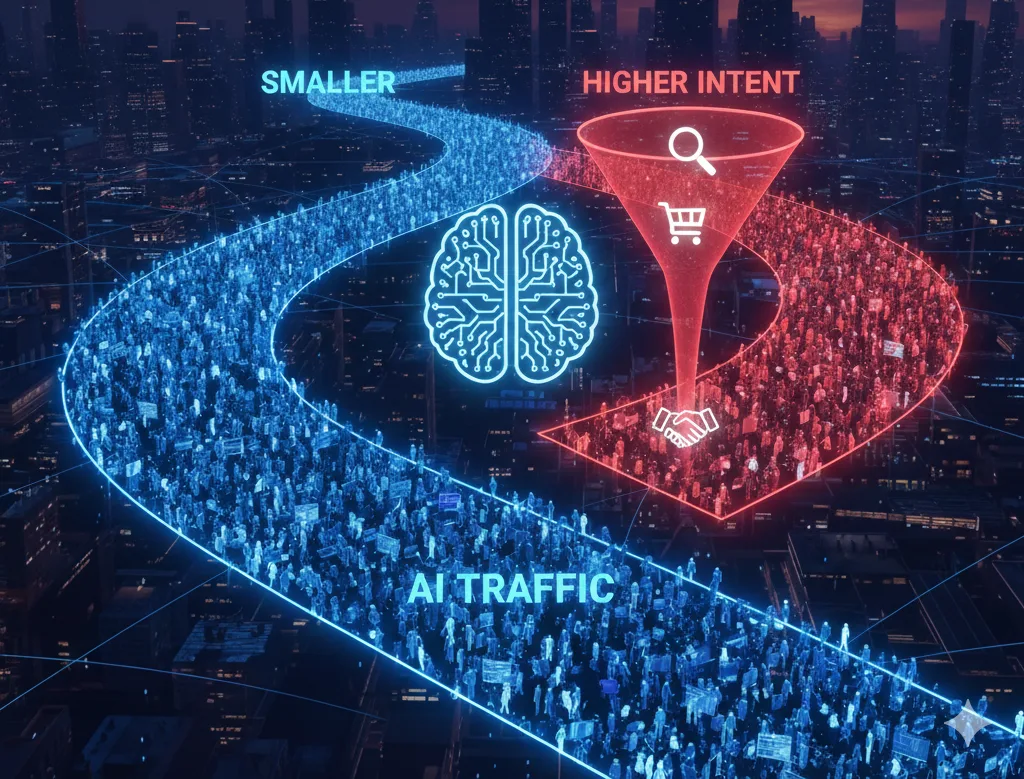
AI traffic is often smaller, but higher intent.
5. Brand Search Volume: Indirect AI Influence
AI mentions often lead to:
“Let me Google this brand.”
Track brand queries in GSC:
- Brand name
- Variations
- Brand + category
Rising brand search alongside rising AI citations usually signals real influence, even without direct attribution.
6. Citation Quality Score (CQS): One Executive Metric
To simplify reporting:
CQS =
- Citation Frequency × 0.30
- Context Quality × 0.25
- Query Coverage × 0.25
- Recency × 0.10
- Platform Diversity × 0.10
Score interpretation
- 0-20: Minimal
- 21-40: Emerging
- 41-60: Moderate
- 61-80: Strong
- 81-100: Dominant
This shift toward AI visibility metrics is already happening. Many SEOs now openly discuss AI brand presence as a first-class KPI, alongside impressions and clicks, not a replacement, but a parallel signal.
Are AI brand visibility metrics starting to matter more than traditional SEO analytics?
byu/outrankerai inOutrankerAI
Setting Realistic Expectations
AI visibility compounds slowly.
Typical trajectory
- Months 1-3: Baseline (CQS 15-25)
- Months 4-6: Early traction (30-45)
- Months 7-12: Consistency (50-65)
- Year 2+: Category strength (65-80)
Trends matter more than precision.
If AI Search Visibility Feels Hard to Measure, You are Not Alone
If you are reading this and thinking, “We honestly don’t know if AI tools are helping us or ignoring us,” that’s normal.
Most teams aren’t failing at AI search.
They are just measuring it with the wrong tools.
Rankings don’t apply.
Traffic is incomplete.
Attribution is messy.
What matters is whether your brand shows up in the answers that shape decisions, and whether that visibility is improving over time.
If you want to sanity-check:
- Whether AI tools are citing your brand at all
- How strong or fragile your AI visibility is
- What’s realistically worth improving at your stage
You can share a bit of context with us here: https://tally.so/r/3EGEd4
No audits. No dashboards. No AI hype.
Just a short form to understand what you are building, what you are measuring today, and whether a conversation would actually be useful.
If there’s a clear fit, we will take it forward.
If not, you will still leave with more clarity than you had before.
Common Questions About Measuring AI Search Visibility
Run controlled tests across ChatGPT, Claude, Perplexity, and AI Overviews using relevant category and comparison queries. If your brand rarely appears where it should, AI systems don’t yet see you as a strong authority.
No. It’s a supporting signal. Citation frequency and citation context matter more because many high-impact AI mentions never result in a click.
Because rankings reward keyword optimization, while AI tools reward clarity, structure, and explanatory depth. A page can rank well and still be unusable for AI answers.
Yes. AI visibility usually shows up first as brand mentions and brand searches. Traffic often follows later once demand compounds.
Monthly is enough. AI answers vary daily, so trend direction over time matters far more than individual responses.
They favor trusted authority, not just size. Smaller brands can outperform large ones by owning narrow use cases, industries, or specific problems.
Trying to force precision. AI visibility is directional, not exact. Teams that track trends make progress faster than those waiting for perfect attribution.