How to Optimize B2B SaaS Content for Google’s Search Generative Experience (SGE)
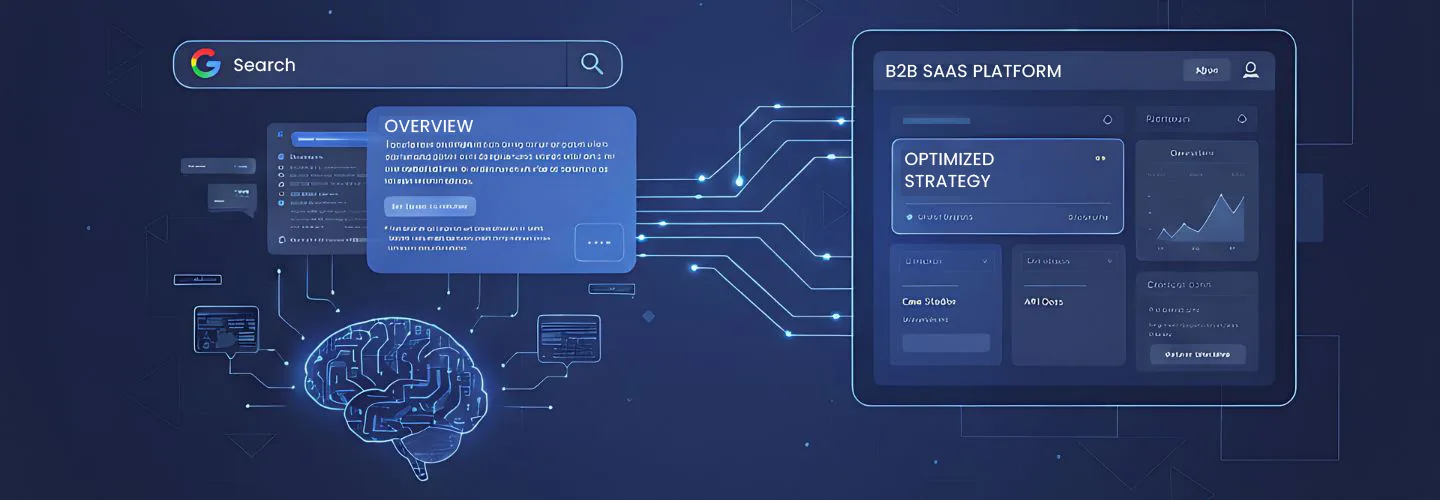
If you want your B2B SaaS content to get picked up by Google’s AI-powered summaries, you must write for clarity, structure, and trust, not just for keywords.
SGE now privileges content that delivers crisp answers, strong context, and credible signals over long-form blogs stuffed with jargon.
What Most SaaS Marketers Still Get Wrong
Many content strategies remain rooted in traditional SEO thinking:
- Write long blogs aiming for rankings.
- Pack in keywords hoping for visibility.
- Assume that ranking = discovery.
But SGE isn’t about ranking, it’s about being selected for AI answers. As described by Google, SGE generates summarised answers using multiple sources and surfaces those that best match clarity, reliability, and context.
That means: nice-looking articles may rank on Google, yet never show up in SGE snapshots, where many users now begin their research.
One marketer in a recent Reddit thread summed it up plainly:
Google SGE: The New Frontier of Search Visibility
byu/Every_Ambassador_535 inDigitalMarketingHack
This shift means we must rethink how we create content, focusing on clarity, structure and credibility first.
A 5-Step Framework to Make Your B2B SaaS Content SGE-Friendly
Here’s a refined, practical framework to prepare SaaS content for the future of search.
1. Write for “Answer Density”, Not Word Count
SGE prefers content that delivers fast, clear, contextual answers. That means:
- The core answer should appear within the first 40-100 words.
- Each section should address a specific question or subtopic.
- Avoid fluff, skip vague intros or filler paragraphs.
What works:
Concise definitions, clear “how-to” steps or solutions (“How to set up X in 5 steps”), outcome-focused points.
What fails:
Long narrative intros, generic statements, meandering paragraphs.
2. Use Question-Answer Blocks to Boost Extractability
Generative AI loves content that looks like a conversation: Question → Answer → Context.
Example structure:
What makes content eligible for SGE citation?
SGE looks for clarity, factual accuracy, alignment with user intent, and strong source credibility. Pages with clear Q&A formatting or structured layout get picked more often.
This kind of structure makes it easier for AI to parse, understand, and reference in summaries.
3. Strengthen Your Entity Signals (the Hidden Layer)
SGE, like other LLM-powered systems, treats your brand, product, and the domain topics as entities.
To optimize:
- Use consistent naming and descriptions across all content.
- Implement schema markup (Organization, Product, Article, FAQ).
- Build clear internal linking and topical clusters (e.g. all content about “workflow automation” links together).
This helps AI systems understand your “knowledge footprint”, not just as isolated posts, but as a coherent, credible entity.
If you want to go even deeper into how AI systems interpret your brand and surface it in their answers, read our guide on how to get your brand visible in LLM results. It expands on entity signals, knowledge footprints, and how to make LLMs treat your brand as a trustworthy source.
4. Build “Credibility Pockets” Inside Content
Merely stating features or benefits isn’t enough. SGE favours content backed by data, citations, and real-world proof.
Use statistics, case studies, and external references: for example, instead of “Our onboarding tool reduces churn,” write: “A 2024 industry study found structured onboarding can reduce user churn by up to 35%.”
Data-driven, authoritative content signals trust and helps AI decide whether your page merits inclusion in summaries.
5. Use Structured Data & Clean Formatting, Make Your Content Machine-Readable
SGE tends to prefer content that’s easy to parse structurally:
| Format Practice | Why It Matters |
|---|---|
| H2/H3 with question or topic headings | Helps AI map content structure |
| Bullets, tables, short paragraphs | Easier for AI to digest |
| FAQ/schema markup / product schema | Provides metadata for AI understanding |
| Fast loading, clean HTML (no heavy JS) | Ensures AI crawlers can access content |
What SGE Prefers vs What It Avoids
| Factor | SGE Prefers | SGE Avoids |
|---|---|---|
| Content Style | Direct, answer-first, context-rich | Keyword stuffing, vague intros |
| Structure | Q&A, bullet points, tables, short sections | Long narrative blocks |
| Data & Proof | Stats, citations, case studies | Unsubstantiated claims |
| Technical SEO | Schema, fast loading, clean HTML | Heavy JS, slow load times |
| Authority | Brand/entity clarity, external validation | Single page, unverified content |
Old vs. SGE-Optimized Content: A Quick Comparison
Old (SEO-style) version:
“Workflow automation software helps businesses streamline processes and save time.”
SGE-optimized version:
Workflow automation software reduces manual tasks by creating rule-based triggers. In B2B teams, this can cut admin workload by 20-40%, according to a 2024 productivity study on automation tools.”
Why this works better: it’s specific, factual, aligned to a use-case, and includes a quantifiable data point, making it far more “AI-worthy.”
SGE Rewards Clarity, Structure, and Truth, Not SEO Tricks

SGE isn’t replacing search; it’s reshaping how great content gets discovered. For B2B SaaS marketers, the playbook is simple: write with precision, use structured layouts, support claims with data, and strengthen your entity signals.
When your content becomes easier for AI to understand and trust, it becomes easier for AI to cite.
Google’s AI systems don’t surface the longest articles or the most keyword-packed pages. They surface content that gives fast answers, strong context, and credible proof.
If you shift from traditional SEO habits to answer-first, evidence-backed content, your pages won’t just compete for rankings; they will earn a place inside SGE summaries, where real discovery now happens.
Want to Know If Your SaaS Content Is Actually SGE-Ready?
If you are serious about improving your content and not just “trying things,” fill out our short diagnostic form.
We are selective, not to be rude, but because great work needs the right mindset on both sides.
The form helps us understand:
- What you are building and why it matters, what isn’t working in your growth?
- How do you think about marketing,
- and whether we are genuinely the right team to guide you?
If we are a fit, we will share a sharp, personalized SGE-readiness breakdown, no fluff, no recycled audits, no agency-speak.
If not, we will tell you straight and won’t waste your time.
Start here (2 minutes): https://tally.so/r/3EGEd4
FAQs
SGE cites sources that deliver clear, concise, and trustworthy explanations. It evaluates whether the content answers the query directly, uses structured formatting, maintains consistent entity signals, and includes verifiable data. Pages that rely on vague statements or long narrative build-ups rarely get selected, even if they rank well.
No. SGE doesn’t reward length; it rewards precision. A short, well-structured section that delivers a complete answer is far more valuable than a long article filled with filler. SGE extracts the cleanest, clearest expression of an idea, not the longest one.
The most common reason is poor extractability. If the content has unclear headings, weak structure, generic explanations, or inconsistent terminology, SGE struggles to interpret it. Ranking signals don’t guarantee inclusion in AI summaries because SGE evaluates clarity and understanding separately from traditional SEO metrics.
Yes, but indirectly. Backlinks strengthen your domain’s authority and help Google trust your explanations. When SGE determines which sources are reliable enough to cite, it looks at that broader authority picture. Even if backlinks don’t directly feed into the AI generation layer, they support the credibility signals SGE depends on.
Yes. SGE performs better with tightly focused clusters around a single concept or entity rather than broad thematic structures. When all related pages reinforce the same terminology and context, SGE can more confidently understand your expertise and select your content.
Yes. Many older blogs were written for traditional SEO and lack the clarity or structure SGE needs. Updating the introduction with a direct answer, simplifying sections, clarifying your terminology, and adding data-backed claims significantly increases the likelihood of SGE recognition, even without adding new sections.
Yes. Google uses entity relationships to assess the expertise of the person behind the content. Authors who consistently publish on specific topics, appear on credible platforms, or have complete public profiles send stronger expertise signals. SGE uses this as part of its trust evaluation before citing explanations.
It can, especially if the original content is vague or open to interpretation. The clearer and more specific your explanations are, with explicit definitions, measurable statements, and unambiguous context, the less likely SGE is to distort the meaning. Precision reduces misinterpretation.
SGE tends to surface blog posts, how-to guides, documentation, and explainer content because they contain structured, educational information. Product pages are less likely to appear unless they include clear definitions, comparisons, or technical explanations that directly answer a user’s query without sales language.
A good rule is every six to twelve months, or sooner if your product evolves, new industry data becomes available, or you notice shifting terminology. SGE performs better with fresh, clearly contextualized information, so outdated content loses authority and visibility over time.