Why Your B2B SEO Breaks Across Bing Chat and Google SGE

AI search is no longer a single system to optimise for.
B2B SEO teams are now operating in a dual AI-search reality:
- Google SGE, embedded inside traditional search behaviour
- Bing Chat (Copilot), embedded inside decision workflows
They look similar on the surface.
They are not evaluated the same way underneath.
Teams that treat “AI search” as one channel are already losing visibility, not because their SEO is bad, but because their content resolves intent differently across platforms.
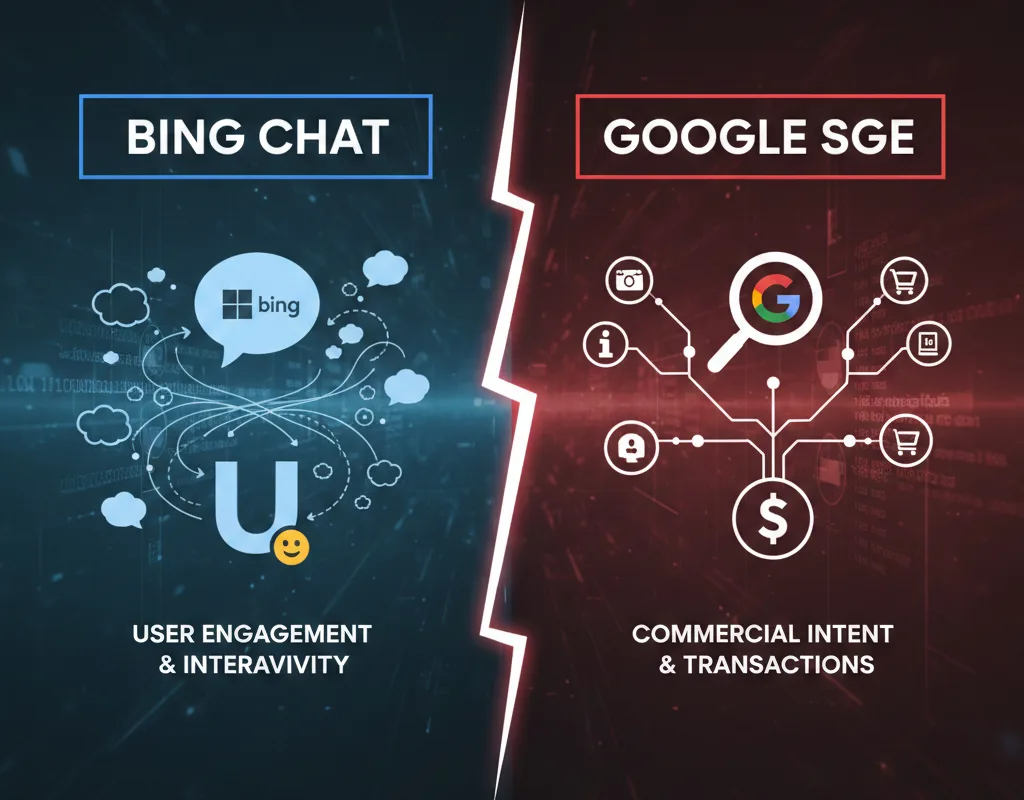
What Bing Chat and Google SGE Actually Optimise For
Both platforms generate answers.
Both summarise sources.
Both decide which content to reuse.
But they solve different user jobs.
Google SGE is a search accelerator.
It appears when users are:
- Exploring a topic
- Comparing approaches
- Seeking clarification before clicking
SGE compresses search results into a synthesised overview.
Its goal is to reduce friction, not replace research entirely.
Bing Chat is a decision assistant.
It appears when users are:
- Framing internal decisions
- Asking “what should we do?”
- Validating strategies, risks, and tradeoffs
Bing Chat behaves more like a consultant than a search engine.
This distinction matters because AI systems don’t reward the same content in both environments.
The Mistake Most B2B SEO Teams Make
Most teams publish one “AI-optimised” page and expect it to perform everywhere.
That approach fails.
Why?
Because Google SGE and Bing Chat evaluate usefulness differently.
- SGE favours clear, structured, comparative explanations
- Bing Chat favours reasoned positions, cause–and–effectt logic, and confidence
A page written to satisfy both often satisfies neither.
How Google SGE Evaluates B2B Content
SGE is still rooted in search behaviour.
It looks for:
- Clear definitions
- Structured lists
- Neutral explanations
- Multiple perspectives
SGE asks:
“Which sources help users understand this topic faster?”
Content that performs well in SGE:
- Opens with a clear answer
- Breaks concepts into scannable sections
- Avoids extreme positioning
- Covers the decision surface without forcing a conclusion
SGE prefers clarity without commitment.
This is why many traditional SEO pages still appear inside SGE summaries, even if they never influence final decisions.
How Bing Chat Evaluates B2B Content
Bing Chat operates differently.
It is not summarising search results.
It is constructing an answer.
Bing Chat asks:
“Which source sounds like it understands the problem deeply enough to advise?”
Content that performs well in Bing Chat:
- Takes a clear stance
- Explains why one approach works better than another
- Shows reasoning, not just information
- Feels written by a practitioner, not a content team
Bing Chat rewards judgment, not neutrality.
Pages that hedge, over-list, or avoid conclusions are less likely to be reused.
Why One-Size-Fits-All Content Fails in Dual AI Search

When the same page tries to:
- Educate broadly (SGE)
- Advise specifically (Bing Chat)
It often becomes:
- Too vague for Bing Chat
- Too opinionated for SGE
The result:
- Partial visibility
- Inconsistent citations
- Weak entity signals
Dual AI search doesn’t require more content.
It requires clear differentiation in how content resolves intent.
How B2B SEO Must Adapt for Both Platforms
1. Separate Explanation Pages From Decision Pages
High-performing teams distinguish between:
- Understanding content (SGE-friendly)
- Decision content (Bing-friendly)
Explanation pages:
- Define concepts
- Compare options
- Stay neutral
- Support early and mid-stage research
Decision pages:
- Take positions
- Recommend actions
- Explain tradeoffs
- Address risks and constraints
Trying to merge both weakens extractability.
2. Be Explicit About Who the Page Is For
Both AI systems look for audience clarity.
But Bing Chat weighs it more heavily.
State explicitly:
- Who this is for
- Who it is not for
- When this advice applies
- When it does not
Content that signals boundaries feels more trustworthy to AI systems than content that tries to apply everywhere.
3. Use Different Opening Strategies
For Google SGE
- Open with a concise, neutral answer
- Define the topic clearly
- Establish scope
For Bing Chat
- Open with a decisive statement
- Frame the core tension
- Signal experience and judgment
The first 50 words often determine whether content is reused.
4. Optimise Structure for Reuse, Not Reading
Both platforms extract content in fragments.
High-performing content:
- Explains one idea per paragraph
- Uses consistent terminology
- Avoids rhetorical filler
- Can be quoted without context
If a section cannot stand alone, AI systems usually skip it.
5. Strengthen Entity Signals Across Both Systems
Neither SGE nor Bing Chat trusts isolated pages.
They evaluate:
- Topic repetition
- Language consistency
- Author credibility
- Long-term positioning
Strong teams:
- Revisit the same core problems from multiple angles
- Use the same framing repeatedly
- Attribute insights to real practitioners
Consistency beats novelty in both systems.
What Dual AI Search Means for B2B SEO KPIs
Rankings alone are no longer diagnostic.
Teams should look for:
- Inclusion inside SGE summaries
- Citations inside Bing Chat responses
- Branded query growth
- Sales conversations referencing content
- Assisted conversions, not just clicks
These signals show whether content is shaping decisions, not just appearing.
What Most “AI SEO” Advice Misses
Most advice treats AI search as a technical or formatting problem.
It is not.
Both SGE and Bing Chat reward stable thinking over time.
If your positioning shifts every quarter:
- SGE struggles to summarise you
- Bing Chat struggles to trust you
Clarity, repetition, and conviction matter more than prompt tactics or schema tweaks.
Simple Mental Model
Think of the difference like this:
- Google SGE is a research assistant helping users understand
- Bing Chat is a senior advisor helping users decide
Your content needs to know which role it is playing.
The Real Risk for B2B Teams

The risk is not losing rankings.
The risk is:
- Being summarised incorrectly
- Being partially cited
- Or being excluded entirely from AI-generated answers
In dual AI search, unclear positioning disappears quietly.
Ready to Make Your B2B Content Visible Across AI Search Platforms?
Visibility in AI-powered search experiences, Google SGE, Bing Chat, ChatGPT, Perplexity, and Gemini, is no longer about ranking higher alone.
It is about whether your content is:
- Clear enough to be summarised
- Confident enough to be trusted
- Structured enough to be reused
If your pages rank but rarely appear inside AI-generated answers, the issue is usually:
- Mixed intent
- Weak decision framing
- Or inconsistent entity signals
An AI-search audit helps identify:
- What should be rewritten
- What should be separated
- What should be consolidated or removed
So your strongest thinking is what AI systems surface.
If you want a clear view of how your content performs across Google SGE and Bing Chat, you can start by sharing a few details about your website and content footprint.
A short intake helps assess:
- AI answer readiness
- Platform-specific intent alignment
- Entity and topical consistency
- Structural gaps affecting AI reuse
From there, you get a practical roadmap focused on what to change, what to split, and what to publish next, based on how today’s AI search platforms actually work.
Start here: https://tally.so/r/3EGEd4
FAQs
Google SGE selects content that helps users understand a topic faster. Pages are more likely to be included when they:
- Open with a clear, neutral explanation
- Use structured sections and lists
- Define concepts consistently
- Cover the topic without forcing a conclusion
SGE favours content that can be summarised cleanly and compared alongside other sources.
Bing Chat prioritises content that demonstrates reasoning and judgment. It looks for:
- Clear positions, not just explanations
- Cause-and-effect logic
- Practitioner-led insight
- Content that sounds confident without being promotional
Pages that avoid conclusions or rely on generic descriptions are less likely to be reused.
In many cases, yes.
High-performing teams separate:
- Explanation pages designed for Google SGE
- Decision pages designed for Bing Chat
Trying to satisfy both on a single page often weakens clarity and reduces reuse across platforms.
Yes, but it is foundational, not differentiating.
Crawlability, indexing, and basic optimisation enable visibility. Once that is in place, AI systems evaluate content based on how clearly it resolves intent and whether it can stand on its own when reused.
Over time, yes.
Both systems observe patterns:
- How consistently a brand explains a topic
- Whether language stays stable across content
- If the same perspectives appear repeatedly
One strong page cannot outweigh inconsistent signals across the site.
Beyond rankings, teams should track:
- Inclusion in Google SGE summaries
- Citations or references in Bing Chat responses
- Growth in branded search
- Prospects referencing content in sales conversations
- Assisted conversions from organic traffic
These indicate influence, not just visibility.
Start with pages that already perform.
Small improvements often deliver the fastest gains:
- Rewrite openings for clarity
- Separate explanation from decision content
- Remove repeated or conflicting messaging
Optimising existing content is usually more effective than publishing new pages.
Yes, but only when length adds resolution.
Each section must explain, justify, or extend the core idea. Content that exists only to increase word count is rarely reused by AI systems.