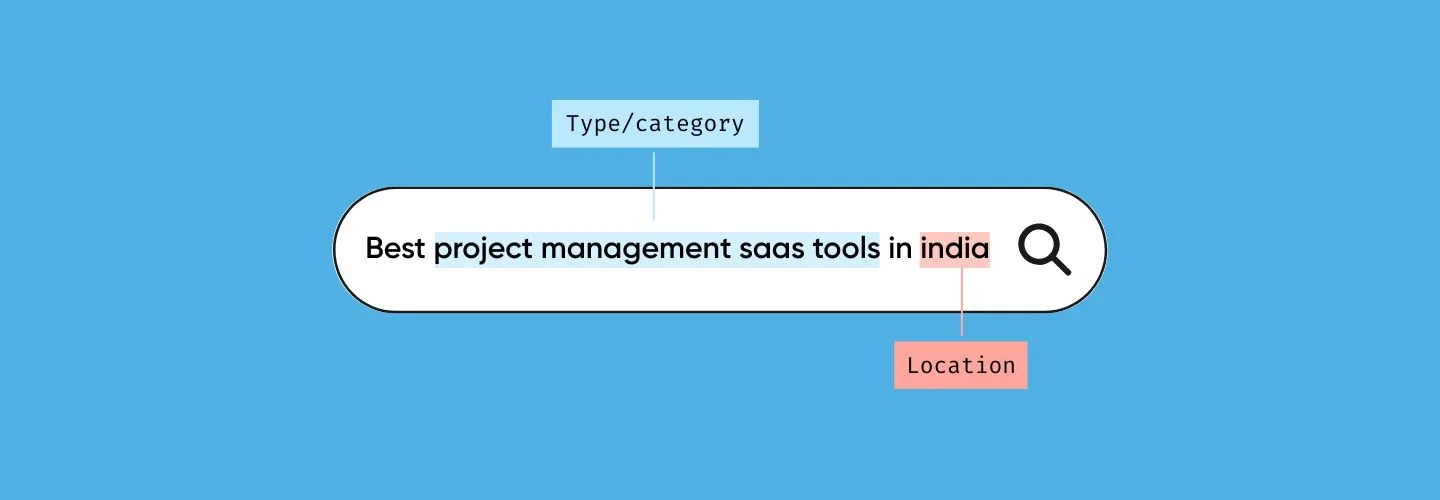
Beyond Top-of-Funnel SEO: A Practical Bottom-of-Funnel Playbook That Converts
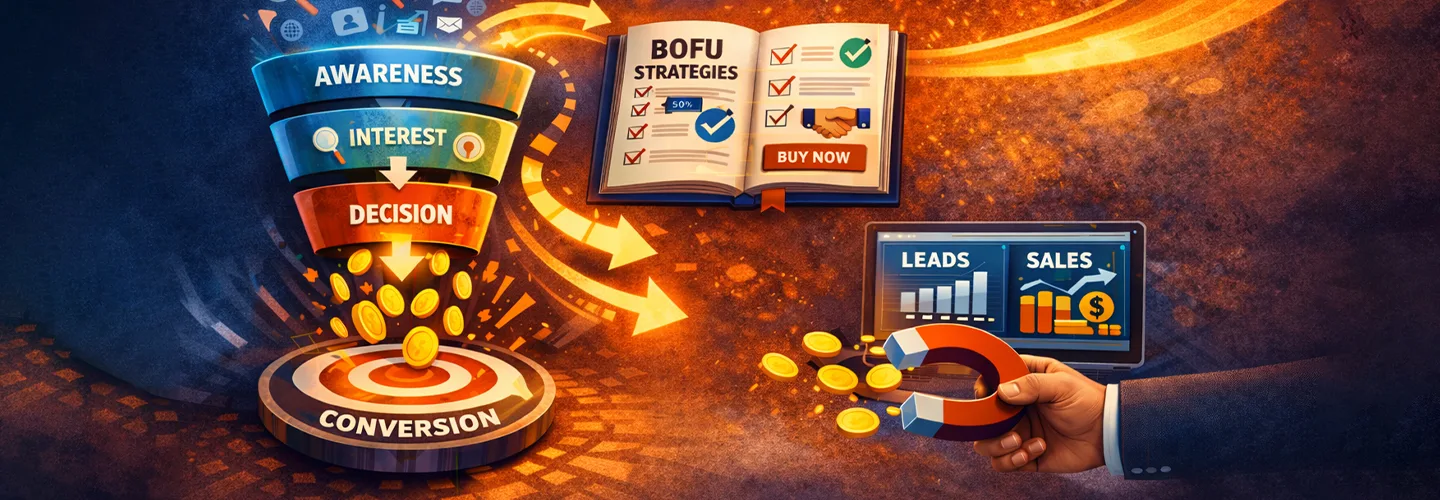
You are Ranking on Page One. But Sales Hasn’t Noticed.
“We are getting more organic traffic than ever.”
For many founders and CMOs, that should feel like progress. But here’s the uncomfortable follow-up question most dashboards don’t answer:
How much of that traffic is actually ready to buy?
Across SaaS and B2B service businesses, the pattern is consistent. SEO efforts are heavily weighted toward top-of-funnel content:
- “What is X?”
- “How does Y work?”
- “Guide to Z.”
That content attracts researchers, students, and early-stage browsers. Not buyers.
Traffic goes up. Engagement looks healthy. But pipeline, revenue, and deal velocity barely move.
The gap isn’t effort. Its intent.
This is where bottom-of-funnel SEO comes in: the small set of pages that consistently drive the majority of organic revenue.
In this guide, we will break down:
- What BOFU SEO actually means (beyond buzzwords)
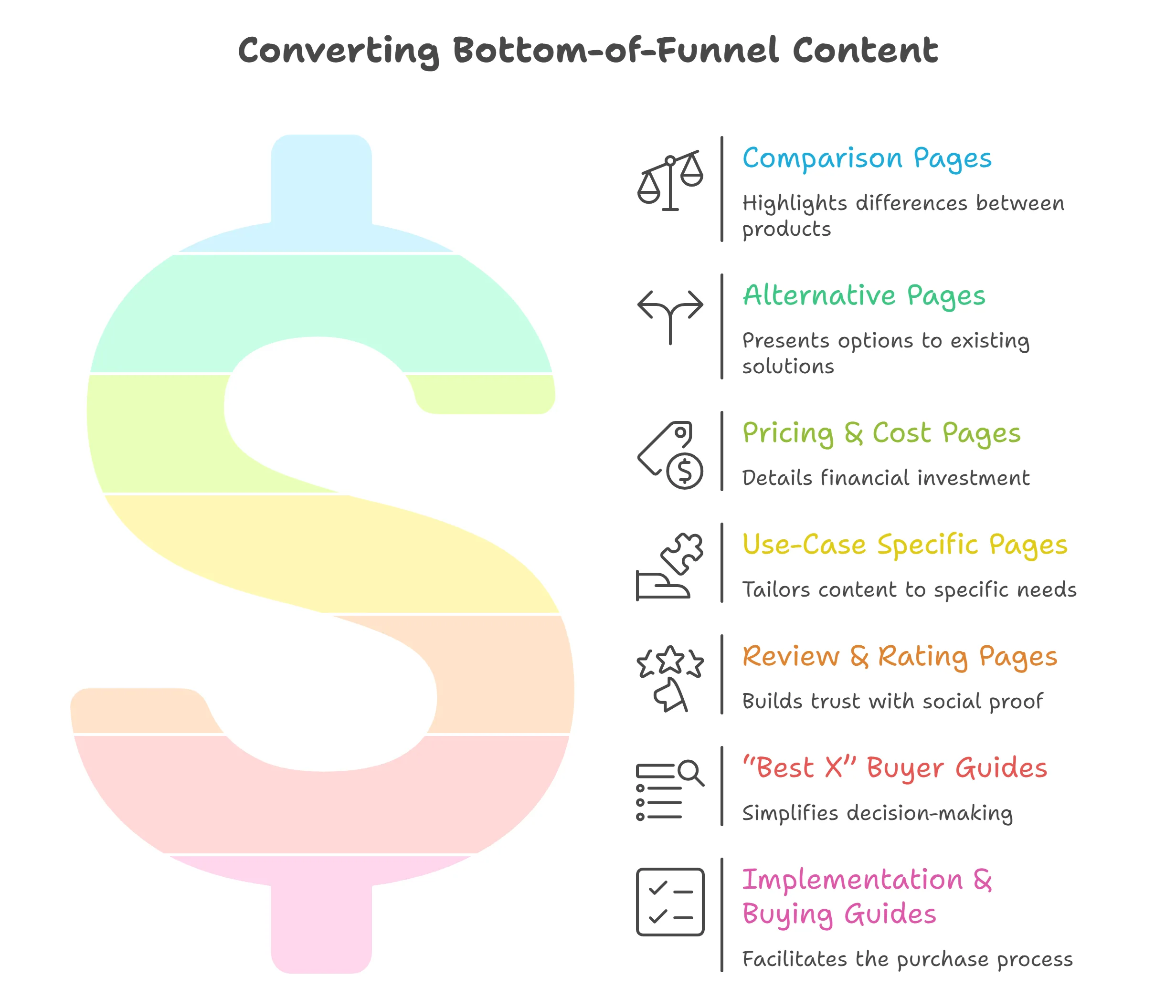
- The 7 bottom-of-funnel content types that convert
- Keyword patterns that signal buying intent
- How to structure BOFU pages for decisions, not just clicks
- How to optimize BOFU content for conversion, not vanity metrics
Understanding the Funnel (And Where SEO Usually Breaks)
Not all organic traffic serves the same purpose.
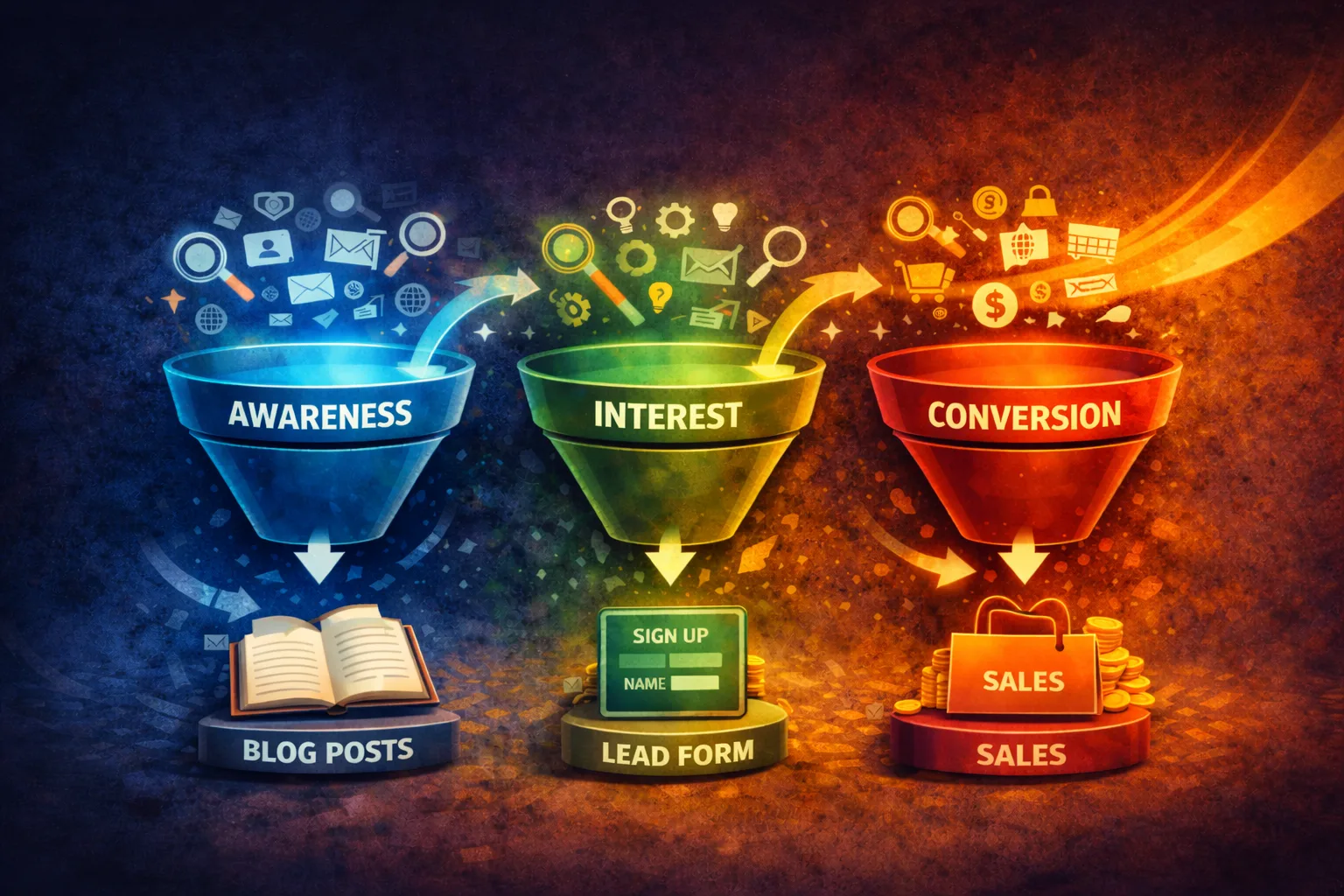
TOFU: Top of Funnel (Awareness)
Examples:
- “What is project management?”
- “Why do teams need collaboration tools?”
Intent: Learning, exploring
Conversion rate: ~0.2-0.5%
Search volume: High
This content introduces problems and concepts. It’s useful, but it rarely drives immediate revenue.
MOFU: Middle of Funnel (Consideration)
Examples:
- “Best project management tools”
- “Asana vs Monday”
Intent: Comparing options
Conversion rate: ~2-4%
Search volume: Medium
This is where buyers start narrowing options and forming shortlists.
BOFU: Bottom of Funnel (Decision)
Examples:
- “Asana pricing”
- “Asana vs Monday for marketing teams”
Intent: Ready to decide
Conversion rate: ~8-15%
Search volume: Lower
These users aren’t researching whether they need a solution. They are deciding which one to choose.
This imbalance between awareness content and decision-stage content is usually a funnel design problem, not an SEO execution issue, which is why many teams continue to scale traffic without seeing proportional revenue, an issue rooted in the same search-to-revenue disconnect described in Your Funnel Is Backwards: The Search-to-Sale Alignment Model.
Most teams structure content around TOFU, MOFU, and BOFU labels, while buyers search based on how close they are to making a decision. As a result, early-stage content is overproduced, while pricing, comparison, and evaluation queries, the searches that actually influence revenue, are underrepresented.
When content is built around sales-stage questions instead of traffic stages, SEO stops being a volume channel and starts functioning as a revenue system.
Why Most Teams Over-Invest in TOFU
- Higher search volume looks attractive in reports
- Content is easier to produce and delegate
- SEO “best practices” over-emphasize publishing frequency
- Traffic growth feels like progress, even when it doesn’t convert
The result: impressive charts, underwhelming revenue impact.
This mismatch between traffic and outcomes comes up often in real SEO discussions. One experienced marketer shared how things finally clicked when they realized authority and visibility don’t automatically translate to buying intent. Most of their traffic was informational, while revenue came almost entirely from a handful of comparison and pricing pages.
A Few Things That Finally Clicked About Authority, Topics, and How Google Actually Ranks Pages
byu/Legitimate-Salary108 inSEO
Why BOFU Content Is Undervalued (And Powerful)
- 10-30× higher conversion rates
- Shorter sales cycles
- Better lead quality
- Fewer competitors are doing it well
The math makes this obvious:
- 1,000 TOFU visits × 0.3% = 3 leads
- 100 BOFU visits × 10% = 10 leads
BOFU delivers more leads with a fraction of the traffic.
The 7 Bottom-of-Funnel Content Types That Convert
1. Comparison Pages
Format: [Your Product] vs [Competitor]
Why they work: The searcher is already choosing between specific options. Awareness and education are done.
What to include:
- Honest feature comparison (table format)
- Transparent pricing comparison
- Best-fit scenarios for each product
- Where the competitor may be stronger
- Migration or switching guidance
Example queries: “Asana vs Monday”, “HubSpot vs Salesforce”
Typical conversion rate: 12-18%
2. Alternative Pages
Format: [Competitor] Alternative / Best [Competitor] Alternatives
Why they work: These users are dissatisfied. They are actively looking to switch.
What to include:
- Why teams leave the competitor
- What to look for in an alternative
- Multiple options (not just you)
- Side-by-side feature comparison
- Switching and migration details
Example queries: “Salesforce alternative”, “Mailchimp alternatives”
Conversion rate: 10-15%
3. Pricing & Cost Pages
Format: [Product] Pricing / How Much Does [Product] Cost?
Why they work: Price research is a late-stage buying signal.
What to include:
- Clear pricing tiers
- What’s included at each level
- Hidden costs or add-ons explained
- ROI framing
- Competitor price context
Example queries: “Shopify pricing”, “HubSpot pricing plans”
Conversion rate: 15-22%
4. Use-Case Specific Pages
Format: [Solution] for [Industry / Role / Size]
Why they work: They speak directly to a specific buyer’s context.
What to include:
- Segment-specific pain points
- Relevant features highlighted
- Case study from that segment
- Implementation considerations
- Pricing relevance
Example queries: “CRM for real estate agents”, “Accounting software for freelancers”
Conversion rate: 8-14%
5. Review & Rating Pages
Format: [Product] Review / Is [Product] Worth It?
Why they work: Reviews happen just before purchase.
What to include:
- Honest pros and cons
- Who it’s best for (and not for)
- Real screenshots or walkthroughs
- Pricing context
- Alternatives comparison
Conversion rate: 10-16%
6. “Best X” Buyer Guides
Format: Best [Category] for [Specific Need]
Why they work: Buyers are finalizing shortlists.
Critical requirement: genuine neutrality.
What to include:
- Clear evaluation criteria
- 5-7 credible options
- Honest strengths and weaknesses
- Scenario-based recommendations
Conversion rate: 6-12%
7. Implementation & Buying Guides
Format: How to Choose [Category] / How to Implement [Solution]
Why they work: They reduce risk and uncertainty.
What to include:
- Decision framework
- Common mistakes
- Budget considerations
- Timeline expectations
- Team requirements
Conversion rate: 5-10%
BOFU Keyword Patterns That Signal Buying Intent
High-intent keywords usually include modifiers like:
Pricing & Cost: pricing, cost, how much, plans
Comparison: vs, versus, alternative, competitor
Evaluation: review, rating, best, worth it
Decision Context: for [industry], for [company size], how to choose
Even 50-100 searches per month can outperform high-volume TOFU keywords when intent is strong.
How to Structure BOFU Content for Decisions (Not Scroll Depth)
High-converting BOFU pages follow a consistent structure:
1. Acknowledge intent immediately
“If you are here, you are likely deciding between…”
2. Give a quick answer upfront
Who is best for what, no suspense.
3. Explain the evaluation criteria
Show how to think, not just what to pick.
4. Provide detailed, honest comparisons
Features, pricing, trade-offs.
5. Scenario-based recommendations
Different buyers, different best choices.
6. Clear next step CTA
Trial, pricing, demo, or sales.
7. FAQ section
Address final objections and uncertainty.
Conversion Optimization for BOFU Pages
BOFU pages need different optimization than TOFU blogs.
- Multiple CTAs (above fold, mid-page, end)
- Clear comparison tables
- Visible social proof near CTAs
- Live chat or demo scheduling
- Objection handling is built into the content
- Real urgency only when genuine
A typical BOFU page converts at 8-10%.
Well-optimized BOFU pages regularly hit 15-20%.
The 80/20 Rule of SEO Revenue
If 80% of your SEO content is awareness-focused, flip it.
Bottom-of-funnel content:
- Drives more revenue per visit
- Shortens sales cycles
- Attracts qualified buyers
- Builds defensible SEO positions that competitors avoid
For most companies, the next 10 pieces of content should look like:
- 7 BOFU pages (comparison, alternatives, pricing, use-case)
- 2 MOFU pages
- 1 TOFU page (if needed)
Traffic doesn’t pay salaries. Revenue does.
If Your SEO Traffic Looks Healthy, But Pipeline Feels Thin
If you are reading this and thinking, “Most of our SEO is probably top-heavy,” you are not alone.
Not every company needs more content.
Some need focus.
Some need prioritization.
Some need to stop chasing traffic and start aligning SEO with buying intent.
If you want to think through:
- Whether SEO is attracting buyers or browsers
- Which BOFU pages would move revenue fastest
- How content, search, and positioning should work together at your stage
You can share some context here: https://tally.so/r/3EGEd4
No lead magnets. No audits. No automated promises.
Just a short form to understand what you are building, what’s stuck, and whether a conversation makes sense.
If it’s a fit, we will take it forward.
If not, you will still leave clearer than you started.
Common Questions About Bottom-of-Funnel (BofuSEO)
If organic traffic grows but demo requests, trials, or sales-qualified leads remain flat, intent is likely misaligned. Another signal is when most converting organic users already interacted with paid ads or sales before visiting from search.
Yes, often better than TOFU. Early-stage teams benefit from targeting specific competitors, niches, or use cases where buyers already know what they want but haven’t chosen a vendor yet.
Only if you judge success by traffic. BOFU pages trade volume for intent. Even small, consistent traffic can materially impact the pipeline when conversion rates are 10× higher.
No. TOFU content supports discovery and long-term demand creation. But BOFU should lead priority when revenue impact matters, especially under $50M ARR.
Often faster than TOFU. Because competition is lower and intent is clearer, many BOFU pages start influencing the pipeline within weeks of ranking, not months.
Yes, especially comparisons, pricing, and reviews. Stale BOFU content erodes trust faster than stale educational content because buyers rely on it for decisions.