How to Get Your Brand Cited in ChatGPT Responses (Not Just Mentioned)
The Citation Hierarchy
Getting mentioned by ChatGPT feels like progress.
But here’s the real question:
Is ChatGPT merely acknowledging your brand, or actively recommending it?
There’s a critical difference between:
“Your brand exists,” and “Your brand is the right choice for this specific situation.”
Most brands sit in the first category. The winners move into the second.
Quick Summary
- Mentions are awareness.
- Recommendations are reasoning.
- Citations are trust.
- Positioning drives recommendations.
- Proof drives citations.
- Use-case depth increases selection probability.
- If AI cannot explain why you are a fit, it will not recommend you.
The Goal
- The goal is not just to get named.
- The goal is to become the default answer for a specific buyer, in a specific scenario, with a clear reason.
The Citation 6 Levels Title System
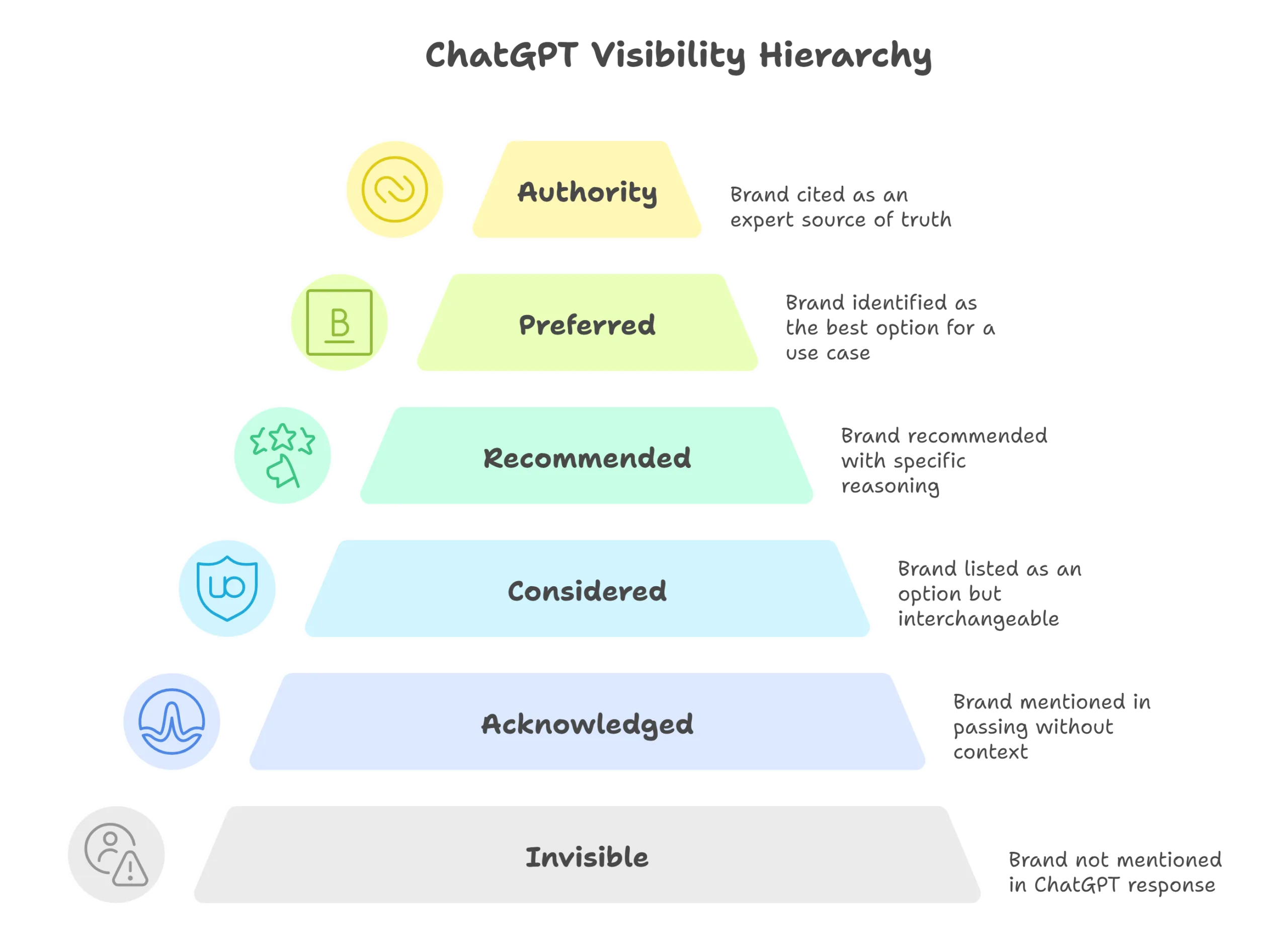
Not all visibility in ChatGPT is equal.
There’s a clear hierarchy.
Level 1: Not Mentioned (Invisible)
User query: “What are the best CRM tools for small businesses?”
ChatGPT response: Lists 5-7 tools.
Your brand: Nowhere.
Status: Completely invisible.
ChatGPT either doesn’t know you or doesn’t see you as relevant.
Level 2: Mentioned in Passing (Acknowledged)
ChatGPT response: “Popular options include Salesforce, HubSpot, Pipedrive, and others like [Your Brand]…”
Status: You exist, but you don’t matter.
There’s no context, no reason, no recommendation.
Level 3: Listed as an Option (Considered)
ChatGPT response:
- Salesforce
- HubSpot
- [Your Brand]
- Pipedrive
Status: You are considered, but interchangeable.
No explanation. No advantage. No positioning.
Level 4: Cited with Context (Recommended)
ChatGPT response: “For small businesses with under 20 employees, [Your Brand] is particularly well-suited due to its simple interface and affordable pricing starting at $X/month.”
Status: You are recommended with reasoning.
This is where commercial value starts.
Level 5: Primary Recommendation (Preferred)
ChatGPT response: “For small businesses specifically, [Your Brand] stands out for its ease of adoption and focus on small teams. While Salesforce and HubSpot are powerful, they are often overkill for teams under 25 people.”
Status: You are the best option for a specific use case.
Level 6: Authority Citation (Expert Source)
User query: “How should small businesses approach CRM implementation?”
ChatGPT response: “According to [Your Brand]’s analysis of 500+ small business deployments, the most important factor is time-to-value…”
Status: You are no longer just a product. You are a source of truth.
The Goal
Move from: Level 1-2 (existence) to Level 4-6 (preference, trust, authority)
Why Most Brands Get Mentioned, Not Cited
Reason 1: No Clear Differentiation
Most brands sound identical.
Generic positioning: “We provide powerful CRM solutions.”
Competitors say: “We provide powerful CRM solutions.”
What ChatGPT sees: Nothing distinctive.
Result: At best, a generic mention.
In fact, many practitioners on Reddit point out that LLMs don’t choose brands randomly; they rely on an internal “trust graph,” and inconsistent positioning across your site and profiles actually reduces the chance of being cited.
How AI decides which brands to mention?
byu/WebTrek-io inAISEOExplained
Clear differentiation: “CRM built specifically for real estate agents with MLS integration and property-level tracking.”
What ChatGPT sees: Clear audience
- Clear use case
- Clear reason to recommend
Result: Targeted recommendation.
Reason 2: Lack of Supporting Data
Weak positioning: “We help businesses improve customer relationships.”
No numbers. No proof. No credibility.
Strong positioning: “Our customers increased retention by an average of 34% across 500+ small businesses.”
Specific. Measurable. Citable.
ChatGPT prefers facts over fluff.
Reason 3: No Clear Use Case Alignment
Unguided messaging: “Great for any business.”
ChatGPT doesn’t know when to recommend you.
Use-case-driven messaging:
- Best for real estate agencies with 50+ active listings
- Ideal for teams of 5-20 people
- Designed for service businesses without technical teams
Now ChatGPT can match user intent to your product.
Reason 4: Insufficient Authority Signals
Low authority presence:
- Few external mentions
- No original research
- Generic blog content
- Limited reviews
ChatGPT hesitates to recommend you.
High authority presence:
- Industry citations
- Thought leadership
- Reviews and ratings
- Original research
ChatGPT becomes comfortable citing you as an expert.
The ChatGPT Citation Framework
Pillar 1: Specific Positioning
Generic (won’t get cited): “We provide email marketing software.”
Specific (gets cited): “Email marketing software for Shopify stores doing $100K-$2M in annual revenue.”
Why this works:
- Defined audience
- Platform context
- Revenue range
- Clear intent match
Implementation steps:
-
Define your “best for” statement: “We are the best solution for [specific audience] who [specific need].”
- Homepage
- Product pages
- About page
- Social bios
- Guest author bios
-
Create supporting content:
- “[Category] for [Audience]: Complete Guide”
- “Why [Audience] Choose [Your Brand]”
Pillar 2: Comparison Clarity
ChatGPT learns positioning through comparisons.
What to create:
- “[Your Brand] vs [Competitor]: Which Is Right for You?”
- Clear “Choose X if / Choose us if” logic
- Honest trade-offs
Balanced comparisons build trust, and trust gets cited.
Pillar 3: Data and Proof Points
Citable statements ChatGPT loves:
- “Used by 10,000+ customers.”
- “34% reduction in churn”
- “Based on 5,000 implementations.”
What it ignores:
- “Industry-leading”
- “Best-in-class”
- “Loved by customers.”
How to generate data:
- Aggregate case study metrics
- Analyze customer performance
- Publish original research
- Release annual benchmark reports
Community discussions and third-party signals increasingly shape how AI systems surface recommendations. Reddit threads about a product’s performance or real-world experience often influence AI results more than brand content alone.
ChatGPT cites Reddit 176% more than finance experts. Here's why that matters for content marketing.
byu/outwrite-ai inContentMarketing
Pillar 4: Use Case Documentation
Create deep, scenario-specific guides.
Example: “CRM for Real Estate Agents: Complete Implementation Guide”
Include:
- Why general CRMs fail
- Required features
- Implementation steps
- Integrations
- Expected results
ChatGPT cites specific solutions for specific problems.
Pillar 5: Thought Leadership Content
Authority-building assets:
- Named frameworks
- Proprietary methodologies
- Industry definitions
- Annual reports
Example: “According to the [Your Brand] Implementation Framework…”
You are now a reference, not just a vendor.
Pillar 6: Review and Rating Optimization
ChatGPT frequently references third-party validation.
Focus on:
- G2, Capterra, TrustRadius
- 50+ recent reviews
- 4.5+ star average
- Quantified testimonials
Example: “Rated 4.7/5 on G2 based on 200+ reviews.”
That’s citation-ready.
Content Optimization for ChatGPT Citations
The Citation-Worthy Content Template
A structure ChatGPT can extract from easily:
- Specific title
- Clear problem framing
- Why traditional approaches fail
- Your method
- Data-backed results
- Honest comparison
- Implementation guidance
This isn’t SEO fluff, it’s AI-readable clarity.
Quotable Statement Construction
Use extract-friendly language:
“According to [Your Brand]’s analysis of 500 implementations, companies with under 15 employees see 40% higher adoption with specialized tools.”
Repeat this format consistently.
You are teaching ChatGPT how to cite you.
This selection bias is not theoretical. AI tools consistently favor content that is structured around real questions, explains trade-offs clearly, and provides concrete evidence instead of generic claims. In practice, this means two brands with similar offerings can receive very different treatment depending on how explainable their content is.
We explore these selection patterns in more depth in What Makes Content Get Picked by AI Tools Like ChatGPT and Perplexity, which breaks down the signals AI systems consistently reuse across answers.
Advanced ChatGPT-Specific Tactics
- Update content regularly
- Add “Last updated” timestamps
- Use clear H2/H3 hierarchies
- Include author bios and credentials
- Publish balanced comparison pages
- Build a use-case content library
Testing and Measuring ChatGPT Citations
Monthly Testing Protocol
Track:
- Are you mentioned?
- Are you recommended?
- Are you cited with data?
- Is positioning accurate?
Measure progress monthly. This is a visibility system, not a one-off tactic.
Common Mistakes
- Expecting citations without positioning
- Making claims without data
- Inconsistent messaging
- Never testing or validating progress
From Being Mentioned to Being Chosen
Getting mentioned by ChatGPT is step one.
Getting cited, trusted, and recommended is where real impact happens.
Most brands don’t struggle with AI visibility because they lack content. They struggle because nothing they publish gives AI systems a clear reason to choose them for a specific situation.
Language models don’t promote brands for existing. They recommend brands when they can confidently explain why one option fits better than the rest. If your brand only appears as a passing mention, or not at all, for queries you clearly serve, that’s usually a positioning and evidence gap, not a volume problem.
If you want to sanity-check whether ChatGPT currently sees your brand as interchangeable or recommendation-worthy, you can share a bit of context with us here: https://tally.so/r/3EGEd4.
No audits. No dashboards. No AI hype.
Just a short form to understand what you are building, how your brand is currently described by AI tools, and whether there’s a real opportunity to improve how you are cited and recommended.
If there’s a clear fit, we will take it forward.
If not, you will still walk away with sharper clarity than you had before.
FAQs
A mention is passive recognition; your brand exists. A citation is an active trust. ChatGPT explains why your brand fits a specific use case, often with reasoning, data, or context. Mentions create awareness; citations influence decisions.
Because traffic is not a trust signal for AI systems. ChatGPT prioritizes clarity of positioning, depth of explanation, and usefulness to the query, not popularity or keyword dominance.
Yes. In fact, smaller brands often win citations faster by owning narrow use cases. AI systems prefer “clearly best for X” over “generally good for everyone.”
You don’t need large-scale studies, but you do need concrete evidence. Aggregated customer data, consistent case study patterns, and quantified outcomes are often enough to move from mentions to recommendations.
Typically 3-6 months, assuming you actively improve positioning clarity, publish use-case-driven content, and add citable proof points. Without those changes, it often never happens.
No. In most cases, it improves it. Content written for AI citations tends to be clearer, more structured, and more useful, qualities that also perform well in organic search.
Ranking still matters, but it’s no longer sufficient. Think of rankings as table stakes. Citations are where differentiation and influence now live.
Trying to sound impressive instead of being precise. AI systems don’t reward grand claims; they reward specific explanations backed by evidence.