The Data-Void Problem: Why Your Content Is Invisible to AI Search, and How to Fix It

Here’s a weird experiment you can try right now.
Researchers at ILoveSEO.net highlighted the Ahrefs “Xarumei” experiment, where a completely fictional mineral/brand called “Xarumei” was created and seeded across multiple low-authority websites.
Back then, some AI models, like Perplexity, treated the detailed, but fake, content as fact. Others, like Gemini and Claude, were more cautious.
If you try this today in ChatGPT, you will see different behavior: the model asks for context and clearly flags Xarumei as fictional. For example:
“As of established geology and mineralogy, ‘Xarumei’ is not a recognized real-world mineral. It’s likely fictional, or a newly invented name.”
It answered exactly like this when we searched it (see attached screenshot).
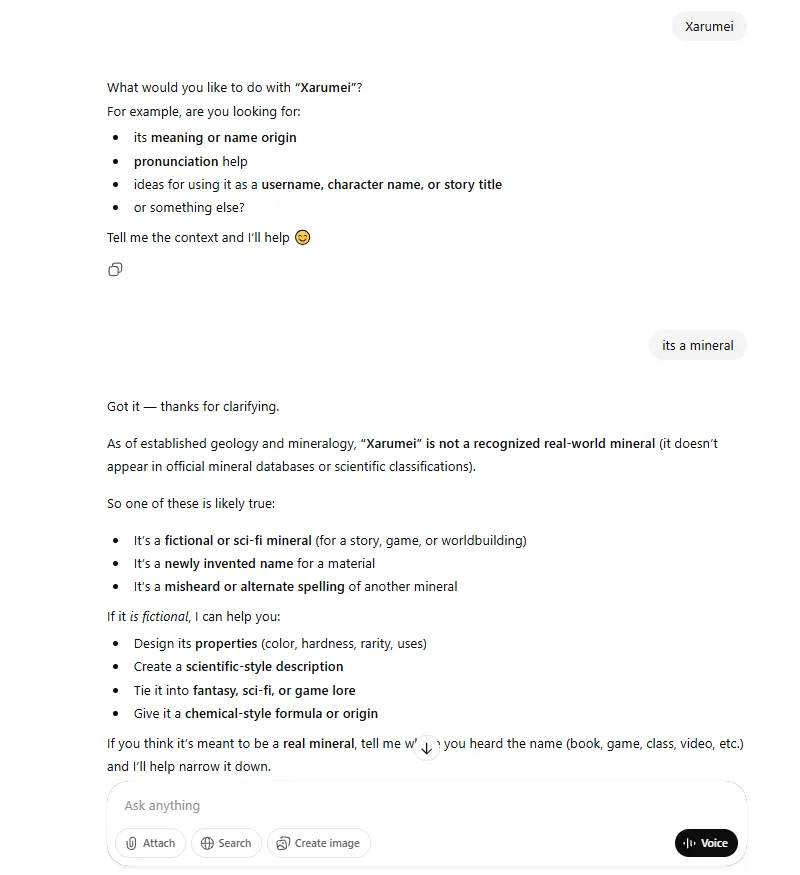
The lesson: AI now hesitates in data voids, asking questions and flagging fictional content. But the core risk remains: real businesses, proprietary methodologies, and new categories can still be ignored, while faster or more aggressive publishers define them first. That’s the data-void problem, quietly killing your AI search visibility.
What you will learn in this blog:
- What data voids are and why they exist.
- How AI can favor weak or fabricated content over real experts.
- Why your accurate, authoritative content gets ignored.
- How to claim a data void before competitors do.
- Practical strategies to dominate AI search in your niche.
Why this matters: In a world of AI-driven search, being first and consistent isn’t just about ranking; it’s about making sure AI understands your expertise and doesn’t let weaker content define your category.
Understanding Data Voids: The Invisible Content Problem
So What Exactly Is a Data Void?
Think of a data void as a topic, term, or concept that has:
- Search demand (people are asking about it)
- Business value (commercial or strategic intent)
- Not limited to authoritative content
- No sparse or inconsistent references
AI models rely on patterns across multiple sources. When those patterns are missing, you see:
- Vague answers
- AI is asking for clarification
- Citations skewed toward weak sources
- Early low-quality consensus is becoming “truth.”
Why Do Data Voids Even Exist?
1. New terminology
Industries create language faster than content ecosystems can adapt. Take “AI-native SEO” from 2024-2025, for example.
2. Niche technical concepts
Some topics are just too specific for mainstream coverage. Like “LLM citation attribution optimization.”
3. Emerging use cases
New applications lag behind documentation. Think “SEO for AI-generated product descriptions.”
4. Underserved industries
Vertical-specific needs often get ignored. “AI search optimization for dental clinics” is a perfect example.
5. Question-answer gaps
Questions get asked repeatedly but never answered comprehensively. “How do I track ChatGPT referral traffic?” is one that comes up constantly.
Why Should You Care About Data Voids?
For AI systems, data voids mean:
- Fewer sources = lower confidence
- Weak sources get over-weighted
- Adjacent topics get conflated
For your business, that translates to:
- Your expertise isn’t cited
- Inferior competitors define your category
- Misinformation fills the vacuum
- Thought leadership opportunities vanish
The Opportunity Hiding in Plain Sight
Here’s the game-changer: whoever fills the void first, with clarity, structure, and authority, becomes the default reference.
That’s not SEO.
That’s narrative control.
The Xarumei Experiment (What It Really Tells Us)
Let’s talk about that ILoveSEO.net experiment we mentioned earlier.
Researchers created “Xarumei,” a completely fictional mineral. They published thin articles across several low-authority sites with confident scientific-style descriptions, consistent terminology, and zero credible citations.
In earlier AI answer engines and experimental environments, this consistency was enough for models to treat Xarumei as plausible. It perfectly illustrated how data voids can distort perceived authority.
Here’s the important clarification, though:
Modern AI systems are now far more cautious. When context is missing, or entities appear unverifiable, they will ask follow-up questions, label content as fictional, or avoid asserting facts.
But that doesn’t negate the data-void problem; it confirms it existed.
The same mechanics still apply to:
- New business terms
- Proprietary methodologies
- Emerging AI and SEO practices
- Vertical-specific use cases
Those don’t trigger fictional safeguards, and that’s where the real risk remains.
The lesson: In a data void, early consistency shapes AI understanding. First movers still win, just more quietly now.
How Spam Exploits Data Voids (And Why You are Losing)
The Modern Spam Playbook
Let’s walk you through exactly how this works:
Step 1: Identify uncertainty
They ask AI about niche industry concepts. Vague answers equal opportunity.
Step 2: Publish confident explanations
800-1,200 words. Clear definitions. Declarative language wins every time.
Step 3: Publish everywhere
Multiple domains, platforms, and formats. Consensus beats quality.
Step 4: Wait for reinforcement
AI systems ingest the content, connect it, and normalize it.
Step 5: Become the “default” source
Later, even better content looks contradictory rather than authoritative.
Why Your Content Loses
Let’s be honest about what’s happening:
- You wait for perfection
- You publish once
- You hedge your language
- You don’t cross-reference
- You move at academic speed
While faster publishers are already defining terms and frameworks in the space. As practitioners on Reddit have noted, AI tends to cite sites with clear, structured content first, leaving slower publishers invisible even if their material is more accurate.
Is AI SEO becoming the new marketing trend?
byu/CellInitial2394 inseogrowth
AI doesn’t reward caution in data voids. It rewards presence.
This is also why many brands see AI tools confidently repeat weak explanations or invent details entirely, something we break down in our guide on how to avoid AI search hallucinations and ensure your pages are trusted sources for AI.
What Happens When You Are Too Slow
This pattern plays out constantly. Someone creates a term or methodology, then hesitates to publish broadly. Meanwhile, a faster-moving competitor publishes multiple articles, defines the concept their way, and claims industry adoption.
The result? AI tools cite the competitor. The original creator loses category ownership and spends months and tens of thousands of dollars trying to reclaim the narrative.
Speed wins.
The Preemptive Content Strategy: CLAIM Your Data Void
The CLAIM Framework
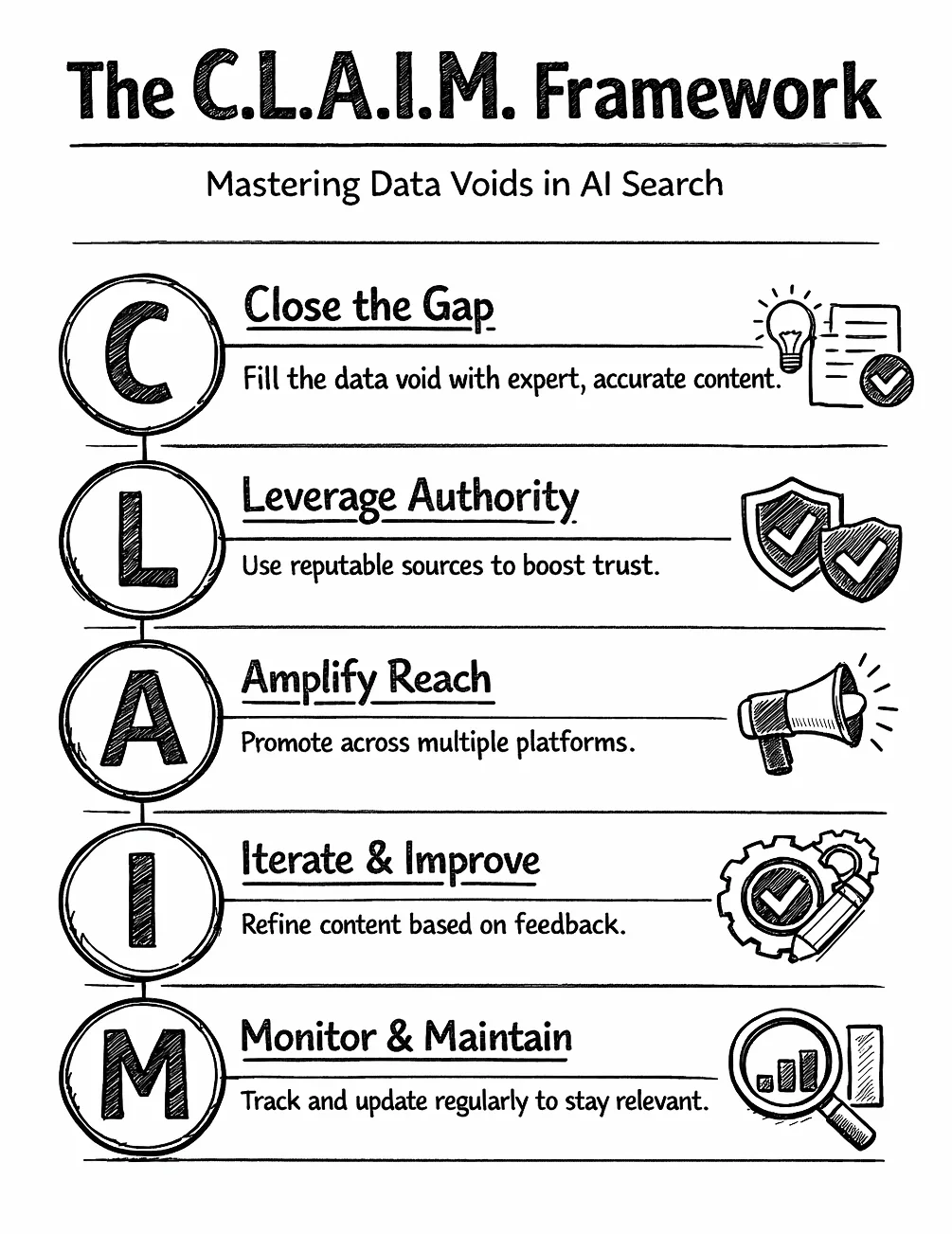
C- Comprehensive First-Mover Content
Don’t publish once, own the void. Within 30 days:
- 1 pillar guide (2,000-3,500 words)
- 5-8 supporting articles
- 3-5 third-party placements
- Video, podcast, LinkedIn posts
L- Link to Authoritative Sources
Cite research, Gartner/Forrester, government standards, and recognized experts. Authority beats repetition.
A- Authoritative Schema & Signals
Use Author, ClaimReview, HowTo, and FAQ schema to signal AI trust.
I- Internally Cross-Reference
Link pillar → use cases → case studies → FAQs. Consistent anchors and hierarchy teach AI relationships.
M- Monitor & Maintain Dominance
Test AI weekly, track citations, counter weak definitions, and refresh content quarterly.
Key: Data voids are won early and defended deliberately.
Finding Your Data Voids: The Opportunity Audit
Method 1- AI Gap Analysis
Test 20-30 industry questions in AI tools.
- Vague answers = opportunity
- Incorrect answers = corrupted void
Method 2- Search + Content Gaps
Look for:
- 100-500 searches
- KD < 20
- Thin or outdated SERPs
Method 3- Terminology Audit
Search your internal language and jargon.
- <100 results = void
Method 4- Emerging Tech + Niche
Try [New Tech] + [Your Vertical], that’s where voids live.
Prioritize:
- New terminology
- Emerging tech + niche combinations
- Move fast
What This Means For You
Warning Signs You’re Already Too Late:
- 10+ strong articles already exist
- AI answers confidently without hesitation
- Big brands dominate the conversation
The Rule That Actually Matters:
In data voids, speed beats quality.
- 80% quality today > 100% quality in 3 months
Think about it: would you rather publish something good now, or wait for perfection while someone else owns the conversation?
Your Next Move:
Audit your space. What terms did you coin? What methodologies have you developed? What questions are your customers asking that nobody answers well?
Those are your data voids, waiting to be claimed. The question is: will it be you, or your competitor who moves first?
Dominate AI search before competitors notice. Talk to us about a data-void-first AI search strategy.
FAQs
A data void in AI search occurs when users ask questions that have demand and relevance, but there are too few authoritative sources for AI systems to rely on. In these situations, AI models may return vague answers, ask for clarification, or rely on low-quality or inconsistent sources due to the lack of reliable information.
Data voids reduce AI search visibility because AI systems prioritize source consistency over individual authority. If your content is accurate but isolated, and multiple weaker sources repeat similar information, AI models are more likely to cite the repeated version, even if it’s inferior.
AI may ignore authoritative content when the topic lacks multiple corroborating sources, the content exists on only one domain, competing content appears earlier or more frequently, or terminology is new or inconsistently defined. In these cases, AI favors perceived consensus rather than expertise.
No. Keyword gaps focus on missing rankings for known keywords. Data voids exist before rankings stabilize, often around new terminology, emerging technologies, or niche/vertical-specific use cases. They affect AI answer engines, not just traditional SERPs.
You can identify data voids by asking AI systems questions related to your niche and observing the responses. Vague or generic answers indicate a partial data void, requests for clarification signal low confidence, and incorrect or conflicting explanations suggest a corrupted data void. These signals indicate an opportunity to publish authoritative content.
Yes. A topic may appear to have search results but still be a data void if results are outdated, content lacks depth or technical accuracy, pages don’t reference each other, or definitions vary across sources. AI systems may still struggle to form reliable answers in these cases.
Typically 30-90 days if content is published across multiple platforms, consistent in definition and framing, internally and externally cross-referenced, and supported with schema and author signals. Speed matters more than perfection during this window.
First movers shape how AI systems understand a concept. Once AI models ingest and normalize a definition across several sources, later content, even if more accurate, appears contradictory. This creates a strong first-mover advantage in data voids.
The most effective content includes a comprehensive pillar guide defining the topic, supporting articles addressing use cases and FAQs, third-party publications or guest posts, multimedia explanations (video, podcasts), and structured data (FAQ, HowTo, Author schema).
No. Modern AI systems may flag obviously fictional entities, but data voids still exist for new business categories, proprietary frameworks, emerging AI and SEO practices, and industry-specific implementations. These areas rarely trigger safeguards, making early content strategy critical.