The Educational Content Trap: Teaching Without Selling

“We published 50 how-to guides. Traffic is great. Sales is… asking what we are doing.”
If that line sounds familiar, you are not alone.
Many teams invest heavily in educational content strategy because it feels safe, helpful, and future-proof. Teach generously. Explain clearly. Add value before asking for anything in return. The belief is simple: if we educate people well enough, they will buy from us when they are ready.
But here’s the uncomfortable reality.
They do learn from you.
They just don’t buy from you.
Instead, your blog becomes a free learning hub. Your audience leaves smarter, more confident, and fully capable of solving the problem themselves or choosing a competitor’s tool that happens to be more visible at the moment of decision.
This is the educational content trap.
In this article, you will learn:
- Why pure educational content often backfires
- How to build a bridge between education and conversion
- How to teach and sell without sounding salesy
- A content framework that actually converts
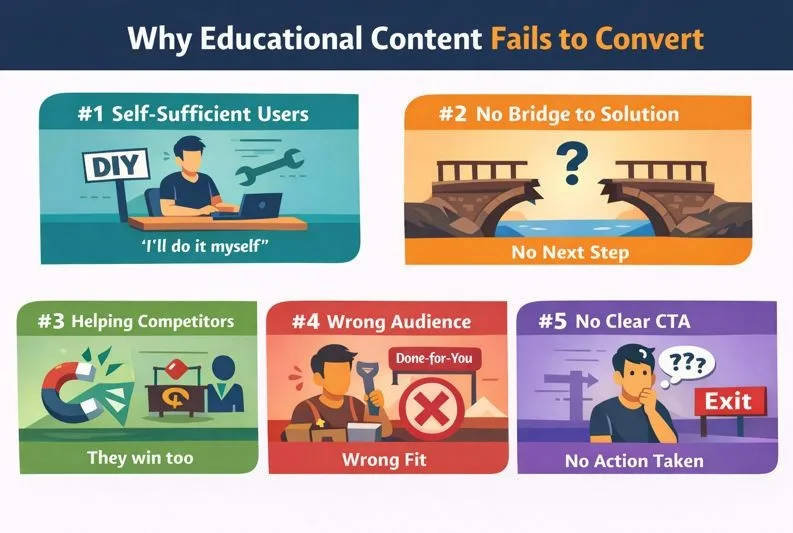
Why Educational Content Fails to Convert
For years, content teams have followed a well-intentioned philosophy:
“If we provide massive value for free, people will remember us when they are ready to buy.”
In practice, this breaks down in predictable ways.
Problem 1: You are creating self-sufficient users
You publish content like:
- “How to do email marketing.”
- “How to set up automation step by step.”
- “How to optimize campaigns manually.”
Readers learn exactly what to do.
They think: “I don’t need a tool. I can do this myself.”
Your content didn’t create demand. It removed it.
Many founders eventually recognize this pattern. In one Reddit discussion, a solo founder shared how they thought they were doing content marketing, only to realize they were publishing helpful explanations with no strategic connection to a product or outcome. The content performed well, but the business didn’t move forward because education alone never clarified why someone should choose their solution.
I thought I was doing content marketing. Turns out I was just advertising (and it cost me months).
byu/Spiritual_Heron_5680 inSideProject
Problem 2: There’s no bridge to your solution
Most educational articles end with something like:
“Now you know how!”
And that’s it.
No mention of how your product fits.
No suggestion that there’s an easier or safer approach.
No next step.
The reader leaves educated, but unconverted.
Problem 3: Generic advice benefits everyone
When you teach general best practices, readers apply them using any tool.
Your competitors benefit just as much as you do, sometimes more, because they are clearer about positioning their product as the natural next step.
You paid for the traffic.
Someone else gets the sale.
Problem 4: You are attracting the wrong audience
DIY content attracts people who want to DIY.
But many products are built for:
- Teams that want automation
- Buyers who want speed
- People who want outcomes, not instructions
If your content teaches manual execution while your product is “done-for-you,” you have created a mismatch from the first click.
Problem 5: No clear next step
The content ends.
The reader thinks: “That was helpful.”
Then they leave and forget you.
This disconnect is becoming increasingly common. In another Reddit thread, marketers discussed how modern visibility often creates awareness without commercial impact, leaving teams confident they are “doing the right things” while conversions stay flat.
The data reflects this:
- Pure educational content: ~0.5-2% conversion rate
- Education + solution positioning: ~2-10%
Same traffic. Up to 10× difference.
This is why many teams end up with strong dashboards and weak pipelines, a pattern we explore further in Organic Traffic but No Conversions.
The Education-Solution Framework
Content that converts doesn’t stop educating.
It connects education to action.
Part 1: Teach the Concept (40%)
Start with real, generous education:
- What the concept is
- Why it matters
- How it works
- Best practices
Example:
Email deliverability is the percentage of emails that reach inboxes instead of spam folders.
It’s influenced by sender reputation, authentication protocols, and content quality.
Understanding how these factors interact is essential for maintaining high open rates.
Give value freely. This builds trust.
Part 2: Show the Challenge (20%)
Now introduce reality.
Explain:
- Where teams struggle
- Why execution is harder than it looks
- Time, expertise, and risk are involved
Example:
Setting up SPF, DKIM, and DMARC requires DNS access and technical precision. A single misconfiguration can break authentication or harm the sender’s reputation. What looks simple often turns into hours of troubleshooting.
You are not saying “you can’t do this.”
You are saying, “This is what it actually takes.”
Part 3: Present the Solution Spectrum (20%)
Instead of pushing one answer, show all options.
DIY
- Cost: $0
- Time: 8-10 hours setup + ongoing maintenance
- High technical effort
Hire a specialist
- Cost: $2,000-$5,000 setup + retainers
- High expertise, high cost
Use software
- Cost: $200-$500/month
- Setup: ~20 minutes
- Best for teams without technical resources
This honesty builds trust.
Part 4: Position Your Solution (15%)
Now introduce your product naturally.
Explain:
- Who it’s for
- What it automates
- What it replaces
Example:
[Your Product] automates authentication, monitoring, and alerts in one place. It’s designed for teams that need reliable results without becoming infrastructure experts.
Add proof. Be specific.
Part 5: Clear Call-to-Action (5%)
Tell readers what to do next:
- Start a trial
- Book a demo
- Download a checklist
Different readers need different paths.
The winning ratio
- 40% education
- 40% challenge + context
- 20% product positioning
That’s content that converts.
7 Ways to Bridge Education to Conversion
1. The “Or Use This” Transition
“That’s the manual approach. Or you can automate it with [Your Product] in minutes.”
2. The Complexity Reveal
Teach the easy steps, then show where things break down.
3. The Time-Cost Calculator
166 hours/year manually vs. automation. Let math do the selling.
4. DIY vs Buy Comparison
Side-by-side tables make trade-offs obvious.
5. “We Built This So You Don’t Have To”
Position your product as a compressed experience.
6. Mid-Content Case Study
Insert proof where pain is highest.
7. The Honest Recommendation
“If you have time and expertise, DIY works. Most teams prefer focusing on strategy, that’s who this is for.”
As several practitioners have pointed out in AI-search discussions, the real problem often isn’t a lack of content; it’s measuring success using signals that don’t reflect influence or buying behavior.
AI search ROI Frameworks: 73 % track the wrong metrics
byu/Salt_Acanthisitta175 inAISearchLab
When to Teach, When to Sell
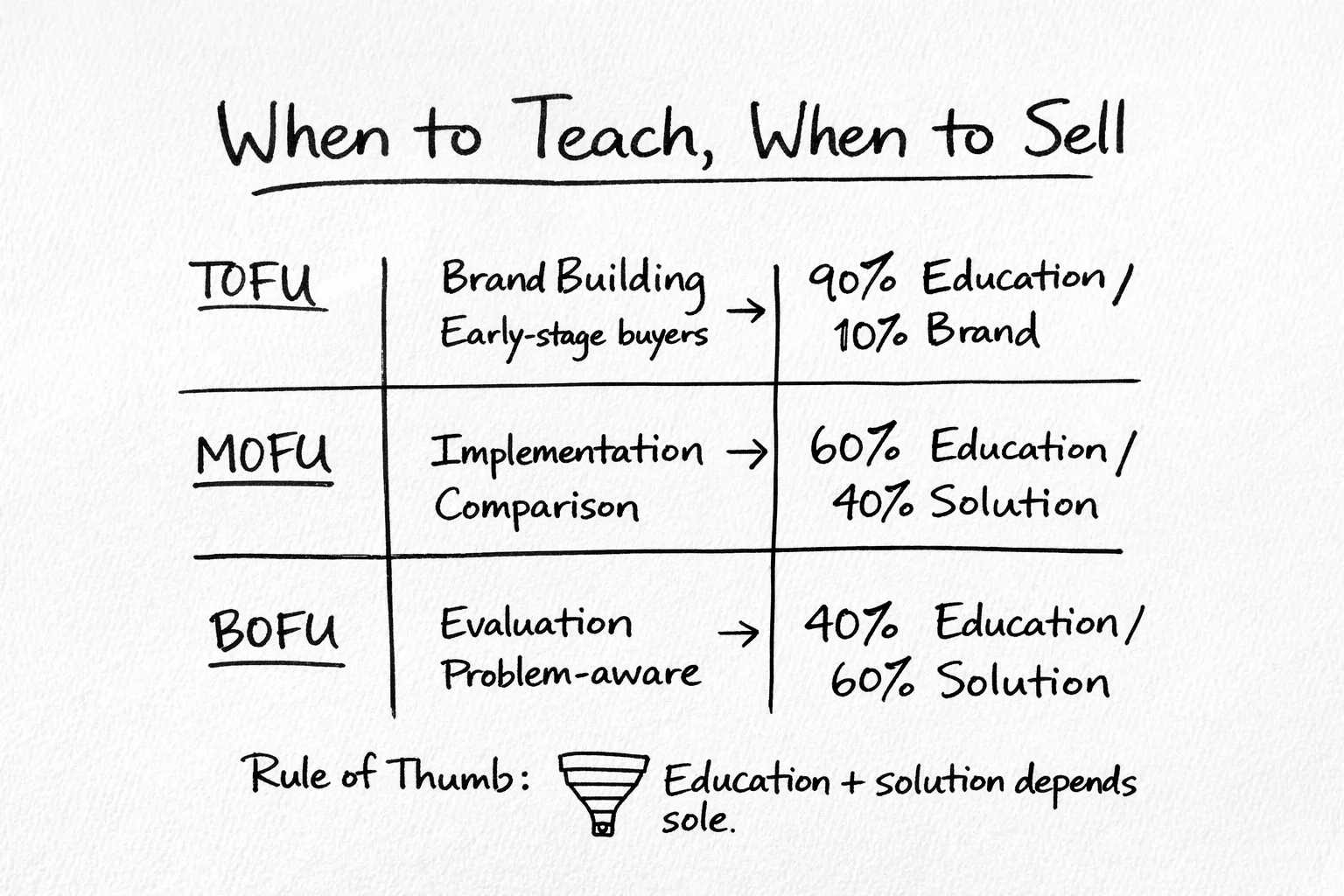
Pure education works when:
- TOFU brand building
- Teaching adjacent concepts
- Very early-stage buyers
Education + solution works when:
- Implementation content (MOFU)
- Comparison and evaluation (BOFU)
- Problem-aware audiences
Rule of thumb:
- TOFU: 90% education / 10% brand
- MOFU: 60% education / 40% solution
- BOFU: 40% education / 60% solution
When content ignores the buyer stage, it’s rarely a writing problem; it’s a funnel problem. We explore this further in Your Funnel Is Backwards: The Search-to-Sale Alignment Model.
Education Is Marketing, Not Charity
Educational content should support business goals, not replace them.
You are not running a free university.
You are demonstrating expertise to earn trust that leads to sales.
The best educational content:
- Teaches genuinely useful ideas
- Reveals real complexity
- Positions solutions honestly
- Respects the reader’s choice
Teach the why and the what.
Offer to handle the how.
Before You Publish Another Educational Blog
If you are reading this and thinking, “Most of our content is helpful… but we honestly don’t know if it’s driving sales,” you are not behind.
Most teams aren’t bad at content.
They are just stuck in an education-first mindset without a conversion bridge.
Traffic looks healthy. Engagement looks fine.
But sales conversations don’t reflect the effort.
That doesn’t mean you need more content or louder CTAs.
It usually means your education is doing the job too well without showing where your product fits.
If you want to sanity-check:
- Whether your content is training people to DIY instead of buying
- Where readers drop off instead of moving closer to a decision
- Which posts should educate and which should convert
You can share a bit of context with us here: https://tally.so/r/3EGEd4
- No content calendars.
- No forced funnels.
- No “just add CTAs everywhere” advice.
Just a short form to understand what you are teaching today, what you sell, and whether your content is quietly helping revenue, or working against it.
If there’s a clear fit, we will take it forward.
If not, you will still leave with more clarity than you had before.
FAQs
Yes, but only when it points to a clear next step. Education builds trust, but without direction, it rarely turns readers into leads or buyers.
Because education without positioning makes your solution interchangeable. Readers use what they learn with whichever tool feels easiest to choose later.
Not when done contextually. Showing where your product fits after explaining the problem feels helpful, not promotional.
It depends on buyer intent. Early-stage content should be educational, while mid- and late-stage content should clearly present solutions.
Teaching full execution without explaining trade-offs. This often removes the need for a product instead of creating demand for one.
If your content answers “how do I do this?” perfectly but never explains why tools exist or who they are for, you are likely over-educating and under-positioning.