Your FAQ Page No Longer Works: AI Answers Replaced It

FAQ Page That Nobody Visits
You have an FAQ page with 40-50 questions.
You spent time:
- Collecting common customer queries
- Writing concise answers
- Adding FAQ schema
- Optimizing for SEO
And yet, Organic traffic: nearly zero.
Meanwhile, when users ask the exact same questions:
- ChatGPT answers them
- Claude answers them
- Perplexity answers them
Instantly. Completely.
Without sending traffic to your site.
This article explains:
- Why have FAQ pages stopped working
- What changed between 2023 and 2026
- What replaces traditional FAQs
- How to rebuild your content strategy for AI-first search
Because the problem isn’t that people stopped asking questions.
They just stopped asking you.
What Happened to FAQ Pages
How FAQ Pages Used to Work (2015-2020)
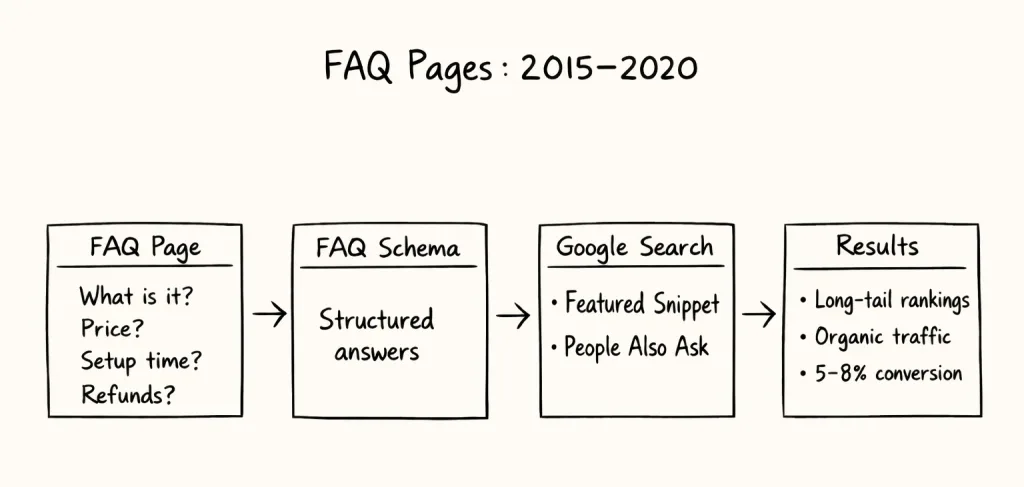
The traditional FAQ strategy was simple and effective.
You would:
- Create a page answering common questions:
- “What is [product]?”
- “How much does it cost?”
- “How long does setup take?”
- “Do you offer refunds?”
- Add FAQ schema markup
- Rank for question-based searches
- Capture featured snippets, and People Also Ask
- Convert visitors with clear, concise answers
The results back then:
- Strong rankings for long-tail queries
- Regular featured snippets
- Meaningful organic traffic
- Conversion rates around 5-8%
FAQ pages worked because Google needed websites to answer questions.
That assumption is now broken.
What Changed in 2023-2026
The AI Takeover
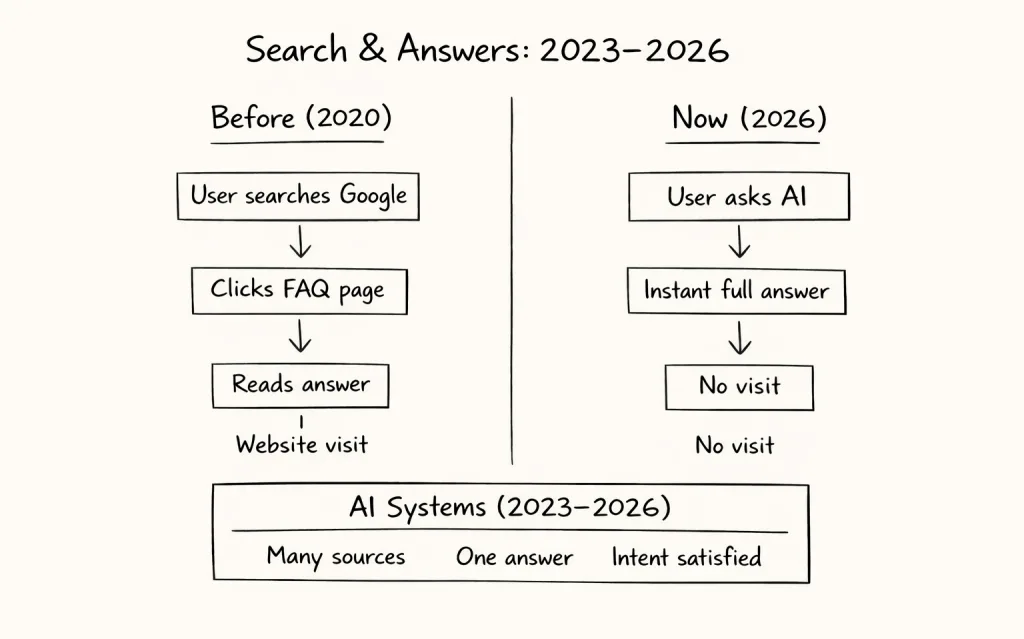
User question: “How much does project management software typically cost?”
Before (2020):
- User searches Google
- Clicks an FAQ page
- Reads the answer
Now (2026):
- User asks ChatGPT
- Gets a complete breakdown instantly
- Never visits a website
Example AI response:
Project management software pricing varies widely:
- Basic plans: $5-15 per user/month
- Mid-tier: $20-40 per user/month
- Enterprise: $50-100+ per user/month
Pricing depends on automation, integrations, and reporting needs.
Question answered.
Intent satisfied.
Click avoided.
The Zero-Click Reality
AI tools:
- Synthesize answers from dozens of sources
- Personalize responses based on context
- Remove the need to “check one more site.”
Your FAQ page doesn’t compete with one competitor anymore.
It competes with the entire internet, summarized instantly.
This shift is largely explained by the prompt gap between AI questions and Google searches; users now ask AI tools conversational, situational questions that traditional FAQ pages were never designed to capture.
The Data: FAQ Page Traffic Decline
Across 80+ B2B and SaaS sites, the pattern is consistent:
- Q1 2022: Baseline traffic
- Q4 2023: -15% (ChatGPT adoption)
- Q2 2024: -35%
- Q4 2024: -52%
- Q1 2025: -68%
- Q4 2025 (projected): -75%
People still ask the questions.
They just don’t ask Google or your FAQ page anymore.
AI tools answer questions directly and satisfy intent without clicks, a trend reflected in declining FAQ traffic patterns.
As one Reddit commenter put it, AI-generated answers are dramatically reducing organic clicks, driving down traditional traffic across query types, and forcing many teams to rethink how they measure visibility and influence.
AI search is killing organic traffic – how are you adapting your brand strategy?
byu/Vegetable-Rub-8241 inGrowthHacking
Why Traditional FAQs Don’t Work Anymore
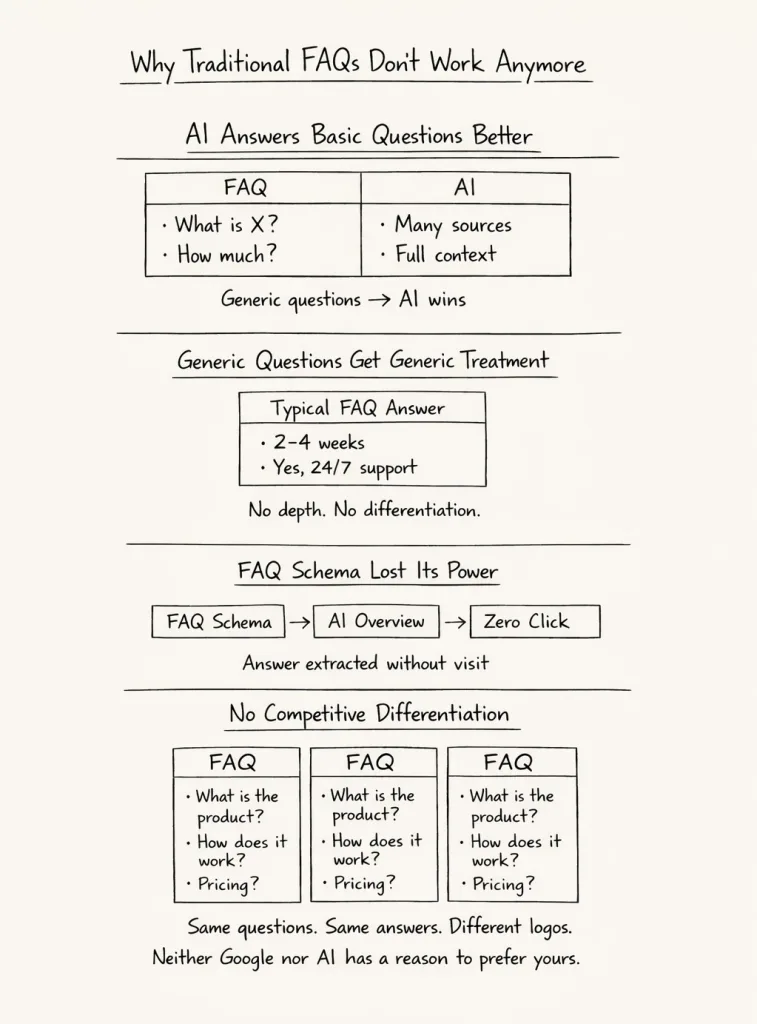
Reason 1: AI Answers Basic Questions Better
FAQ pages usually cover:
- What is X?
- How does X work?
- How much does X cost?
- What are the benefits?
AI tools:
- Combine multiple sources
- Explain context
- Adjust answers dynamically
Your value proposition: “We answer common questions about our product.”
AI’s value proposition: “I answer common questions about every product, instantly.”
For generic questions, AI wins every time.
Reason 2: Generic Questions Get Generic Treatment
Typical FAQ answers look like this:
Q: How long does implementation take?
A: Implementation typically takes 2-4 weeks.
Q: Do you offer support?
A: Yes, we offer 24/7 email support.
Problems:
- Surface-level responses
- No context
- No examples
- No differentiation
AI can generate this without you.
This is why structured, question-driven content performs better in AI search; language models reward depth, context, and explanatory completeness, not short, surface-level FAQ answers that every competitor publishes.
Result:
- No SEO advantage
- No AI citation value
- No meaningful user value
Reason 3: FAQ Schema Lost Its Power
What we thought:
- FAQ schema would help pages win featured snippets
- Featured snippets would drive consistent traffic
What actually happens now:
- FAQ schema feeds answers into Google AI Overviews, resulting in zero clicks
- AI tools extract the answer without clear attribution
- Users get answers instantly and skip visiting the website
- Your FAQ page becomes invisible despite being “optimized.”
The schema irony: Perfect FAQ markup makes it easier for AI to extract your answers without sending traffic.
In fact, many SEO practitioners on Reddit have questioned whether FAQ sections still matter at all in the age of AI, pointing out that while FAQ content can still serve site visitors, search engines (and AI answers) increasingly bypass them entirely.
Is FAQ section still relevant?
byu/Complex_Issue_5986 inseogrowth
Reason 4: No Competitive Differentiation
Compare three competitors’ FAQs.
They all ask:
- What is the product?
- How does it work?
- Pricing?
- Support?
Same questions. Same answers. Different logos.
Neither Google nor AI has a reason to prefer yours.
What Replaces Traditional FAQ Pages
Strategy 1: Deep-Dive Q&A Content
Instead of:
Q: How long does implementation take?
A: 2-4 weeks.
Create: How Long Does [Product] Implementation Actually Take? (Based on 200+ Deployments)
Include:
- Timelines by company size
- Real examples
- Variables that affect speed
- Hidden costs
- Readiness checklists
Why it works:
- Too detailed for AI summaries
- Uses proprietary insights
- Creates curiosity
- Gets cited
- Drives clicks
One deep guide beats ten shallow FAQs.
Strategy 2: Problem-Specific Content (Not Question-Specific)
FAQ mindset: “Why isn’t my email delivered?”
Better approach: Email Deliverability Dropped Suddenly: Diagnosis & Fix Guide
Cover:
- Symptoms
- Root causes
- Step-by-step diagnosis
- Recovery timelines
- Prevention strategies
Why it works:
- Solves real problems
- Requires full process
- AI answers aren’t enough
Strategy 3: Comparison & Decision Content
FAQ: “What’s the difference between Plan A and B?”
Replace with: Which [Product] Plan Is Right for You? A Complete Decision Guide
Include:
- Who each plan is for
- Budget thresholds
- Use-case mapping
- Upgrade signals
- Real customer decisions
Why it works:
- Decision frameworks can’t be summarized well
- Users need nuance
- Higher conversion intent
Strategy 4: Hyper-Specific Industry Content
FAQ: “Does this work for healthcare?”
Replace with: [Product] for Healthcare: HIPAA, EHR Integration & Compliance Guide
Include:
- Industry regulations
- Specialized integrations
- Implementation nuances
- Real healthcare workflows
Why it works:
- AI answers stay generic
- Buyers want reassurance
- Builds trust fast
Strategy 5: Interactive Tools & Calculators
FAQ: “How much will this cost?”
Replace with: [Product] Pricing Calculator
Let users:
- Enter team size
- Select plans
- Add integrations
- See first-year cost + ROI
Why it works:
- AI can’t replicate interactivity
- Personalized results
- High engagement
- Strong conversion intent
The New FAQ Strategy
Keep a Basic FAQ Page, But Redefine Its Role
Purpose now:
- Support deflection
- Sales enablement
- Existing customers
Not: SEO or traffic growth.
Keep:
- 10-15 essential questions
- Short answers (2-3 lines)
- Clear links to deep-dive guides
Content AI Can’t Replace

AI struggles with:
- Proprietary data & research
- Complex decision frameworks
- Step-by-step implementation guides
- Industry-specific depth
- Honest, technical comparisons
That’s where your moat is.
Measuring Success (What to Track Now)
Stop tracking:
- FAQ traffic
- FAQ rankings
- FAQ snippets
Start tracking:
- Deep-dive guide traffic
- Engagement metrics
- AI citations
- Conversion rates
- Support ticket reduction
What Actually Matters Going Forward
- FAQ pages have lost 60-80% of their traffic across most B2B and SaaS sites
- AI answers generic questions better, faster, and without sending clicks
- FAQ schema often accelerates zero-click behavior instead of growth
- Surface-level Q&A no longer creates differentiation or trust
- Deep, problem-solving content outperforms FAQs in both visibility and conversions
- Interactive tools and calculators create defensible engagement
- Industry-specific depth beats generic “best practices” every time
- FAQs should support users, not carry your SEO strategy
Your FAQ Page Didn’t Fail. The Internet Changed.
Your FAQ page isn’t dead, its role has fundamentally changed.
It’s no longer a traffic engine or an SEO growth asset. It’s a support tool.
And that shift didn’t happen because you did something wrong.
AI tools didn’t just reduce clicks.
They quietly removed entire categories of content from the traffic equation.
Most teams didn’t fail at FAQs.
The environment changed around them.
The real growth now comes from content that AI can’t fully replace:
- Deep, decision-oriented guides
- Proprietary insights and real-world experience
- Honest comparisons and trade-offs
- Interactive tools and calculators
- Industry-specific expertise
The hard part isn’t accepting that FAQ pages don’t drive traffic anymore.
It’s knowing:
- Which questions are still worth keeping
- Which ones should become deep guides
- And which content is no longer worth maintaining at all
If you want to pressure-test:
- Whether your FAQ page has stopped working or is just mis-positioned
- Which questions does AI already answer better than you
- Where long-form guides would outperform FAQs
- And what’s simply not worth rewriting anymore
You can share a bit of context with us here: https://tally.so/r/3EGEd4
No content audits.
No SEO checklists.
No “replace everything with AI pages” advice.
Just a short form to understand what you sell, what your customers still ask, and whether moving beyond traditional FAQs would actually create leverage.
If there’s a clear opportunity, we will say so.
If not, you will still leave knowing exactly why your FAQ page stopped mattering, and what to do next.
FAQs
No. FAQ pages are still useful for customer support, onboarding, and sales enablement. What changed is their role. They no longer function well as traffic drivers or SEO growth assets because AI tools answer most basic questions directly.
In most cases, no. Instead of deleting it, reduce it to 10-15 truly essential questions and link each answer to a deeper guide. Treat the FAQ page as a navigation and support resource, not a ranking page.
Because rankings don’t guarantee clicks anymore. FAQ answers often appear directly in AI Overviews, featured snippets, or AI tools, satisfying user intent without requiring a visit to your site.
They help machines understand your content, but that’s a double-edged sword. While schema can improve extraction and visibility, it often accelerates zero-click behavior instead of driving traffic.
Long-form, problem-driven, decision-oriented content. Deep implementation guides, industry-specific resources, comparison frameworks, and interactive tools outperform surface-level Q&A in both AI citations and organic traffic.
They can replace generic answers. They struggle with proprietary data, real-world examples, complex trade-offs, step-by-step processes, and industry-specific nuance. That’s where human-created content still wins.
Test them directly in AI tools. If ChatGPT or Claude fully answers a question without referencing your site, it’s a candidate for deeper content or removal. If the answer feels shallow or generic, that’s an opportunity for a comprehensive guide.
In most cases, yes. While individual FAQs lose traffic, well-structured guides often attract long-tail queries, get cited by AI tools, and convert better because they support real decision-making.
All current indicators suggest yes. AI answering behavior is becoming more prominent, not less. The strategic advantage now comes from adapting content depth and structure, not waiting for FAQ traffic to return.