How can founders and marketers increase CTR from 0.3% to at least 1%?
If your CTR is stuck at 0.3%, it’s rarely because your content is bad; it’s because the way it shows up on Google is misaligned with intent.
This guide breaks down how founders and marketers can fix titles, meta descriptions, structure, and snippet clarity so your page becomes the most clickable result for the keyword.
Context: What Most Teams Get Wrong About CTR
CTR looks like a performance metric, but it’s actually a relevance signal.
Low CTR happens when:
- The wrong title angle is used
- Meta descriptions explain nothing specific
- Google can’t extract a clear answer
- Your snippet loses space to competitors with better formatting
- The page ranks, but does not “match the moment” of the user’s search
- Google suppresses your snippet because intent alignment is weak
Truth:
Google ranks based on signals.
Humans click based on clarity.
If that clarity is missing, your CTR can sit at 0.3% for months, even for high-ranking pages.
If you want a deeper breakdown of why pages don’t earn clicks even when they rank, we’ve explained this in our guide on Search Market Fit, why SEO only works when your content matches what the market actually wants.
Core Insight: The CTR Extraction Framework
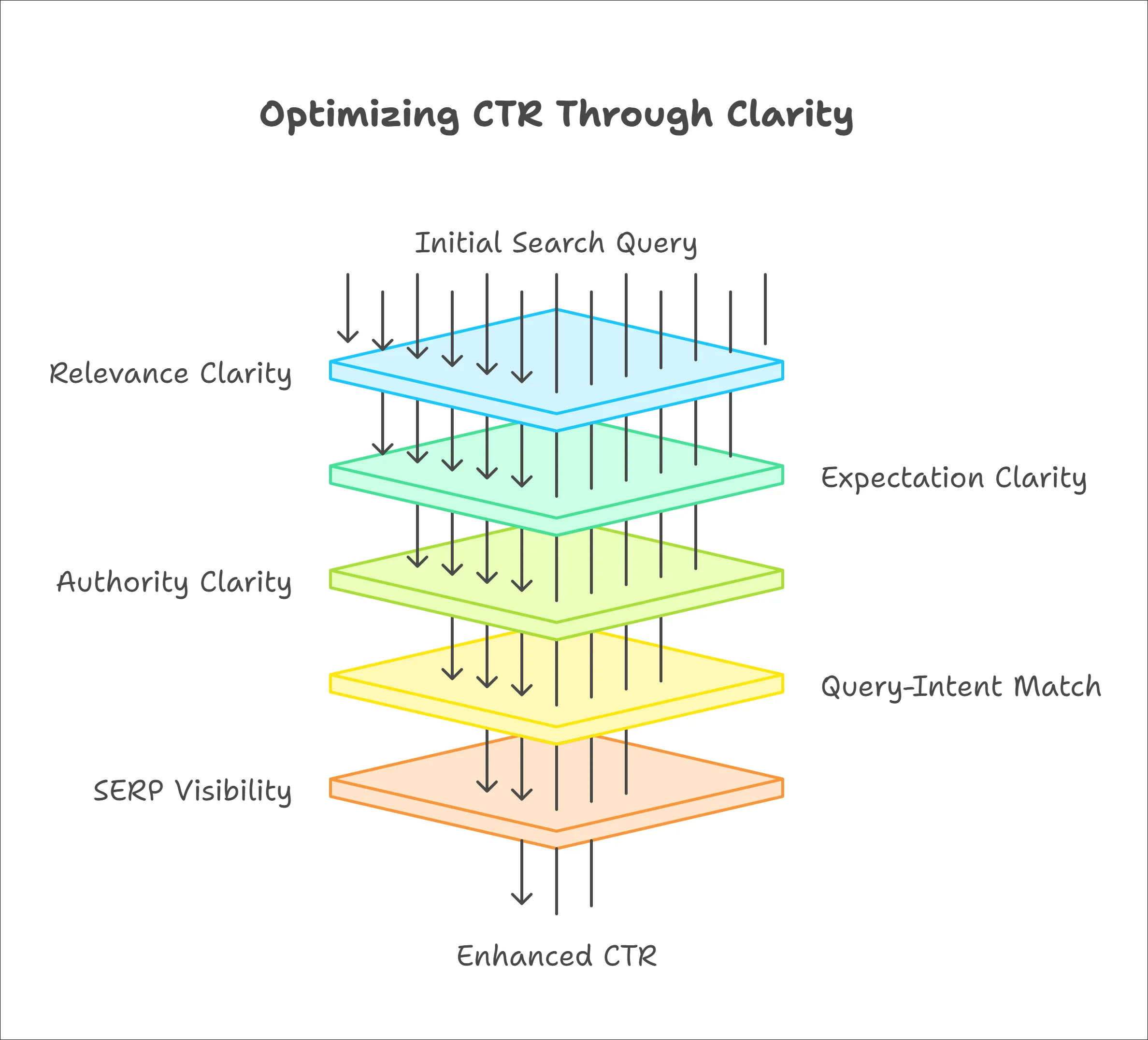
CTR improves when five clarity signals align:
1. Relevance Clarity (Title)
People click titles that reflect their current state, not your content structure.
Bad: “Improve Conversion Rate in 2026”
Better: “Conversion Rate Dropped? 7 Fixes Working in 2026.”
Best: “Facing a 0.3% Conversion Rate? Here’s How Teams Lift It Fast”
The third title names the pain, sets an outcome, and signals expertise.
2. Expectation Clarity (Meta Description)
A meta description should feel like a tiny promise, not a summary.
Bad:
“This article shows how to increase CTR.”
Better:
“Low CTR often means unclear intent match. Here’s how to rewrite your titles and snippets to move from 0.3% to 1% without new content.”
Google understands intent → users understand value → CTR rises.
3. Authority Clarity (Entity Trust)
Google gives better visibility to brands it can verify.
Signals:
- A strong About page
- Clear author profiles
- Consistent product descriptions across the web
- Third-party citations
- Structured metadata (Organization, Person, WebPage)
If Google can’t confirm who you are, your snippet doesn’t get premium placement, even if you rank well.
4. Query-Intent Match (Semantic Alignment)
CTR collapses when the title doesn’t match the user’s search intention.
If the query is:
How to improve e-commerce CTR.”
Then:
“Ecommerce CTR: From 0.3% to 1% With 5 Fixes That Work”
…beats
“How to Improve CTR (Full Guide)”
Specificity wins clicks.
5. SERP Visibility (Snippet Real Estate)
CTR is proportional to how much space your snippet occupies.
You win by adding:
- FAQ schema
- How-To schema
- Short, extractable answers
- Clean, descriptive URLs
- Highly structured headers
- Visible tables Google can lift
More SERP real estate → more perceived authority → higher CTR.
As one SEO practitioner recently wrote on Reddit:
“Unlike traditional SEO (where backlinks and keywords ruled), AEO focuses more on: Building topical authority so AI models ‘trust’ your content. Using structured data (schema, FAQs, knowledge graphs). Creating concise, answer-style content that AI can easily summarise.”
Is Answer Engine Optimization (AEO) the future of SEO in 2025?
byu/OliverPitts inseogrowth
That shift isn’t a 2025 trend; it’s becoming standard for 2026 and beyond. If you want your content to show up in AI answer engines (not just classic SERPs), you must think beyond rankings and optimise for retrieval.
How CTR Extraction Differs From Old SEO
| Factor | Old SEO | Modern CTR Optimization |
|---|---|---|
| Purpose | Rank the page | Win the click |
| Focus | Keywords | Message clarity |
| Strength | Long content | Intent-aligned snippet |
| Google Tests | Content depth | Snippet performance |
| Human Behavior | Reads page | Decides in 0.8 seconds |
| Success Metric | Position | CTR growth |
Ranking is visibility.
CTR is selection.
You need both to win.
Real-World Case Studies
Case study 1: SaaS Productivity Tool, CTR jumps from 0.29% → 1.12%
A SaaS tool ranked #4 for “best employee productivity apps,” but CTR was 0.29%.
Problem: The Title was too generic.
Before:
“Best Productivity Apps for Teams in 2025”
After:
“Struggling With Low Team Output? 11 Productivity Apps That Actually Improve Performance”
Why it worked:
- “Struggling” matches emotional intent
- “Actually improve performance” adds credibility
- The title acknowledges the frustration, not just the topic
CTR grew 285% in 14 days.
Case study 2: B2B fintech, CTR jumps from 0.32% → 0.98%
Ranked #7 for “cross-border payment process”.
The snippet lost to competitors with cleaner definitions.
Fix: Add a tight, extractable definition.
Added in H2 section:
“Cross-border payments transfer money between countries using correspondent banks, local payout partners, or RTP rails. Every transaction includes currency conversion, compliance, routing, and settlement.”
Google started showing this definition as the snippet → CTR nearly tripled.
Case study 3: D2C Brand, CTR jump 0.37% → 1.21%
Keyword: “how to choose skincare products for oily skin”.
Old title:
“How to Choose Skincare Products”
New title:
“Choosing Skincare for Oily Skin? Avoid These 5 Common Mistakes First”
Small shift.
Massive difference.
This matches the moment the user is in: confused → seeking relief → wants clarity.
CTR crossed 1% within 9 days.
Case study 4: B2B Tax Software, CTR jump 0.42% → 1.03%
Problem: Google didn’t trust the snippet because the brand’s web descriptions were inconsistent.
Fixes:
- Updated organization schema
- Unified product descriptions across directory listings
- Rewrote meta description for clarity
- Added FAQ schema with clear definitions
CTR passed 1% with no change to the content.
Your CTR Is a Structural Problem, Not a Traffic Problem
CTR is predictable.
CTR is diagnosable.
CTR is fixable.
When titles, descriptions, snippet clarity, entity trust, and intent alignment work together, your CTR moves from 0.3% to 1% like clockwork.
At Thrillax, led by Krunal Soni’s two decades of “improvement-first” SEO practice, we don’t guess why your CTR is low; we measure it:
- your snippet structure
- your entity clarity
- your SERP space
- your intent alignment
- your extraction-ready content
This isn’t optimisation for ranking.
It’s optimisation for retrieval and selection.
Get Your CTR Strategy Ready for 2026’s Search Landscape
Modern CTR growth isn’t about adding more content; it’s about restructuring your message so Google and users can recognise your relevance instantly.
Search now rewards clarity, extractable value, and hyper-aligned snippet messaging, not generic SEO patterns.
If your brand wants to lift CTR from 0.3% to 1% and beyond, you need a system that sharpens your titles, strengthens your metadata, aligns your intent angles, and expands your snippet visibility.
Why this matters now:
- CTR is the fastest indicator of user intent clarity
- Google increasingly tests snippets, not pages
- AI-led search surfaces the clearest result, not the longest one
- Weak metadata suppresses visibility even for strong content
- Most teams rewrite articles, but very few rebuild SERP-first messaging
Your titles, your metadata, your definitions, and your consistency determine whether your page earns the click or gets skipped.
Winning CTR today is not guesswork.
It is a process.
If you’re ready to see which parts of your snippets are blocking clicks, what intent mismatches exist, and what metadata gaps are holding your CTR below 1%, start by sharing your page URL and keyword here:
CTR Diagnosis Form: https://tally.so/r/3EGEd4
FAQ
Because ranking ≠ selection. Google may show your page on page 1, but if your title doesn’t match user intent or your snippet is overshadowed by SERP features, users skip you.
Yes. CTR often doubles simply through rewriting titles, tightening meta descriptions, and adding schema that expands snippet size.
Google tests snippet formats using:
- Intent match quality
- Clarity of definitions
- Presence of structured data
- Entity trust
- Historical click behavior
If your snippet is unclear, Google suppresses it.
Only when recency impacts the decision (e.g., SaaS pricing, tax rules, algorithm updates). Overusing the word lowers trust.
Google re-evaluates snippet relevance upon recrawl. If the new title aligns better with searcher expectations, it gets tested more, displayed more prominently, and clicked more.
Schema does not guarantee clicks. But it does expand your SERP footprint, richer snippets, more structured elements, and clearer context, which often leads to higher click-through rates because your result stands out visually and communicates value faster.
Yes, when impressions spike (Google tests your new snippet in more results), CTR may temporarily fall. It stabilizes within 7-21 days.
They win message alignment. Clearer titles, sharper angles, stronger entity authority, and better structured snippets make them more clickable, even if they rank below you.
Indirectly, Google uses user trust signals from branded queries to shape how aggressively your non-branded results are tested.
Writing titles that describe the content instead of solving the searcher’s problem.