From Keywords to Conversations: How AI Search Changes Decisions in 2026

Keywords haven’t stopped working.
They have stopped deciding outcomes.
In the old days of search, keywords were the bridge between what you typed and the stuff you found online.
Getting the exact words right was super important to show up high in the results. It was a simple system. But now, with AI-powered search, things are changing big time.
Generative tools and chatbots don’t just pull up links for you to look through; instead, they create full, easy-to-understand answers right away to solve your problems.
That shift quietly breaks the keyword-first model.
When buyers ask ChatGPT, Gemini, or Copilot a question, they are not looking for pages. They want reasoning, trade-offs, clarity. The system’s job isn’t to show options; it’s to reduce uncertainty.
This is why many pages still rank but no longer influence decisions. They were written to match keywords, not to be part of a conversation.
How the Shift from Keywords to Conversations Changes Search
In AI-driven search, you’re not just optimizing pages anymore. You’re optimizing conversations.
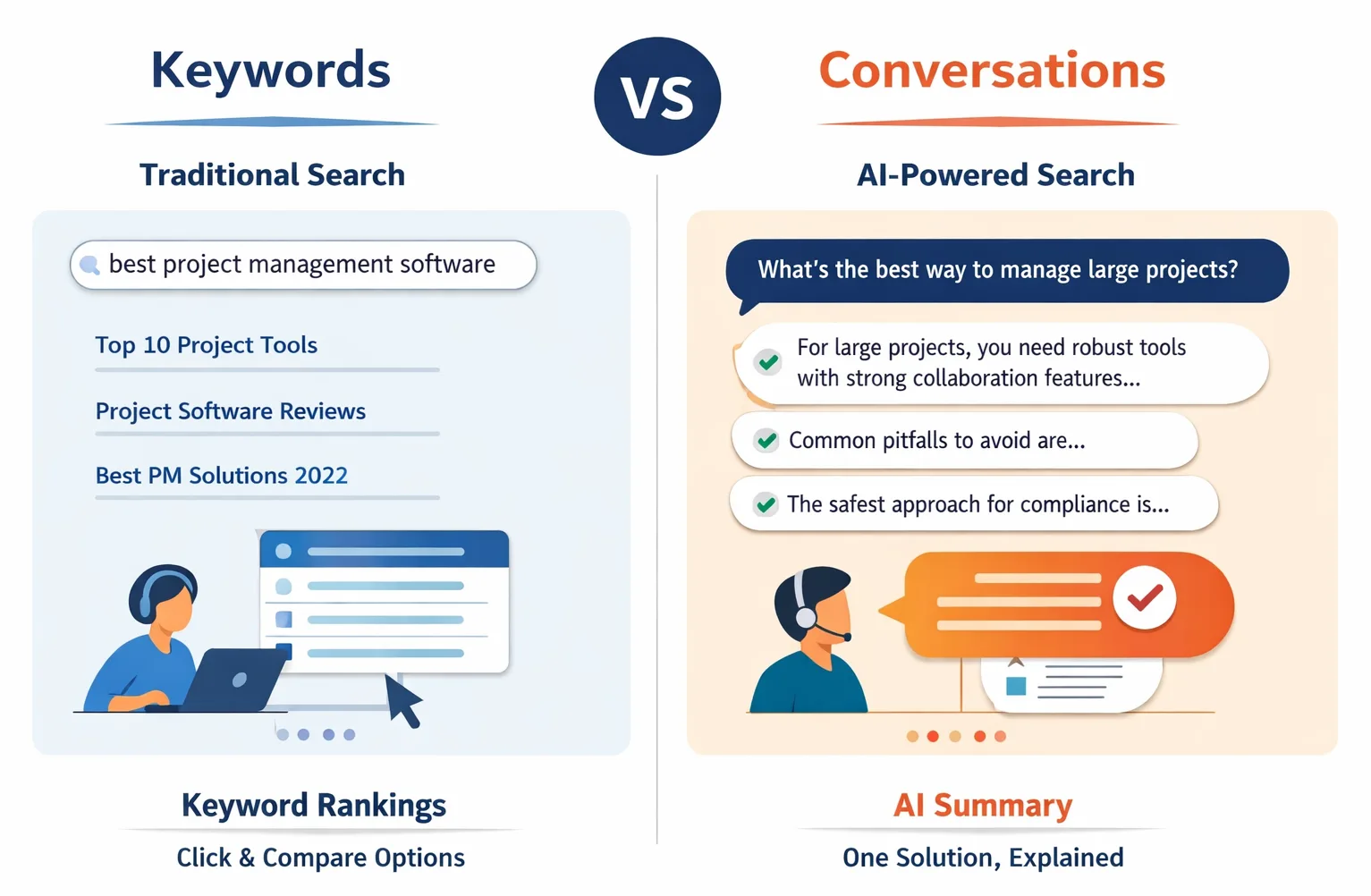
Generative systems judge content by how well it keeps a conversation going.
That means they prefer sources that:
- Answer questions directly, without preamble
- Maintain consistency across related explanations
- Anticipate follow-up questions
- Reduce ambiguity instead of expanding it
AI search is all about getting clear answers, so pages that only care about stuffing keywords don’t work well. These pages aim to be found, not to actually help you.
They often bring up topics and then drop them, use fuzzy language instead of having a solid point, or rely on you knowing other stuff to make sense.
AI doesn’t like this kind of confusion, so if your explanation can’t stand alone in a chat, the AI will just skip it.
In real user discussions, many people explicitly compare ChatGPT to traditional search, calling it “better for information search” because it synthesizes answers rather than returning a list of links.
Why ChatGPT is better for information search: a comparison with other popular AI search engines
byu/Kseniia_Seranking inChatGPT
Why Conversations Replace Queries in Modern Research
B2B buyers rarely think in keywords. They think in sequences.
A typical AI-assisted research flow looks something like:
- “How are teams handling X today?”
- “What usually breaks when this scales?”
- “What should we avoid if compliance matters?”
- “Which approach is safer for our situation?”
Each question builds on the previous one. AI systems select sources that can move with that progression. Content that only answers a single keyword-framed query becomes a dead end.
Conversation based search isn’t about long-tail keywords; it’s about continuity of thinking. Brands that show up repeatedly across these exchanges start to shape understanding. Brands that appear once and disappear don’t.
In online discussions, many users say they “rarely use Google anymore” because they can get direct explanations and answers from ChatGPT instead of sorting through links.
What AI Systems Look for in Conversational Content
Generative AI evaluates conversational usefulness through a few consistent signals:
- Intent alignment: Does the explanation match the sophistication of the question being asked?
- Reasoning quality: Does the content explain why something works, not just what to do?
- Follow-up readiness: Can the explanation support the next logical question without contradicting itself?
- Language stability: Does the brand explain the same idea the same way across topics and time?
Keywords help the AI find your stuff. But making sure your content is super clear and conversational is what gets the AI to actually use and reuse it.
Why Keyword Mapping Breaks in a Conversation Based World
Keyword mapping used to be simple: one page, one query, one intent. Done.
But AI search is conversational, and it breaks that old rule.
AI systems now check if your whole brand agrees with itself. If the definition of a concept changes from one page to the next, or your conclusion shifts, the AI gets confused and your authority drops.
That’s why so many sites with great keyword coverage still don’t show up in AI answers. They don’t sound like one smart person talking; they sound like a messy collection of pages.
In this new world, consistency is your superpower.
If you contradict yourself, the AI won’t try to figure it out; it’ll just exclude you.
How High-Performing Teams Adapt from Keywords to Conversations
We are moving from optimizing content for keyword ranking to structuring our knowledge so AI systems can confidently and safely reuse our explanations in their conversational answers.
What This Means for Our Content Creation (The New Adoption):
- Lead with the Answer: Pages must open with a direct answer to the core question, rather than lengthy scene-setting or introductions. Get straight to the point.
- Consistency is King: We need to ensure concepts and terminology are explained identically across all formats, posts, and materials. This builds authority and helps the AI connect our content.
- Write for Quotability: Our content should be sharp, precise, and easily quotable. Think less “skim-and-scan,” and more “definitive statement.”
- Clear Signaling: Every piece of content must clearly signal who it is for and the specific scenario or context where the advice applies. No more vague, catch-all articles.
- Commit to a Position: Instead of exhaustive lists of options, our content must commit to a clear position or recommendation. AI systems favor confident, authoritative sources.
This operational shift requires us to rethink how we structure our explanations, not just what we optimize. Read more: SEO for AI Answer Engines
Let’s discuss how to integrate these practices into our next sprint.
Why Conversations Become an Authority Signal
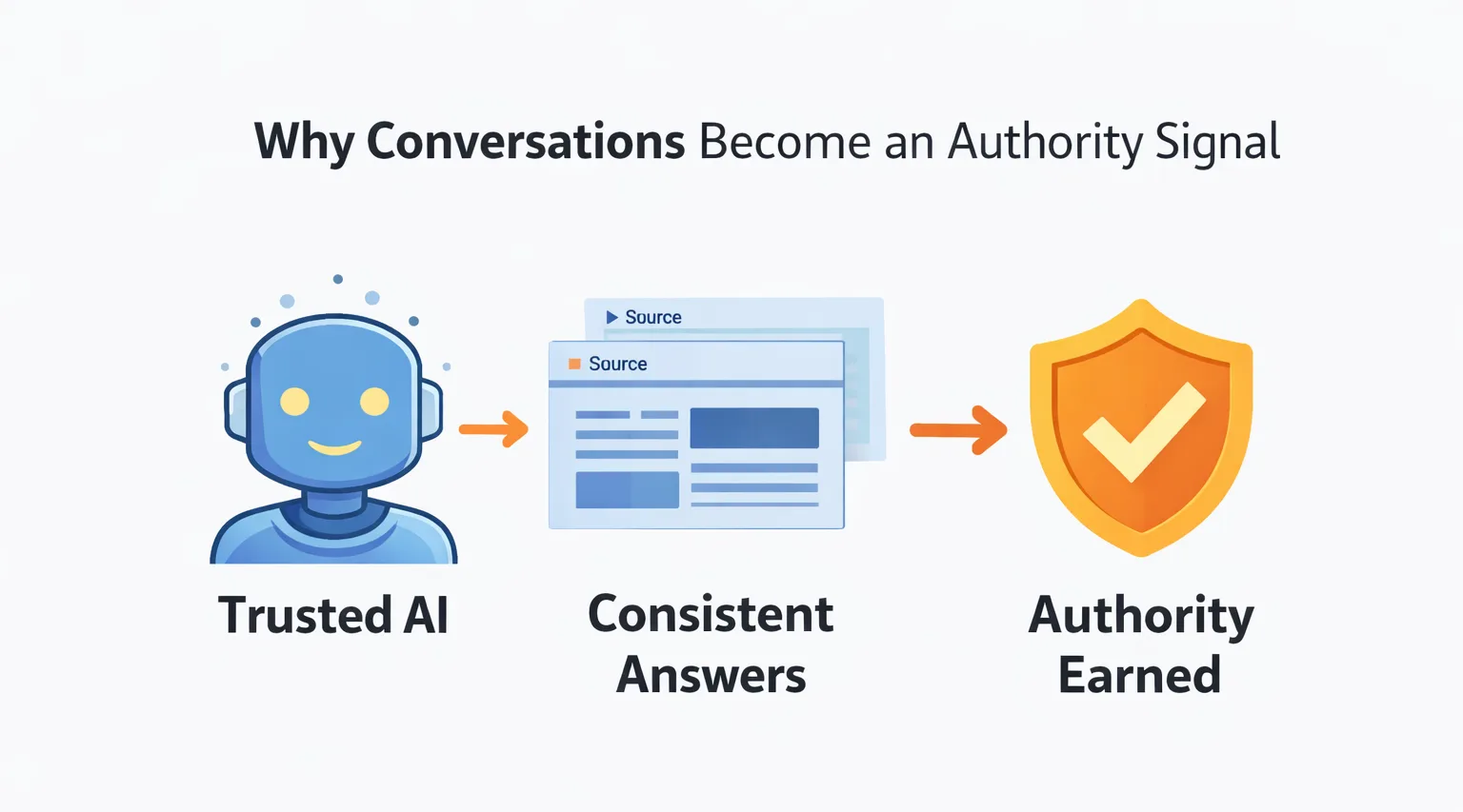
AI systems now look at a brand’s proven reliability to decide if it has authority.
They don’t care about how persuasive the brand is.
A brand truly gains authority when AI consistently chooses its explanations for similar questions. These explanations must also stay the same across different conversations. They need to match other trusted sources perfectly. The brand should not just copy others.
This change makes conversational SEO a strong, natural boost for E-E-A-T.
Genuine experience shows up as good judgment. Expertise is proven by consistent, stable reasoning. Authority is earned when your content is used again and again, not just by making strong claims.
The Hidden Risk of Ignoring Conversational Search
The biggest risk isn’t just lost traffic, it’s lost influence, a silent killer of your future pipeline.
AI now shapes your buyers’ entire decision-making framework before they ever search for a vendor. If your content isn’t embedded in these conversational flows, you’re not just missing a click, you’re ceding control over the narrative.
In 2026, ranking high while being conversationally invisible is a false, dangerous signal of success.
Your window to secure that narrative control is closing, and the cost of waiting is the permanent erosion of your market authority.
Before You Try to “Optimize” for AI Conversations
Most teams do not have a chatbot problem. They have a clarity problem.
AI systems make patterns visible quickly.
They surface whether your brand explains ideas consistently, stays within a clear domain of expertise, and resolves intent instead of circling it.
When content fails to appear in AI conversations, the issue is rarely volume or tooling; it’s fragmented thinking, mixed positioning, or explanations that never fully commit.
Ready to Move from Keywords to Conversations?
Getting visible inside ChatGPT, Gemini, and other generative interfaces isn’t guesswork. It’s about structure, clarity, and conversational reliability.
At Thrillax, we review how your content behaves inside AI-driven conversations, what gets reused, what gets skipped, and where trust breaks down.
If you are serious about becoming part of the conversations buyers actually have, start by filling out a short intake. It helps us assess conversational clarity and reuse readiness, consistency across topics and explanations, and where keyword-led content is blocking AI inclusion.
From there, you get a focused roadmap on what to fix, what to consolidate, and what to stop publishing entirely.
Start here: https://tally.so/r/3EGEd4
FAQs
Long-tail keywords are like asking for a specific book title (retrieval).
AI Conversation is like having an ongoing debate where each answer shapes the next question (continuity of reasoning).
No. Ranking pages get you noticed (discovery).
The clarity of your content determines if the AI actually uses it in its answer (reuse).
Because your content is too vague or depends on what’s written nearby.
AI needs super clear, stand-alone explanations that are safe to reuse.
To answer this question, ask yourself:
- Look for real-world impact: Did a salesperson mention your article on a call?
- Is your brand name being searched more?
- Are people converting after seeing your content?
- Is the AI consistently pulling from your pages?
Nope, it’s even more crucial for people making big decisions (mid-to-late stage).
Why? Because those questions involve tough trade-offs, risks, and needing strong justification.
Start with your best pages; the ones already getting a lot of clicks.
The quickest wins often come from simply making your existing explanations tighter
and your language more stable, rather than writing brand-new articles.