Link Building That Hurt More Than It Helped: 8 Backfire Patterns

When More Links = Worse Rankings
You did everything the “old SEO playbook” said to do.
- Built 200 backlinks in 3 months
- Watched rankings… drop instead of improve
- Traffic declined
- Google Search Console showed warnings, or worse, a manual action
This isn’t bad luck.
This is a modern SEO reality.
In 2026, more links can absolutely mean worse rankings if those links follow patterns Google now associates with manipulation.
This article breaks down:
- Why link building assumptions from the past no longer work
- When and how Google’s algorithm learned to detect manipulation
- 8 link building patterns that consistently backfire
- How to audit, clean up, and rebuild a healthy link profile
If your rankings dropped after “doing SEO,” chances are one of these patterns is the reason.
The Link Building Assumptions That No Longer Hold
What We Thought Was True
For years, SEO advice revolved around a few core beliefs:
- More links = better rankings
- Any link is better than no link
- Link building is a numbers game
- High DA sites always help
- Guest posts are a “safe” tactic
Those assumptions built entire agencies and link marketplaces.
They are also the reason many sites are now struggling.
What’s Actually True in 2026
Google’s understanding of links has evolved dramatically:
- Quality matters exponentially more than quantity
- Bad links don’t just get ignored; they actively hurt
- Patterns matter more than individual links
- Domain authority alone doesn’t determine value
- Many once “safe” tactics now trigger spam filters
Links are no longer votes.
They are signals, and bad signals poison the system.
When Google’s Algorithm Got Smarter

Penguin (2012-2016)
- Targeted manipulative link schemes
- Penalized over-optimized anchor text
- Turned low-quality links into liabilities
Core Updates (2018-Present)
- Rewarded genuine authority and trust
- Devalued artificial link growth
- Favored natural, editorial link profiles
Spam Updates (2021-Present)
- Actively detect link networks
- Identify paid and exchanged links
- Spot unnatural velocity and patterns
The result: Tactics that worked in 2015 now trigger penalties in 2026.
Backfire Pattern #1: Low-Quality Guest Post Spam
What Happened
The strategy:
- Mass outreach to “guest post accepted” sites
- 50+ guest posts in 2 months
- Backlinks from author bios
- Exact-match anchors pointing to the homepage
The sites:
- Accept anyone, no editorial review
- Publish 5-10 posts daily
- Thin, generic, often AI-generated content
- No comments, no shares, no real audience
What Went Wrong
- Months 1-2: Rankings stable
- Month 3: Gradual decline
- Month 4: Sharp drop (positions 8 to 24)
- Month 5: Manual action for unnatural links
Why It Backfired
Google detected:
- Sudden spike in similar low-quality backlinks
- Links clustered in author bios
- Over-optimized anchor text
- Sites known for selling guest posts
This wasn’t “content marketing.”
It was a scaled link insertion.
Warning Signs
If 3+ apply, stop immediately:
- The site accepts any guest post
- Content is thin or generic
- No real traffic or engagement
- Publication in under 24 hours
- Payment for “premium placement.”
- Keyword-rich author bio links
How to Avoid It
Guest post only where:
- Editorial standards exist
- Content quality is genuinely high
- Real audience engagement is visible
- You would write there even without a link
Test:
Would you recommend this site as a resource?
If not, don’t guest post there.
Backfire Pattern #2: Irrelevant Niche Links
What Happened
The strategy:
- Bought “100 high-DA links for $500.”
- DA 40-60 sites
- Completely unrelated niches
Your site: B2B project management software
Links came from:
- Travel blogs
- Gaming sites
- Health and wellness blogs
- Fashion and home improvement sites
Why It Backfired
Topical relevance is foundational.
Google asks: Why would a gaming blog link to project management software?
There’s no natural context, only manipulation.
Warning Signs
- No topical connection
- Link feels forced
- Sidebar/footer placement
- Site links out to unrelated industries
How to Avoid It
Build links from:
- Industry-relevant sites
- Content your audience actually reads
- Pages where your link adds value
If the link wouldn’t make sense to a human, it won’t make sense to Google.
Many SEOs have experienced this firsthand. One Reddit thread discussed how buying hundreds of backlinks from Fiverr gigs did not work at all, compared to earning links naturally through valuable content, with seasoned contributors emphasizing that cheap or irrelevant links simply don’t deliver results or can actively harm rankings.
I saw 25,000 back links. Is that real?
byu/Expensive-Garden-640 inlinkbuilding
Backfire Pattern #3: Anchor Text Over-Optimization
What Happened
- 80 backlinks over 6 months
- Same anchor text: “best project management software.”
- Goal: Rank faster
What Google Saw
Natural link profiles look like:
- Brand names: 40-60%
- Generic anchors: 20-30%
- URLs: 10-15%
- Exact-match keywords: 5-10%
Manipulated profiles look like:
- Exact-match keywords: 60-80%
That’s a textbook spam signal.
Warning Thresholds
- Exact-match anchors above 30 percent are a red flag
- One keyword above 15 percent is a warning
- Brand anchors below 30 percent look unnatural
How to Fix It
For every 10 links:
- 5-6 brand or branded
- 2-3 generic
- 1 naked URL
- 1 keyword (max)
Exact-match anchors should be rare, not a strategy.
Backfire Pattern #4: Link Schemes and Networks
What Happened
- Joined a paid “link exchange network.”
- 100 links in 30 days
- All sites linking to each other
Why It Backfired
Google tracks:
- Hosting and IP similarities
- Cross-linking patterns
- Commercial exchanges
Private Blog Networks and link schemes are explicit violations.
Warning Signs
- “Link network” language
- Pay-to-access sites
- Identical templates
- No real content required
The Only Safe Alternative
- Earn editorial links
- Build relationships with real publishers
- Create content worth citing
No shortcuts survive long.
Backfire Pattern #5: Paid Links Without Disclosure
What Happened
- Paid $200-500 per link
- Dofollow sponsored posts
- No rel=”sponsored” or nofollow
Why It Backfired
Google’s rule is simple:
Paid links must not pass ranking value.
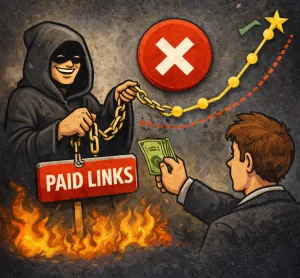
Violations trigger manual actions every time.
How to Do It Right
If you pay:
- Use rel=”sponsored” or rel=”nofollow”
- Treat it as advertising, not SEO
- Measure success by traffic and brand lift, not rankings
Backfire Pattern #6: Directory Spam
What Happened
- 300 directory submissions
- Mostly auto-approval
- Fast link growth
Why It Backfired
Directories built for SEO:
- Has no editorial value
- Exist only to link out
- Trigger spam filters at scale
What’s Still OK (Limited)
- Google Business Profile
- Legit industry associations
- Chambers of commerce
- Government or .edu resources
If the directory exists mainly for SEO, avoid it.
Discussions on Reddit also show how link cleanup itself can be tricky; some SEOs point out that simply disavowing spam links blindly can harm your profile further if you remove legitimate citations, underscoring why careful analysis matters more than automated cleanup.
Backlinks not showing and just getting new spam
byu/Silly-Earth4105 inSEO
Backfire Pattern #7: Forum & Comment Link Drops
What Happened
- Generic comments
- Signature links everywhere
- Minimal engagement
Why It Backfired
Google explicitly lists:
- Forum signature spam
- Comment spam
- Automated link drops
These links get ignored, or worse, flagged.
Proper Engagement Rules
- Add real value
- Link only when relevant
- Build a reputation first
- Use nofollow
- Share links sparingly
Test:
Would your comment survive without the link?
Backfire Pattern #8: Press Release Distribution Spam
What Happened
- Weekly press releases
- Keyword-rich anchors
- Mass syndication
Why It Backfired
Google has been clear since 2013: Press release links should not influence rankings.
Duplicate content + keyword anchors = manipulation.
Do PR the Right Way
- Only for real news
- No keyword-stuffed anchors
- Brand or URL mentions
- Focus on coverage, not links
How to Audit Your Link Profile
Step 1: Export All Backlinks
Use:
- Google Search Console
- Ahrefs
- Semrush
Step 2: Identify Toxic Patterns
Look for:
- Low-quality sites
- Irrelevant niches
- Exact-match anchors
- Known schemes
Step 3: Categorize
- Green: Editorial, relevant, natural
- Yellow: Questionable, monitor
- Red: Manipulative, spammy
Step 4: Clean Up
- Request removal
- Disavow when needed
Step 5: Rebuild Correctly
- Create linkable assets
- Earn editorial mentions
- Focus on value, not tactics
Key Takeaways
- Not all links help; some actively hurt
- Patterns matter more than counts
- Quality beats quantity every time
- Relevance and anchor diversity are critical
- Paid links must be disclosed
- Old tactics are modern spam
- Safe link building doesn’t look like link building
This is also why backlinks themselves aren’t obsolete, only the manipulative ways of acquiring them are. When earned editorially and contextually, links still play a meaningful role in trust and authority, especially as search shifts toward LLM-driven evaluation, which we explore further in Why backlinks are still relevant in the world of LLM optimisation.
When Link Building Feels Right but Rankings Still Fall
Link building in 2026 isn’t about volume.
It’s about editorial trust, relevance, and natural acquisition.
Every tactic that backfires shares the same flaw: it tries to manipulate instead of earn.
Most sites that lose rankings after link building aren’t reckless or spammy. They followed what once worked. They built links consistently. They avoided obvious scams. And still, performance dropped.
That’s because modern penalties rarely come from one bad link. They come from patterns that quietly cross a line, guest posts that scale too fast, anchors that get slightly too aggressive, relevance that looks fine to humans but not to algorithms.
One bad link won’t destroy your site, but a pattern of shortcuts will.
If you are unsure whether your current backlink profile is helping or quietly holding you back, the safest move isn’t more link building. It’s clarity.
You can share a bit of context with us here: https://tally.so/r/3EGEd4
No sales pitch. No automated audits. No scare tactics.
Just a short form to understand how links were built, what changed recently, and whether there’s actually a problem worth addressing.
If there’s a clear issue, we will tell you.
If everything looks fine, you will still leave with more confidence than you had before.
Because today, the safest link building strategy is simple: Stop building links. Start creating things worth linking to.
Common Questions About Harmful Link Building
Google ignores many low-quality links, but patterns of manipulation still trigger penalties or algorithmic suppression. A few spam links won’t hurt you. Repeated, systematic signals will.
There’s no fixed number. Risk depends on:
- Percentage of total link profile
- Anchor text concentration
- Source quality and relevance
- Link velocity
A site with 5,000 links can survive 200 bad ones.
A site with 80 links can be harmed by 15 manipulative ones.
No. Disavowing aggressively can do more harm than good. Disavow only when:
- Links clearly violate guidelines
- They match known backfire patterns
- Manual action risk exists
Google expects you to tolerate some noise.
Yes, editorial guest posts are safe. Scaled, template-driven guest posting for links is not. If the primary reason for publishing is the backlink, it’s risky.
Yes. Over-optimized anchor text is still one of the clearest manipulation signals, especially for commercial keywords. It’s often the trigger that turns ignored links into harmful ones.
Typical timelines:
- Algorithmic suppression: 2-4 months
- Manual actions: 3-6 months after cleanup
- Severe link schemes: 6-12 months
Recovery is gradual, not instant.
They don’t pass ranking authority, but they can:
- Drive referral traffic
- Build brand awareness
- Lead to natural editorial links later
They are not useless, just not SEO shortcuts.
Yes, but only when it looks like earning citations, not building links. In 2026, the safest link building strategies overlap heavily with:
- PR
- Thought leadership
- Research
- Useful tools and resources
If it scales easily, it’s probably risky.
Chasing tactics instead of patterns. Individual links rarely cause problems. Repeated shortcuts always do.