The Real Cost of SEO in 2026 (Beyond Salaries and Retainers)

Most teams don’t overspend on SEO.
They misallocate it.
We have had this conversation countless times. A founder or marketing leader says, “We already invested heavily in SEO, and it didn’t work.” What they usually mean is: “We paid for execution before we understood what we were executing.”
In 2026, the real cost of SEO isn’t a monthly invoice. It’s the months spent building the wrong search footprint because no one challenged the assumptions early enough.
Let’s break down where SEO effort actually goes, why delays happen, and why two companies can invest similar resources and end up with completely different outcomes.
Why Most SEO Cost Conversations Miss the Point
When teams talk about SEO cost, the comparison usually looks like this:
- In-house means salary plus tools
- Agency means a monthly retainer
- Hybrid is somewhere in between
This framing misses what you are actually buying.
SEO cost isn’t a pricing problem. It’s a decision-risk problem.
You are not paying just for content. You are paying for:
- Which problems get prioritized
- Which search intents get ignored
- How long does it take to realize something isn’t working
That’s where the real cost appears.
In-House SEO: What You Are Actually Paying For
On paper, hiring in-house looks efficient. You bring someone capable into the team, give them access to internal knowledge, and expect momentum.
What you explicitly pay for
- Dedicated ownership
- Deep business context
- Long-term continuity
What you implicitly pay for
Limited pattern recognition
Most in-house SEOs have worked on a small number of products or industries. Execution may be solid, but they are often slower to recognize when a topic cluster is flawed, when intent mismatch is suppressing conversions, or when AI-driven visibility is quietly eroding.
Slow feedback loops
Internal teams often wait for traffic changes, attribution reviews, or quarterly assessments before adjusting direction. Incorrect assumptions can run far longer than they should.
Single-point dependency
When strategy lives in one person’s head, progress stalls if they leave. If the foundation was wrong, the organization doesn’t just lose capacity; it inherits technical and strategic debt.
In-house SEO tends to work best after search-market fit is established, not while it’s still being discovered.
Agency SEO: The Cost of Scale Without Specificity

Agencies aren’t bad at SEO. They’re built for repeatability.
That structural reality creates hidden costs.
Strategy abstraction
To scale across clients, agencies generalize. Your audience becomes broad. Pain points flatten into high-level themes. Content targets visibility rather than buyer-level specificity. The sharper language that signals real purchase intent often disappears.
Reporting comfort
Agencies optimize for metrics that are easy to present: rankings, impressions, and publishing velocity. But in 2026, SEO failure often looks like:
- Pages ranking without influencing decisions
- Visibility rising while engagement stalls
- AI answers citing competitors instead of you
Those issues rarely surface clearly in standard reports.
Direction inertia
Once an agency commits to a roadmap, changing course becomes difficult. Not financially, but structurally. Few agencies are incentivized to invalidate their own strategy mid-engagement.
Hybrid SEO: What You Are Really Buying
Hybrid doesn’t mean “cheaper.”
It means faster correction.
Instead of assigning strategy and execution to a single entity, hybrid approaches separate:
- Thinking from production
- Learning from scaling
When assumptions are challenged externally and executed internally, or vice versa, errors surface earlier. That prevents wasted content, misaligned clusters, and long plateaus where effort produces little impact.
Hybrid setups also compress decision timelines. The distance between insight, adjustment, and outcome shrinks. That matters in AI-influenced search, where visibility can change without traditional ranking signals.
Most importantly, hybrid models remain adaptable as positioning, audience clarity, and sales motion evolve.
SEO Cost by Stage: What You Are Actually Funding
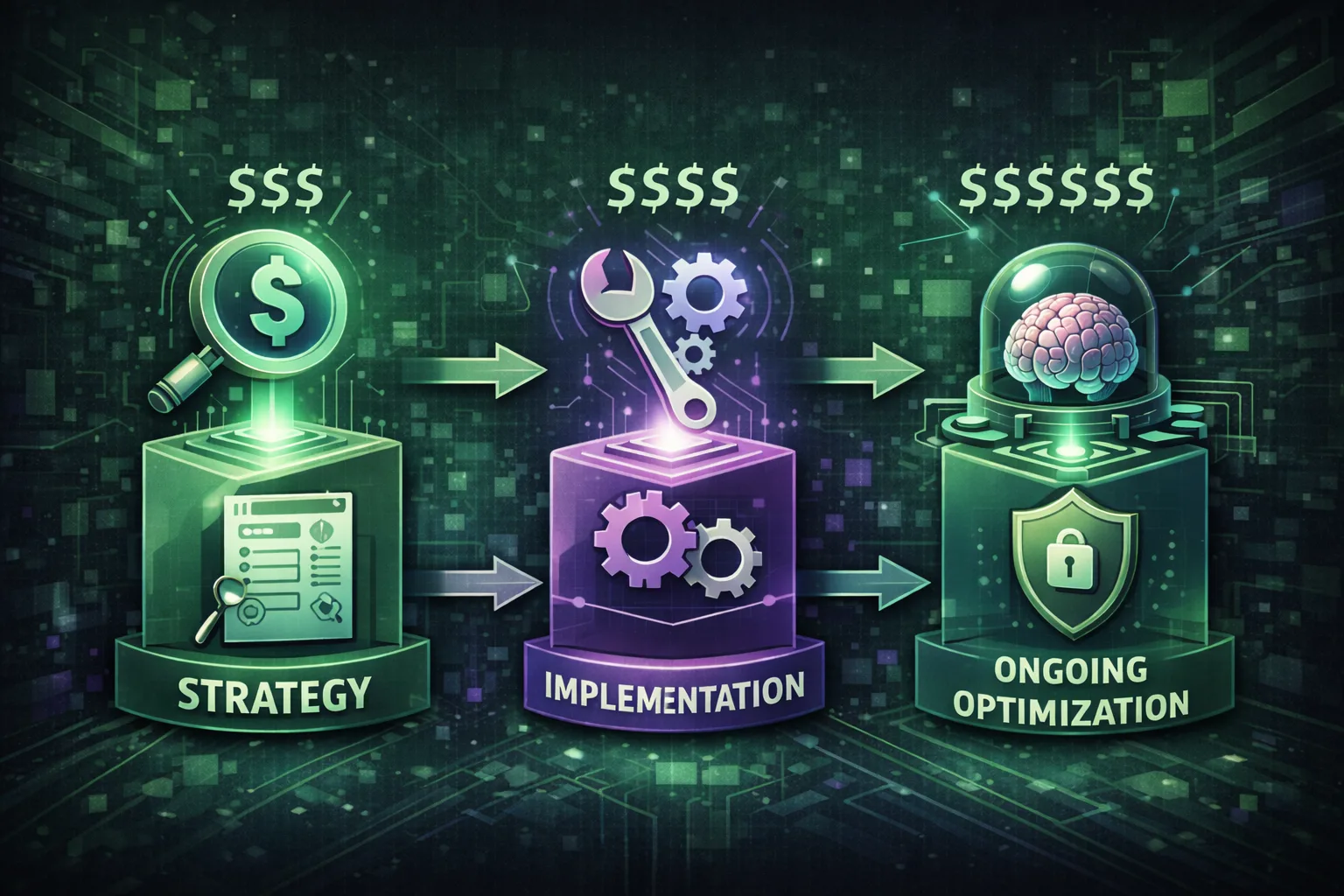
Early Stage (Pre-Validation)
At this stage, SEO isn’t about growth.
It’s about validation.
The goal is to understand:
- What problems people actually search for
- How they describe those problems naturally
- Which angles create engagement versus indifference
Publishing at scale before clarity usually locks in internal assumptions instead of learning from real demand.
Growth Stage
This is where SEO begins to compound, when aligned correctly.
Effort shifts toward:
- Content reflecting real sales and customer conversations
- Pages answering high-intent questions
- Structural improvements that help AI systems summarize your positioning accurately
The main risk here isn’t under-investment. It’s overproducing educational content that never influences decisions.
Scale Stage
SEO becomes a positioning channel, not just a traffic channel.
Focus areas include:
- Category clarity
- Brand-entity association
- Consistent explanation across search results and AI answers
At this stage, SEO mistakes don’t just waste effort. They distort how the market understands you.
What SEO Effort Is Really Buying in 2026
If SEO were just about publishing content, outcomes would be predictable. They aren’t.
Modern SEO includes:
- Intent diagnosis
- Content consolidation and pruning
- Entity reinforcement
- AI extractability tuning
You are paying for judgment, not output.
That’s why two teams investing similar effort can see dramatically different results. One builds trust and demand. The other builds noise.
Why ROI Timelines Vary So Widely
SEO results aren’t delayed because platforms move slowly.
They are delayed because teams hesitate to correct mistakes.
Common patterns:
- Topic clusters that should have been killed early
- Pages are trying to serve multiple intents, and serving none
- Early content that never gets rewritten
The fastest improvements often come from removal and refinement, not from publishing more.
The Hidden Cost Most Teams Ignore
The largest SEO cost in 2026 isn’t financial.
It’s narrative lock-in.
Once the wrong story about who you serve, what problem you solve, and why you exist spreads across dozens of indexed pages, correcting it becomes costly, regardless of future effort.
How to Think About SEO Cost Properly
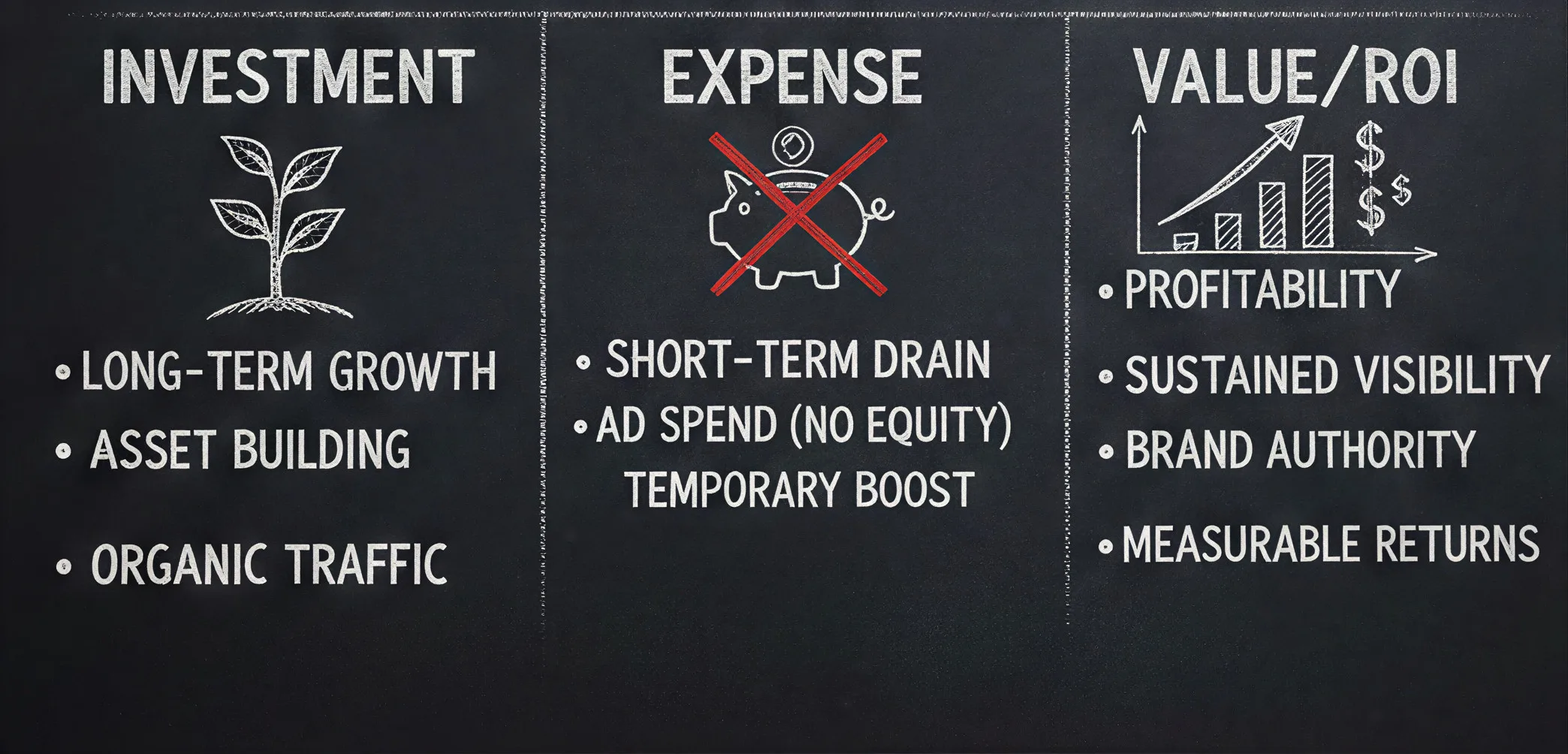
Before asking, “How much should we invest in SEO?” ask:
- What do we still not understand about our buyers?
- Which decisions should SEO influence?
- How quickly can we change direction when something isn’t working?
SEO works when it funds learning first and scales second. Everything else appears efficient until you realize you have been reinforcing the wrong assumptions for months.
A Better Way to Evaluate Your SEO Direction
If you are unsure whether your SEO effort is building clarity or just creating motion, you don’t need a new package or more output.
You need to pressure-test the assumptions behind what you are already doing.
We use a short diagnostic to understand:
- Which buyer assumptions your SEO is reinforcing
- Where intent mismatch may be costing you time and pipeline
- Whether your current setup can correct course fast enough in AI-driven search
There’s no pitch and no obligation, just a focused conversation about whether your SEO decisions are compounding in the right direction.
Start the SEO decision review here: https://tally.so/r/3EGEd4
If nothing else, you should leave with clarity on one critical question: Are we learning from SEO, or just producing more of it?
FAQs
Low effort feels stagnant.
Misdirected effort feels busy but ineffective.
If visibility improves without conversions, engagement stays flat, or AI answers bypass your content, the issue is usually intent alignment, not effort volume.
Because SEO investment buys decision paths, not guaranteed results.
One team uses SEO to test language, kill weak ideas early, and refine unclear pages.
Another focuses on output volume and keyword coverage.
The compounding effect over time is dramatically different.
After core positioning and audience clarity are established.
In-house works best when buyer questions are predictable, objections are consistent, and you already know which topics influence decisions.
AI raises the cost of unclear thinking.
That includes rewriting content for clean summarization, consolidating overlapping pages, reinforcing entity signals, and maintaining consistent explanations across time.
Publishing more doesn’t increase AI visibility. Clarifying what already exists does.
Because rankings are no longer the final signal.
Pages can rank and still lose attention to AI answers. Visibility can rise while influence drops.
SEO feels slow when teams measure movement instead of decision impact.
Yes, but for learning, not scale.
Early SEO should reveal how people search, what resonates, and what falls flat. Scaling before clarity multiplies rewrite costs later.
Ask one question: “Which assumptions have we invalidated recently?”
If the answer centers on output rather than learning, the effort is a funding activity, not insight.
Because effective SEO relies on judgment, not templates.
It requires deciding what not to pursue, aligning with real buyer conversations, and explaining complex value clearly. Those decisions don’t scale cheaply.
No. It’s about reducing long-term correction costs.
Hybrid works because it surfaces wrong bets early, avoids roadmap lock-in, and allows strategy to evolve without friction.
Look for decision-level signals:
- Prospects referencing content in conversations
- Increased branded search after content launches
- Shorter sales cycles for SEO-assisted deals
- AI tools citing or summarizing your content
SEO influence appears in confidence and clarity before dashboards.
Scaling before resolving intent.
Publishing at volume without clarity creates massive content debt. Undoing that work later is far more expensive than building correctly early.
Only if it improves decisions.
Speed comes from killing weak ideas early, tightening explanations, and aligning with real questions. More activity without clarity only accelerates noise.
Any time one of these changes:
- Audience definition
- Product positioning
- Sales motion
- Category maturity
SEO structures that stay fixed while the business evolves inevitably drift.