Schema & Structured Data Tactics to Win in Google’s Generative Search Results

If you want your brand to appear inside Google’s Generative AI results (SGE), schema markup is your strongest leverage. Structured data helps Google understand, validate, and confidently surface your content in AI summaries, panels, lists, and follow-up questions.
This guide breaks down the exact schema strategies marketers should use to win visibility, trust, and conversions.
What Marketers Usually Miss
Most marketers still treat schema as “technical SEO housekeeping,” but the landscape has shifted. Today, schema isn’t just about helping Google crawl a page; it’s about assisting AI models in interpreting meaning, understanding relationships, and determining which entities deserve to be cited.
Here’s what many teams overlook:
- Schema isn’t about ranking; it’s about semantic clarity.
- SGE only cites content it can map to credible entities.
- Basic FAQ/How-To schema is no longer enough.
- Without structured data, Google struggles to determine topical expertise and trust.
Generative search is shifting from keywords to meaning, and schema is the mechanism that feeds Google’s AI the structured context it needs.
As many SaaS marketers have already pointed out in industry discussions, the shift to entity-based results is causing widespread performance gaps, especially in AI-powered SERPs.
Many teams in communities like r/SaaS have said their websites are losing ground because they aren’t adapting to how SGE rewrites the discovery process:
SEO is shifting and most SaaS teams are behind. Here’s what we’re doing instead.
byu/Fantastic-Control-87 inSaaS
Others analysing CTR drops on r/SEMrush are noticing that SGE isn’t just reducing clicks, it’s prioritising structured, entity-rich content over traditional ranking pages:
SGE is here – Your CTRs aren’t just slipping – they’re vanishing.
byu/Level_Specialist9737 inSEMrush
These real-world observations reinforce one truth:
Schema is now the core layer of SGE optimisation.
Core Insight- The 5-Part Schema Framework for SGE Visibility (Thrillax Method)
To appear consistently inside AI-generated answers, your website needs a structured data system, not scattered markup. Here’s the Thrillax framework we use across client projects:
1. Entity-Level Schema (Strengthen Who You Are)
Goal: Build a clear, authoritative entity profile.
Implement:
- Organization
- LocalBusiness (if relevant)
- SameAs
- Logo
- Brand
- WebSite + SearchAction
Why it matters:
SGE only pulls results from entities it trusts. Strong entity markup increases your chances of being cited in AI summaries, comparisons, and recommendations.
2. Page-Level Schema (Explain What Each Page Means)
Every page should explicitly define:
- Topic
- Intent
- Content type
- Author
- Expertise
Use:
- Article
- BlogPosting
- FAQPage
- HowTo
- Service
- Product
Thrillax Tip:
Assign one primary schema type per page for clearer classification.
3. Supporting Schema (Depth = Trust)
Additional layers of schema strengthen verification:
- Review
- Rating
- BreadcrumbList
- VideoObject
- ImageObject
- Dataset
- Event
- Person
SGE prefers structured, interconnected information; supporting schema provides exactly that.
4. Topical Authority Schema (Create a Semantic Graph)
This is where most brands underperform.
Add:
- About
- Mentions
- knowsAbout
- subjectOf
When Google detects consistent schema patterns across related pages, it recognises topical authority, which increases your likelihood of being featured in SGE snapshots.
5. Conversion Schema (Turn Visibility Into Leads)
Schema isn’t just for visibility; it boosts conversions.
Add:
- Form
- ContactPoint
- Offer
- LeadAction
These help your CTAs appear directly inside AI-generated panels, dramatically increasing click-through and lead submissions.
If you also want to improve how your content performs inside AI Overviews and SGE responses, explore our detailed guide on optimising content for Google’s SGE.
Schema Types Mapped to SGE Opportunities
| Goal in SGE | Best Schema Types | Why It Helps |
|---|---|---|
| Appear in AI summaries | Article, BlogPosting, FAQPage | Adds clarity, author data, and topical intent |
| Be cited as an expert entity | Organisation, SameAs, Person | Strengthens entity trust |
| Show up in product/service lists | Product, Service, Review | AI understands attributes + ratings |
| Boost lead submissions | Form, ContactPoint, LeadAction | Makes CTAs recognisable in AI panels |
| Strengthen topical authority | About, Mentions, knowsAbout | Builds semantic clusters |
Real Marketing Scenarios
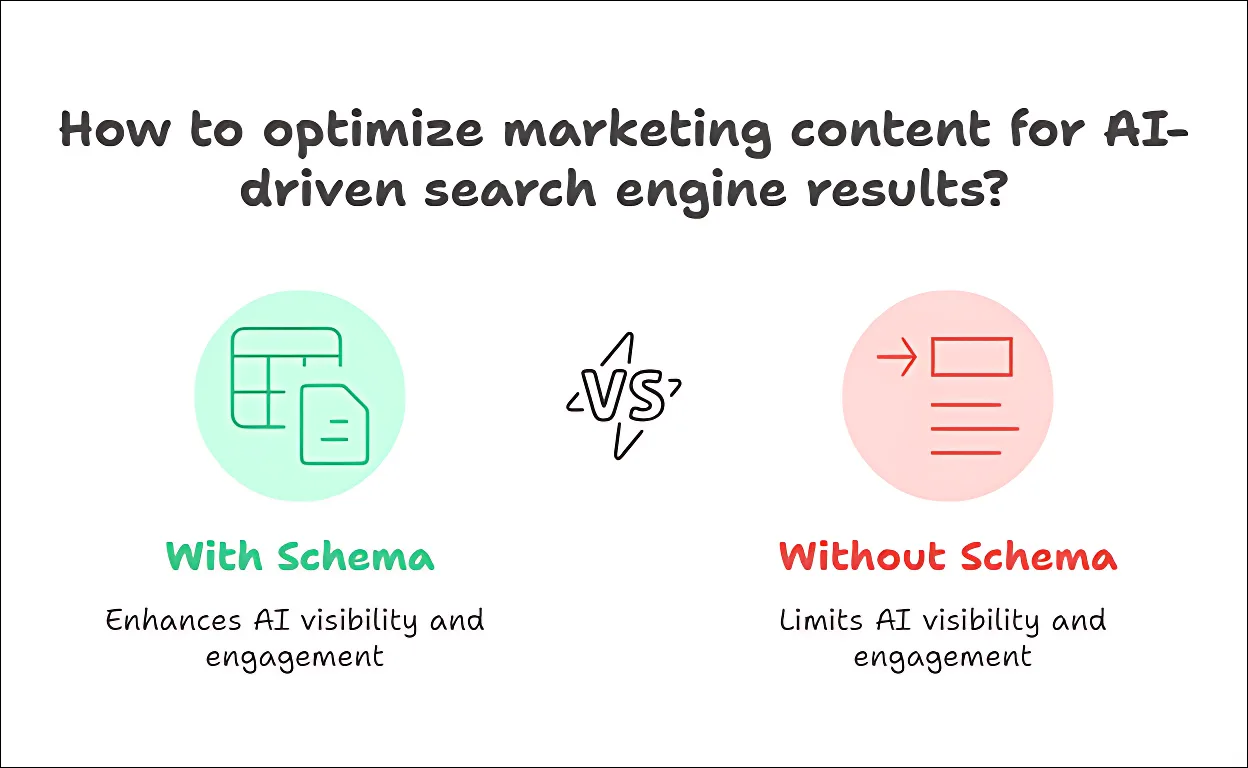
Example 1: Blog on “Best CRM Tools for Startups”
With schema:
Google can pull your comparison table, pricing, pros/cons, and brand descriptions into AI-generated lists.
Without schema:
Google sees it as an unstructured blog.
Example 2: Lead-Gen Landing Page
With Form + ContactPoint schema:
Your form may show up as a CTA inside an SGE panel.
Without schema:
SGE defaults to competitors with cleaner structured signals.
Get Your Schema Strategy Ready for AI-Led Search
SGE doesn’t reward guesswork; it rewards structured truth.
If your brand wants to appear inside AI-generated answers, you need a schema that clarifies meaning, connects entities, and helps models verify who you are. At Thrillax, we map your schema gaps, strengthen your entity signals, and align your content with how AI now interprets information, not how SEO worked in 2022.
Why this matters now:
- AI-assisted search prefers structured clarity, not unformatted content
- Schema accelerates entity understanding, which decides if AI cites you or skips you
- SGE increasingly pulls answers from brands with verified context, not just rankings
- Most teams are adding schema, but very few are building a schema system across the site
- Your entities, your metadata, your consistency, your external proofs, they determine whether Google’s AI uses your content as a source.
Winning in AI search is no longer about adding more pages.
It’s about making every page understandable, verifiable, and semantically rich.
Fixing this isn’t guesswork.
It’s a process.
If you are ready to see where your structured data stands today, what’s missing, what’s conflicting, and what’s blocking AI visibility, start by sharing your schema and entity challenges here: https://tally.so/r/3EGEd4.
FAQs
Because SGE doesn’t evaluate schema alone, it checks if the schema aligns with the actual page meaning, your brand entity, and external sources.
If your schema is technically correct but semantically shallow, SGE ignores it.
Yes. If your schema claims “Product,” but the content reads like a blog, SGE reduces trust.
Mismatches degrade your eligibility for citations.
A lot. SGE relies on entity graphs, not isolated pages.
If your Organisation, Person, Product, and Article schemas are not linked through author, brand, about, or mentions, AI models cannot map your expertise.
Yes, severely. AI models depend on cross-web validation.
If your brand lacks SameAs links to directories, social profiles, docs, GitHub, or knowledge bases, AI models treat your entity as low-confidence.
Yes. SGE cites pages that provide structured, stable facts, definitions, steps, lists, and numbers. Schema strengthens factual grounding and reduces hallucination, making your brand a safer citation.
Because SGE prioritises clarity > ranking > backlink volume.
Competitors who provide structured, concise, contextualised answers are easier for AI to include, even if their SEO authority is lower.
Yes. If key pages have outdated metadata, inconsistent schema, or missing entity links, AI models struggle to map your topical authority and may suppress all related pages.
Check:
- Whether AI tools summarise your brand accurately
- Whether your founder/product appears together in queries
- Whether models maintain consistent naming/description
If answers vary, your entity graph is weak or conflicted.