Your Funnel Is Backwards: The Search-to-Sale Alignment Model
“Your content creates awareness. Your sales team closes deals. And there’s a massive gap between them.”
Sound familiar? Your marketing team produces blog post after blog post, mostly “what is X?” or “top tips” content. Meanwhile, sales is fielding calls full of questions like “How much does this cost?” or “Which product fits my team size?”
Most companies have a backwards funnel:
- 80% awareness content (TOFU)
- 15% consideration content (MOFU)
- 5% decision content (BOFU)
But real buyers spend their time differently:
- 10% in awareness
- 20% in consideration
- 70% in decision stage
The result? You are creating content for the stage where buyers spend the least time. The Search-to-Sale Alignment Model fixes this by flipping your content strategy to meet buyers where they actually search and convert.
Why Traditional Funnels Don’t Match Search Behaviour
The classic marketing funnel assumes a linear path:
TOFU → MOFU → BOFU
The assumption: buyers start at awareness and move step by step toward a decision.
The reality: search data shows otherwise. Buyers jump in at different stages:
- “What is CRM?” → TOFU (early awareness)
- “Best CRM for small business” → MOFU (comparing options)
- “HubSpot vs Salesforce pricing” → BOFU (ready to buy)
Where buyers actually enter:
- 15% start at awareness
- 35% start at consideration
- 50% start at decision
Most companies’ content mix: 70% TOFU, 20% MOFU, 10% BOFU
Optimal mix based on real search behaviour: 20% TOFU, 30% MOFU, 50% BOFU
This pattern, where buyers enter mid‑ or bottom‑funnel search behaviour and skip awareness content, echoes insights from our analysis in Content Velocity Trap, where we observed that high‑volume content focused on generic topics often fails to capture buyer intent or drive conversions.
The Search-to-Sale Alignment Model
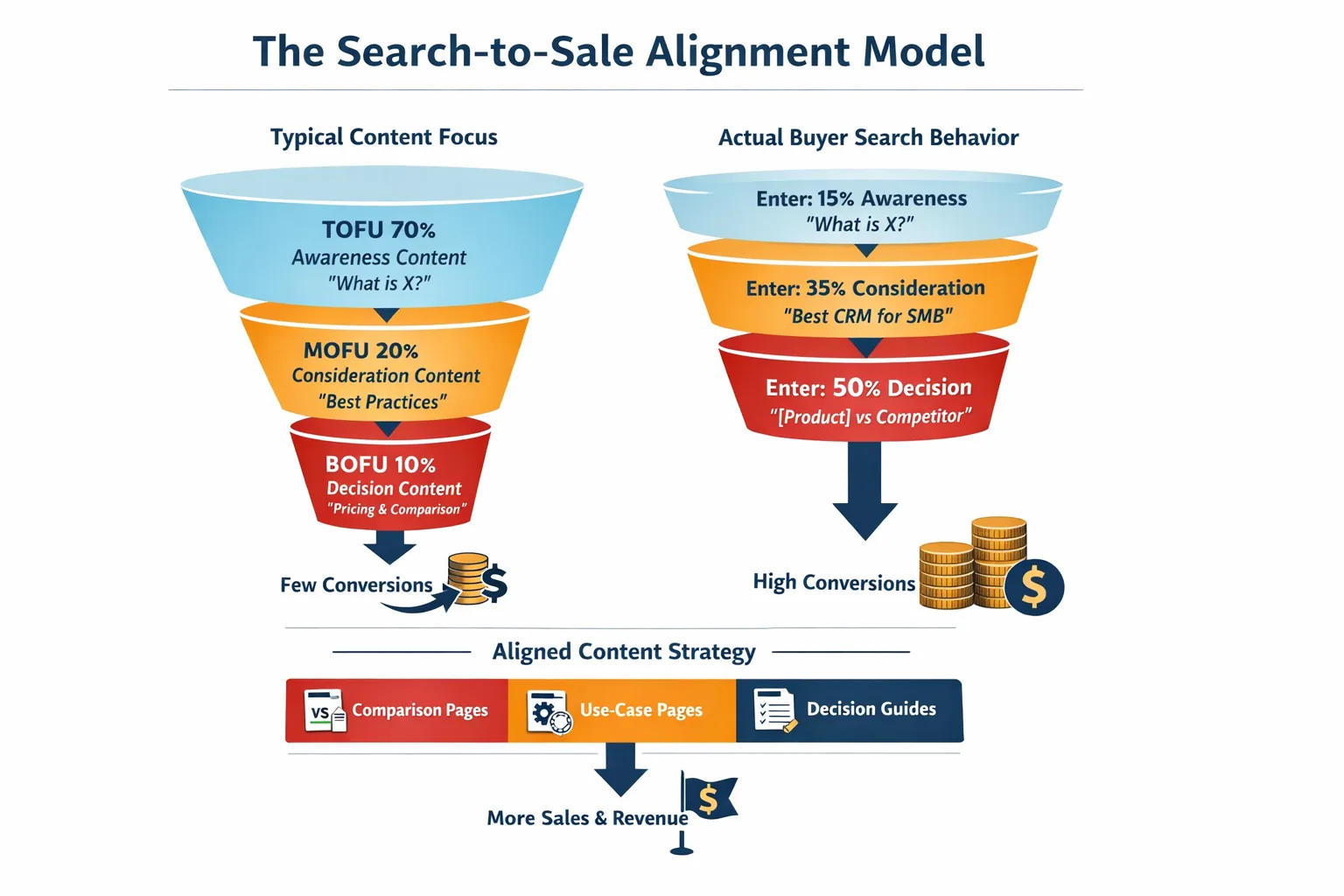
Instead of creating content based on “funnel stages,” build it around real buyer questions mapped to search queries.
Step 1: Interview your sales team
Ask questions like:
- What questions do prospects ask first?
- What objections come up repeatedly?
- What comparisons or alternatives do they consider?
- What terms do they use, not your marketing jargon?
Document 20-30 real questions.
Example: “How much does this cost?” shows buyers searching “[Product] pricing”
Real practitioners confirm this alignment problem isn’t theoretical. One founder reported building over 1,000 pieces of content that never converted, and found the root issue was a mismatch between the content and the buyer’s current stage of awareness.
Once they generated content based on actual buyer needs, inbound leads increased significantly.
I built 1,000+ pieces of content that didn’t convert, here’s what finally fixed it
byu/Spiritual_Heron_5680 inbuildinpublic
Step 2: Map questions to search queries
| Sales Question | Search Query | Volume |
|---|---|---|
| How much does this cost? | [product] pricing | 2,400/mo |
| How is this different from [competitor]? | [you] vs [competitor] | 880/mo |
| Can it integrate with [tool]? | [product] [tool] integration | 320/mo |
This ensures content isn’t guessing; it aligns with real buyer intent.
Step 3: Identify content gaps
For each query, check:
- Do you have content answering this?
- Is the content strong and authoritative?
- Does it rank or provide value?
Insight: Most companies discover 60-70% of sales questions have no content, representing missed opportunities.
Step 4: Prioritise by search + sales value
| Search Volume | Sales Value | Priority |
|---|---|---|
| High | High | 1 |
| High | Low | 2 |
| Low | High | 3 |
| Low | Low | 4 |
Focus first on Priority 1 & 3:
- High-volume, high-intent queries that convert
- Low-volume, high-sales-value queries that close deals
These are high-leverage content opportunities.
Step 5: Create Content for High-Leverage Opportunities
Types of content that directly drive sales:
- Comparison Content (BOFU) → 8-15% conversion
- Use-Case Specific Content (MOFU/BOFU) → 5-10% conversion
- Decision-Support Content (BOFU) → 6-12% conversion
This approach ensures content is purposeful, not just published for volume.
SEO experts often point out that BOFU keywords don’t scale traffic; they scale revenue. Prioritising queries like “[product] pricing,” “[competitor] comparison,” and “[category] alternatives” aligns SEO with sales outcomes, driving higher conversions than generic awareness content.
BOFU keywords don’t scale traffic. They scale revenue. Most SEOs still miss this.
byu/Sad-Bake-484 inAgent_SEO
The Three Content Types That Actually Drive Sales
Type 1: Comparison Content (BOFU, Highest ROI)
- Buyer knows category, comparing options
- Keywords: “[You] vs [Competitor]”, “Best [category] for [use case]”, “[Competitor] alternative”
- Structure: Honest comparison, feature breakdown, pricing, and decision framework
- Conversion rate: 8-15%
Type 2: Use-Case Specific Content (MOFU/BOFU)
- Buyer segment-focused, less competitive
- Keywords: “[Solution] for [industry]”, “[Solution] for teams of 10-50”
- Structure: Segment pain points → Solution → Case study → Pricing → Implementation
- Conversion rate: 5-10%
Type 3: Decision-Support Content (BOFU)
- Addresses objections, helps make final decisions
- Keywords: “How to choose [category]”, “[Product] implementation guide”, “Is [product] worth it?”
- Structure: Evaluation criteria, pitfalls, ROI, options comparison
- Conversion rate: 6-12%
Rebalancing Your Funnel
Current content audit:
- Export all posts/pages
- Tag as TOFU/MOFU/BOFU
- Calculate traffic and conversions
Typical patterns:
- 70% TOFU → 80% traffic → 10% conversions
- 10% BOFU → 5% traffic → 60% conversions
Insight: High volume of awareness content drives traffic but not revenue.
Rebalancing Plan:
Immediate (Month 1-2):
- 5-10 comparison pages (BOFU)
- 5-10 use-case pages (MOFU/BOFU)
Short-term (Month 3-6):
- Shift content mix → 50% BOFU, 30% MOFU, 20% TOFU
Long-term (Month 6-12):
- Audit TOFU content → consolidate or remove underperformers
- Double down on content that actually closes deals
Focus on revenue per piece, not volume of pieces.
If Your Funnel Feels Misaligned
If your content calendar is full but conversions lag, the issue may not be effort; it’s direction.
Some teams need:
- Clarity: understand which content actually moves buyers
- Re-prioritisation: stop TOFU-heavy content and invest in decision-stage content
- Data alignment: connect search intent to real sales questions
If you want to map your sales conversations to search queries, share context here: https://tally.so/r/3EGEd4
No pitch, no automated audit. Just a short form to help identify content gaps and whether a conversation makes sense.
Flip Your Funnel
Most companies create content for people not ready to buy and wonder why conversions are low. The fix: focus on the stage where buyers actually enter the funnel.
Your sales team already has these conversations. Turn them into content. Map real search queries to actual sales questions. Create comparison, use-case, and decision-support content that closes deals, not just drives traffic.
Action step: Interview your sales team this week. Ask for their top 10 most common questions; these are your next 10 content pieces.
Common Questions About Aligning Content With the Buyer Journey
Check whether your content maps to real sales conversations and measurable outcomes. If most organic traffic happens at the awareness stage but leads and revenue stay flat, your content is likely misaligned with buyer needs. Look at search query intent, inbound form submissions, and where conversions actually happen.
TOFU content drives awareness but rarely converts because it answers very early, low‑commitment questions. Buyers in later stages, who are closer to purchase, search for comparison, pricing, use‑case, and objection‑handling content. Without decision‑stage content, your traffic won’t translate to revenue.
Yes. High volume doesn’t always mean high intent. A keyword like “what is CRM” may attract thousands of visits, but decision‑stage terms such as “CRM pricing” or “[product] vs [competitor]” often generate fewer visits but much higher conversion rates because searchers are closer to purchase.
Prioritize pieces that address sales questions with measurable impact: decision‑stage content that matches high‑value search queries, or use‑case content tied to specific buyer segments. These often outperform high‑volume awareness content in revenue per visit and pipeline contribution.
Not when done strategically. Decision‑stage content often incorporates keywords that strengthen your domain’s authority across related topics. When content answers real buyer questions and sales objections, it gains links, shares, and long‑term value, not just short‑term traffic.