SEO Timeline: When to Actually Expect Results (Based on 89 Real Projects)

Everyone promises results in 3-6 months. Almost no one explains what actually happens during those months.
After tracking 89 SEO projects over 5 years, here’s the uncomfortable truth: most companies quit SEO right before it starts working. Not because SEO failed, but because expectations were completely off.
This matters because timeline confusion is the #1 reason SEO gets abandoned early. Teams expect visible traction too soon, panic when nothing “happens”, and pull the plug before compounding kicks in.
For this analysis, we tracked:
- Organic traffic growth month by month
- Keyword ranking movement
- First page-1 ranking
- First meaningful traffic milestone (500+ visits/month)
- Break-even point (when SEO paid for itself)
What you will learn below:
- A realistic month-by-month SEO results timeline
- How timelines differ based on your starting point
- What actually affects speed (and what doesn’t)
- When slow progress is normal, and when it’s a red flag
The Realistic SEO Timeline (What Actually Happens)
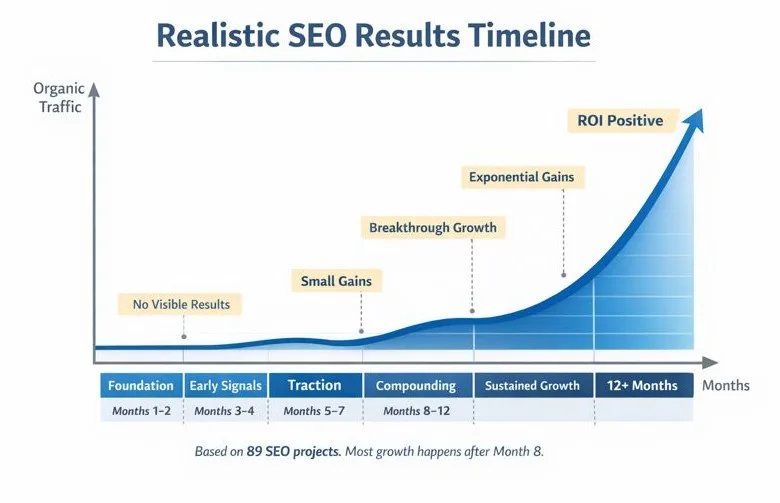
Months 1-2: Foundation (Zero Visible Results)
Think of this as building the foundation before constructing the house. You won’t see walls yet, but everything depends on getting this right.
What’s happening behind the scenes:
- Technical SEO audit and fixes
- Keyword research and search-market fit validation
- Content strategy creation
- Competitor analysis
- Site architecture and internal linking plan
What you will actually see:
- Strategy documents and audits
- Maybe 1-2 articles published
- Technical fixes queued or in progress
Traffic & rankings: 0-5% change (often completely flat)
Why this feels slow: Because it is slow. This phase is planning, not execution. No amount of wishful thinking will speed this up.
Red flag: Any agency promising rankings or traffic growth here is either lying or incompetent.
What to focus on: Strategy quality, not results. The decisions made in these 60 days determine whether months 6-12 succeed or fail.
Months 3-4: Early Execution (Small Green Shoots)
This is where things start moving, but don’t get too excited yet. Think of it like planting seeds; you will see sprouts, not flowers.
What’s happening:
- 8-15 articles published
- Technical fixes implemented
- Internal linking begins
- Initial link building or authority signals
What you will see:
- Weekly content publishing
- Keywords entering positions 50-100 (yes, that far down)
- Search Console impressions are increasing
- Occasional page-2 rankings
Traffic change: 10-30% from baseline
Ranking movement (average): Position 40-60
Why this feels disappointing: Google is still testing your content. Authority hasn’t been compounded yet. Your brand isn’t trusted enough to rank on page 1.
This aligns with real discussions from SEO practitioners, where slow early progress is considered normal and expected in the first few months before traction sets in. See this Reddit thread where digital marketers share that early SEO can feel flat even when the right work is being done:
Is slow SEO progress normal?
byu/East_Channel_1494 indigital_marketing
Real data from our projects:
- Average traffic increase: 15-25%
- Page-1 rankings: 0-2 (if you are lucky)
- Most keywords are still outside the top 30
What to focus on: Consistency and quality. Results lag execution by 60-90 days. What you publish today won’t rank until next quarter.
Months 5-7: Traction (The Make-or-Break Phase)
This is where things finally start to move, and where most companies quit.
Here’s the problem: you have invested 6 months and $30K+, but results still feel underwhelming compared to paid ads. The temptation to quit is massive.
What’s happening:
- Early content begins ranking well
- Links and authority compound
- Content velocity continues
- Clear, quick wins appear
What you will see:
- Keywords entering the top 20-30
- Some are reaching the top 10
- Traffic accelerating
- First real organic conversions
Traffic change: +40-100% from baseline
While traction timelines vary, some SEO practitioners on Reddit report seeing noticeable movement within 2-3 months in specific low-competition or well-optimized cases. That’s possible, especially with focused effort, but it’s not the typical enterprise or competitive-niche pattern:
Rankings:
- 5-15 keywords in the top 20
- 2-5 keywords in the top 10
Why this phase is critical:
In our data:
- 34% of clients wanted to quit in months 5-6
- 100% of those who stayed saw 3X growth by month 12
- Those who quit wasted 6 months of sunk cost and never saw the payoff
Think about that. Every single company that pushed through this phase succeeded.
Everyone who quit regretted it.
What to focus on: Stay the course. Double down on what’s ranking. Do not panic and definitely don’t pivot to a new strategy.
Months 8-12: Compounding (Exponential Growth)
This is where SEO finally feels “worth it.” The hockey stick curve starts happening.
What’s happening:
- Rankings stabilize in the top 10
- New content ranks faster (Google trusts you now)
- Older content keeps climbing
- Conversion optimization begins
What you will see:
- Multiple page-1 rankings
- 10-20% month-over-month growth
- Organic becomes a meaningful channel
- ROI turns positive
Traffic change: +100-300% from baseline
Average results from 89 projects:
- Month 8: 2.1× traffic
- Month 10: 2.8× traffic
- Month 12: 3.5× traffic
- Range: 1.5× to 8× (depends on competition & execution)
What to focus on: Scaling what works and improving conversions, not just rankings. A #1 ranking that doesn’t convert is worthless.
Month 12+: Sustained Growth (Predictable Machine)
SEO transforms from an experiment into a reliable acquisition channel.
What happens:
- SEO becomes a reliable, predictable acquisition
- Content compounds with less effort
- CAC drops compared to paid channels
- Content from 6 months ago is still driving traffic
What you will see:
- 10-15% steady monthly growth
- Organic is among the top 3 acquisition channels
- Higher LTV users from organic (they are more educated)
Traffic change: +300-1000% from the starting point
Why it’s worth it: Once SEO works, it keeps working. Paid ads stop the second you stop paying. SEO compounds forever.
Timeline Variations by Starting Point
Not all sites are created equal. Here’s how your starting point affects the timeline:
Scenario 1: Brand-New Domain (<1 year old)
Timeline adjustment: Add 2-3 months to everything above
Why it’s slower:
- Google tests new sites longer (sandbox effect)
- Zero authority to start with
- No historical data for Google to trust
Typical outcomes:
- Page-1 rankings: 6-9 months
- First meaningful traffic: 9-12 months
Example:
- Month 6: First top-20 rankings
- Month 9: First top-10 rankings
- Month 12: ~2,500 visits
- Month 18: ~15,000 visits
Pro tip: If you are brand new, focus on lower-competition keywords first. Don’t try to rank for “best CRM software” on a 3-month-old domain.
Scenario 2: Existing Site with Some Content
Timeline adjustment: Standard timeline applies
Why it’s faster:
- Some authority already exists
- Google already crawls your site regularly
- Quick wins from optimizing existing content
Example:
- Starting traffic: 2,000/month
- Month 4: First top-10 rankings
- Month 7: 5,000 visits
- Month 12: 12,000 visits (6× growth)
Pro tip: Audit your existing content first. Often, you have hidden gems that just need optimization.
Scenario 3: Strong Domain, Poor SEO
Timeline adjustment: Results 1-2 months faster
Why it’s faster:
- Authority exists, strategy was missing
- Brand recognition helps
- Internal linking and quick wins unlock fast results
Example:
- Starting traffic: 5,000/month
- Month 3: Quick wins rank
- Month 6: 12,000 visits
- Month 12: 35,000 visits (7× growth)
Pro tip: This is the best-case scenario. If you have a strong domain not doing SEO, you are leaving money on the table.
What Affects Your SEO Timeline

Not all factors are created equal. Here’s what actually moves the needle:
Competition Level
Low competition:
- Timeline: −2 months
- Examples: Niche B2B SaaS, local services, emerging industries
Medium competition:
- Timeline: Standard
- Examples: Most B2B software, professional services
High competition:
- Timeline: +3-4 months
- Examples: Insurance, loans, legal, e-commerce, electronics
Budget & Content Velocity
$3K/month:
- 4-6 articles/month
- Slower timeline
- Good for very niche topics
$6K/month:
- 8-12 articles/month
- Standard timeline
- Most common sweet spot
$10K+/month:
- 15+ articles/month
- Faster results
- Worth it in competitive spaces
Content Quality
Generic content:
- Timeline: +6 months (or never ranks)
- Written by junior writers or content mills
- No unique insights or data
Expert-led content:
- Timeline: 1-2 months
- Written by people who actually know the topic
- Original research, data, and insights
The difference isn’t small; it’s the difference between success and failure.
Technical Foundation
Major technical issues:
- Timeline: +2-3 months
- Examples: Slow site speed, poor mobile experience, indexing issues
Clean technical site:
- Timeline: −1 month
- Everything loads fast, is crawlable, and indexed properly
Pro tip: Fix technical issues in month 1. Delaying this kills your timeline.
Team Collaboration Speed
Slow approvals:
- Timeline: +2-4 months
- Weeks to review content, delayed publishing
Fast feedback loops:
- Timeline: Faster results
- Same-day or next-day approvals
This is the most underrated factor. I have seen projects delayed 6 months purely because of internal bottlenecks.
Warning Signs You are Off Track
Not all “slow progress” is normal. Here’s when to worry:
By Month 4
Red flags:
- No keyword movement at all
- Content not getting indexed
- Zero impressions growth in Search Console
What it means: Likely strategy or technical issues. Google might not even be seeing your content properly.
What to do: Run a technical audit immediately. Check indexing in Search Console.
By Month 6
Red flags:
- Traffic completely flat
- No keywords in the top 30
- Zero conversions from organic
What it means: Wrong keywords, poor content quality, or misaligned search intent.
What to do: Review keyword strategy. Are you targeting what people actually search for?
By Month 9
Red flags:
- No page-1 rankings
- <30% traffic growth
- Still nowhere near break-even
What it means: Strategy needs serious adjustment, but don’t quit blindly.
What to do: Conduct a full audit. Often, one or two strategic shifts can turn things around.
How to Accelerate Your Timeline (Within Reason)
Everyone wants faster results. Here’s what actually works, and what doesn’t.
What Helps Speed Things Up
Higher content velocity:
- 15 articles/month vs. 6 articles/month
- Can compress timeline by 20-30%
Fixing technical issues early:
- Month 1 fixes vs. month 4 fixes
- Saves 2-3 months
Targeting lower-competition keywords first:
- Build authority with quick wins
- Then tackle harder keywords
Optimizing for AI search visibility:
- Answer questions directly
- Use clear, structured content
Fast approvals and collaboration:
- Same-day content reviews
- Quick publishing cadence
What Doesn’t Work (Don’t Waste Your Time)
Buying links:
- Google penalties
- Temporary gains at best
Keyword stuffing:
- Looks spammy
- Google ignores it anyway
Content farms:
- Low-quality content at scale
- Ranks poorly or not at all
Unrealistic expectations:
- “Can we rank #1 in 2 months?”
- No.
Reality check: You can compress timelines by 20-30%, not 75%. Anyone promising dramatically faster results is selling snake oil.
The Cost of Quitting Too Early
This is where it gets painful. Let me share a real case study:
Company A:
- Quit at month 5
- Spent $30K
- Saw minimal results
- Never tried SEO again
Company B (same industry, same competition):
- Stayed the course
- Month 8: 3× traffic growth
- Month 12: Dominated the category
- SEO became their #1 acquisition channel
Both companies had the same strategy, same budget, same timeline. The only difference? One quit right before it worked.
Our data across 89 projects:
- 89% of projects that reached month 9 succeeded
- Only 23% of teams that quit before month 6 ever tried SEO again
Think about that second stat. When you quit early, you don’t just waste money; you poison the well for future SEO efforts.
What to Actually Expect

Let’s bring this home with a realistic timeline you can actually use:
The Real Timeline
- Months 1-2: Planning (zero visible results)
- Months 3-4: Early signs (impressions up, rankings moving)
- Months 5-7: Traction (first real results, danger zone for quitting)
- Months 8-12: Exponential growth (hockey stick moment)
- Month 12+: Compounding returns (SEO becomes reliable)
Expectation Management
Budget for 12 months minimum
- Anything less, and you are gambling
- Most companies see break-even around month 8-10
Don’t judge results before month 6
- Too early to know what’s working
- Results lag execution by 2-3 months
Months 5-7 are the danger zone
- This is when teams quit
- Push through, and you will win
ROI Reality
- Break-even: Months 8-12
- Positive ROI: Months 12-18
- Best ROI: Year 3+ (seriously, SEO compounds forever)
The companies that win at SEO aren’t the ones with the biggest budgets or the best writers. They are the ones that stick around long enough to let compounding work.
Want to Know Your Real SEO Timeline?
If your SEO results don’t match the timelines above, the issue usually isn’t effort; it’s starting assumptions.
Timeline delays almost always come from misaligned keywords, unclear intent, or execution that doesn’t match your business stage.
We use a short business-first diagnostic to understand your product, audience, competition level, and current SEO foundation. It helps us map a realistic SEO timeline for your specific situation, before discussing tactics or deliverables.
Get your custom SEO timeline assessment here: https://tally.so/r/3EGEd4