SEO Traffic Is Growing But Leads Aren’t: Brand vs Non-Brand Search Explained

Why Organic Traffic Looks Good But Growth Feels Stuck
“We are doing 10,000 organic visits a month.”
For most founders and CMOs, that sounds like success. But here’s the question that the number doesn’t answer:
How much of that traffic represents new demand versus people who already knew you existed?
Across B2B SaaS and service companies, the data tells a consistent story:
60-85% of organic clicks come from brand-related searches, not discovery. In other words, Google often acts as a navigation layer, not a growth engine. Prospects hear about you through sales calls, paid ads, LinkedIn, podcasts, or referrals, and then use search to find your site.
That traffic is valuable, sure. But it’s not incremental growth. It doesn’t expand your market. It just captures demand that was created somewhere else.
This article breaks down:
- How to measure brand vs. non-brand search accurately
- What do different ratios indicate about business health and growth stage
- Why 80/20 brand-heavy splits are common, and risky
- What a healthy trajectory looks like for companies under $50M ARR
- How to shift SEO from demand capture to demand creation
Brand vs Non-Brand Search Explained for Founders and CMOs
This Is the Difference Between Discovery and Navigation Traffic
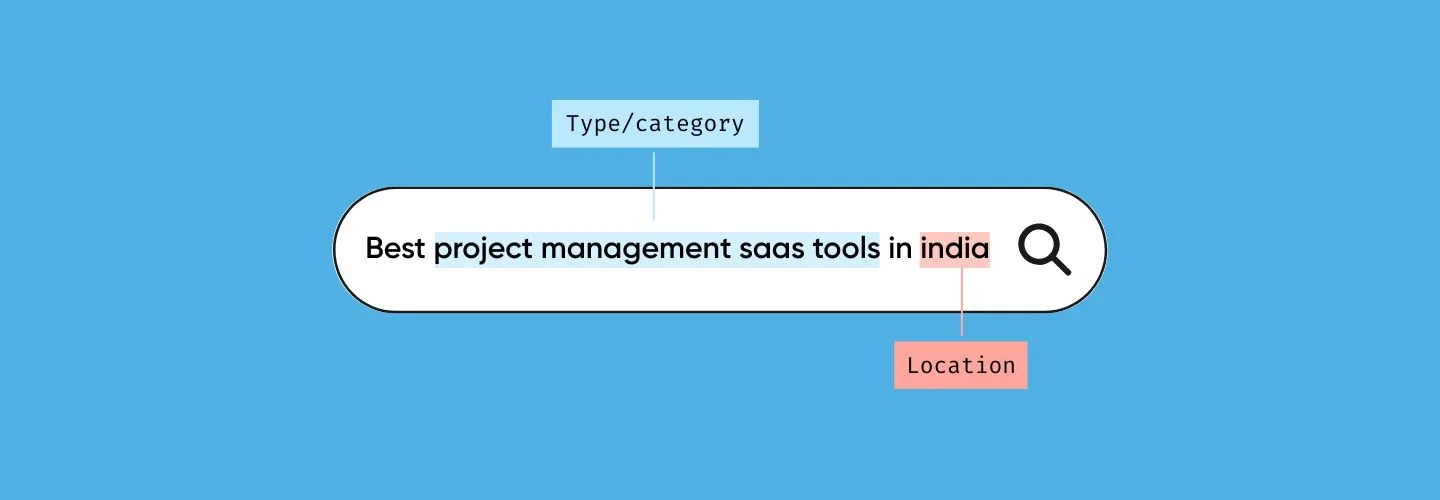
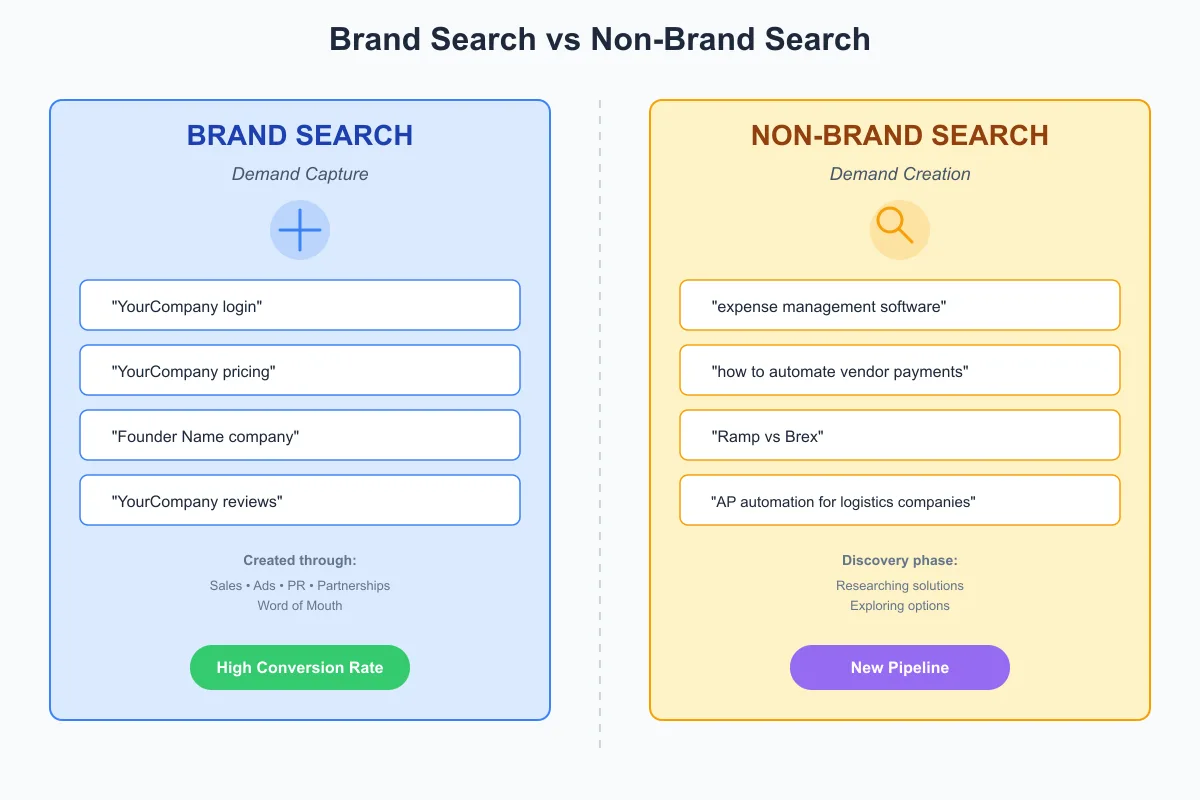
Brand search includes any query containing:
- Your company or product name
- Misspellings or variations
- Founder or flagship product names
- Queries like “login,” “pricing,” “reviews,” or “careers” are tied to your brand
These searches occur after awareness has already been created, through sales, ads, PR, partnerships, or word of mouth.
Non-brand search includes:
- Category queries (“expense management software”)
- Problem-based queries (“how to automate vendor payments”)
- Comparison queries (“Ramp vs Brex”)
- Use-case or industry modifiers (“AP automation for logistics companies”)
From a growth perspective:
- Brand search = demand capture
- Non-brand search = demand creation
Both matter, but they serve very different roles.
A common theme in SEO discussions is that branded search often gets over‑credited. As one Reddit practitioner puts it: “Branded search shouldn’t be considered a pure SEO win; it’s usually the result of other marketing efforts. True SEO wins come from non‑branded keywords.”
Do you consider branded search an SEO win?
byu/devinpickell inSEO
How to Measure Brand vs Non-Brand Traffic in Google Search Console
This analysis should be part of every quarterly growth review.
Step 1: Find Branded vs Non-Branded Queries in GSC
- Export queries and clicks from the last 12 months
- Tag queries containing your brand as brand
- Everything else is non-brand
- Calculate the percentage of total clicks
Many SEO teams point out that this is harder than it sounds due to GSC limitations and anonymized queries. One Reddit thread specifically discusses using RegEx filters to isolate brand terms while acknowledging that GSC will never give a perfectly clean split.
“You can filter branded terms out with regex, but GSC data will always be incomplete; what matters is trend direction, not precision.”
How to track brand vs. non-brand traffic
byu/HeyYouPandaBear inSEO
Step 2: Connect SEO Traffic With Leads and Revenue
Traffic alone is not the point. Compare:
- Conversion rate
- Pipeline contribution
- Revenue attribution
- Quarter-over-quarter growth of brand vs non-brand
In most accounts:
- Brand search converts 2-4× higher than non-brand
- Non-brand search contributes net-new pipeline, even at lower conversion rates
The critical signal to watch:
Is non-brand traffic growing quarter over quarter?
If it’s flat or declining while brand traffic grows, SEO is not expanding reach; it’s riding on other channels.
What Your Brand vs Non-Brand Ratio Says About Your Growth Stage
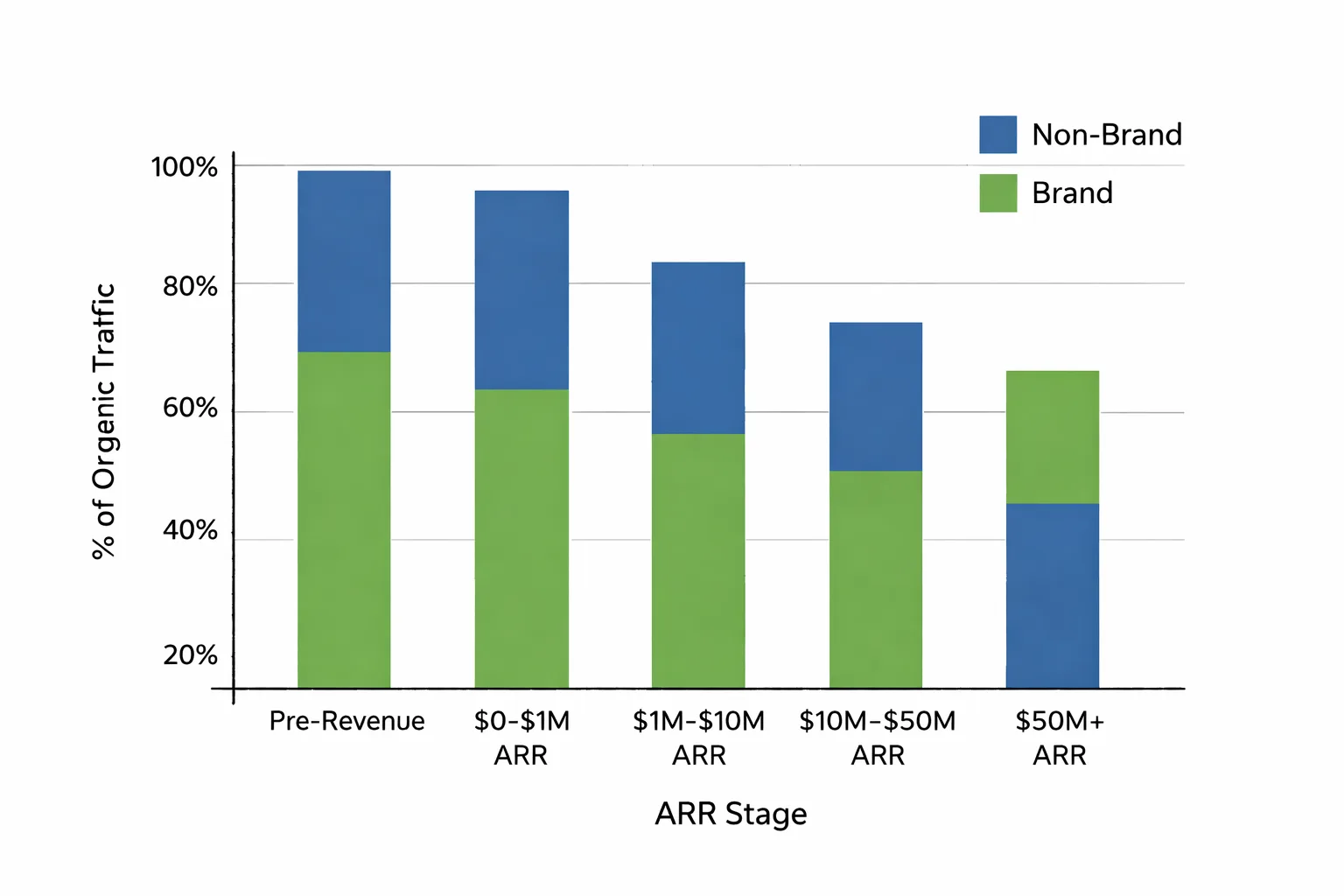
Here are the directionally healthy ranges based on patterns across B2B companies:
- Pre-Revenue / Very Early Stage: 5-10% brand, 90-95% non-brand
- Early Revenue ($0-$1M ARR): 10-20% brand, 80-90% non-brand
- Growth Stage ($1M-$10 ARR): 30-45% brand, 55-70% non-brand
- Scale-Up ($10M-$50 ARR): 50-65% brand, 35-50% non-brand
- Enterprise ($50M+ ARR): 70-85% brand, 15-30% non-brand
If you are under $50M ARR and over 75-80% brand-driven, that’s a red flag.
A recurring Reddit discussion highlights this exact issue: founders believing SEO is “working” because traffic looks strong, while discovery has actually stalled.
“We realised most of our ‘organic growth’ disappeared the moment paid ads slowed. That’s when we saw SEO was just capturing brand demand.”
AI search is killing organic traffic – how are you adapting your brand strategy?
byu/Vegetable-Rub-8241 inGrowthHacking
The SEO Red Flag Most Teams Miss Until Growth Slows
If you are under $50M ARR and:
- 75-85% of organic traffic is brand-driven
- Non-brand traffic is flat or declining
- SEO performance drops when paid or outbound slows
You do not have an SEO performance problem.
You have a discovery dependency problem.
Your growth is being fueled by:
- Paid acquisition
- Sales-led awareness
- Founder or exec visibility
In most cases, SEO is simply harvesting that awareness, not expanding it.
This creates fragility. When awareness channels slow, “organic growth” slows with them.
How to Fix Brand-Heavy SEO and Increase Non-Brand Traffic
The goal isn’t to reduce brand search; it’s to increase non-brand contribution without losing brand capture. Here’s how:
1. Stop Writing Product Pages. Start Solving Problems
Instead of “[Product] features,” create “How companies automate [problem] at scale.”
2. Why Comparison Pages Drive Non-Brand Leads
Pages like “Best [category] software for [industry],” “[Competitor] alternatives,” and “[Category] tools compared” consistently capture high-intent, non-brand demand.
3. How Category Coverage Unlocks Discovery Traffic
SEO growth accelerates when you cover adjacent problems, not just your product.
This ties closely to why branding and SEO can no longer be separated. For a deeper explanation, see our related post: Why SEOs can’t ignore branding anymore.
4. Why Most Sites Over-Focus on Bottom Funnel SEO
Brand‑heavy sites often over‑index on BOFU content.
A sustainable mix:
- TOFU: education, problems, frameworks
- MOFU: comparisons, alternatives, solution guides
- BOFU: product, pricing, implementation
5. How Long-Tail Keywords Bring Net-New Buyers
Instead of competing for “payroll software,” target “payroll software for US companies paying contractors in Mexico.”
The One SEO Question Every Founder Should Ask
The most reliable signal of SEO-driven growth is not total traffic.
It’s this question:
Is SEO bringing new buyers into the funnel who would not have found us otherwise?
For most companies between $1M-$50M ARR, a 60% brand / 40% non-brand split is a strong equilibrium:
- Brand traffic converts efficiently
- Non-brand traffic expands market reach
- SEO is not dependent on other channels to perform
When non-brand share shrinks year over year, growth ceilings follow.
If Your SEO Traffic Feels Right But Results Feel Wrong
If you are reading this and thinking, “Most of our organic traffic probably is brand-driven,” it’s worth taking a closer look.
We don’t believe every business needs more SEO work. Some need clarity. Some need re-prioritization. Some need to stop chasing vanity metrics and fix discovery at the root.
If you want to have a serious, honest conversation about:
- Whether SEO is actually creating new demand for your business
- How dependent is your growth on brand awareness from other channels
- And what role should content, search, and positioning play at your stage
You can share some context with us here: https://tally.so/r/3EGEd4
No fake promises. No lead magnets. No automated audits.
Just a short form that helps us understand what you are building, what’s not working, and whether it makes sense to talk further.
If there’s a clear fit, we’ll take it forward.
If it’s not, you will at least walk away clearer than you came in.
Common Questions About Brand vs Non-Brand SEO
If organic traffic drops when paid ads, outbound sales, or PR activity slows, your SEO is likely brand-dependent. Another signal: organic traffic growth mirrors brand search growth almost exactly, with little movement in non-brand queries over multiple quarters.
Yes. Brand search can mask gaps in category coverage, comparison pages, and problem-led content. SEO may look “successful” on dashboards while contributing very little to market expansion.
Only if non-brand traffic is still growing in absolute terms. A rising brand percentage is normal as awareness grows, but if non-brand traffic plateaus while brand traffic increases, SEO is no longer compounding; it’s just capturing.
Track first-touch attribution for organic leads. If most organic conversions have already interacted with paid ads, sales emails, or social content before searching, SEO is functioning as a follow-up channel, not a discovery engine.
Yes, just on a longer timeline. Non-brand traffic typically enters earlier in the buying journey. While conversion rates are lower, these users expand the top of the funnel and reduce long-term CAC by introducing your brand before paid or outbound channels do.
Once you are a category leader and already rank across most problem and comparison queries, usually $50M+ ARR. Before that point, flat non-brand growth is almost always a strategy issue, not a market limit.
No. Content can introduce your brand, but sustained brand search growth requires reinforcement from distribution, sales, partnerships, founder visibility, communities, or PR. SEO captures and compounds awareness; it doesn’t create it in isolation.
Quarterly. The monthly data is too noisy, annual data is too late. Quarter-over-quarter trends reveal whether SEO is compounding or stalling while there’s still time to course-correct.