Why Voice Search Is Breaking Traditional SEO in 2026
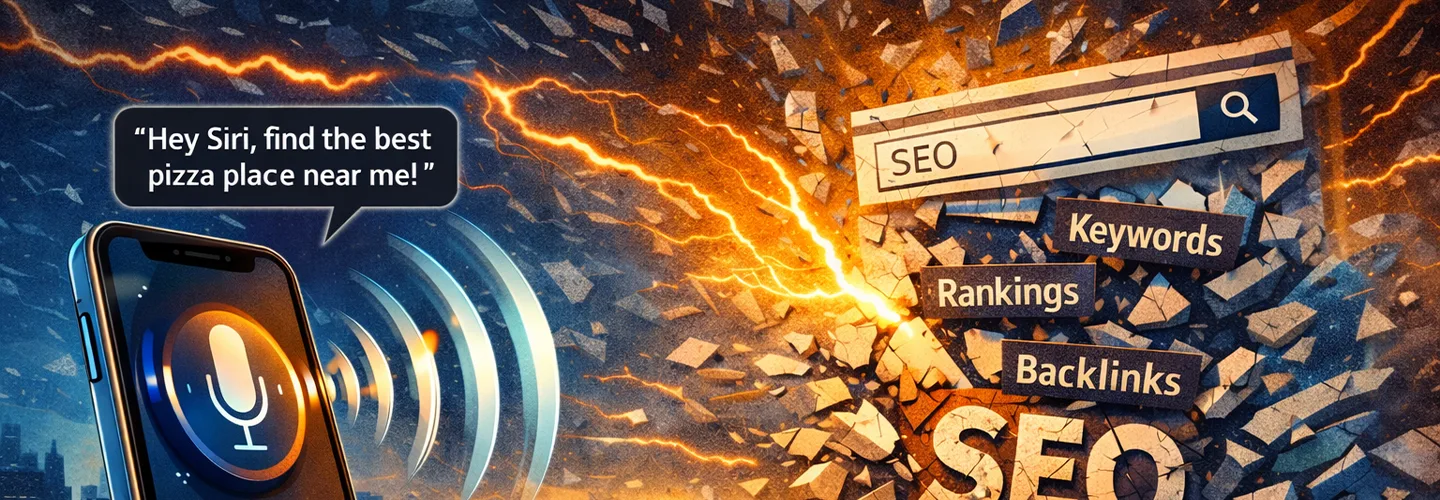
Voice search isn’t breaking SEO because everyone started talking to their phones.
It’s breaking SEO because answers are now delivered, not browsed.
Here’s what’s happening in 2026: when someone speaks a query, it gets routed through the same systems powering AI Overviews and chat-based search. The difference? Commitment.
When a user speaks a question, the system can’t hedge. It doesn’t return ten links. It delivers one explanation.
For businesses and content creators, this changes everything about visibility.
Your content can rank well and still never get spoken aloud. Voice systems only surface explanations that stand alone, resolve intent immediately, and work without visuals.
The shift: Visibility in voice search depends on explanation completeness, not keyword relevance.
What Most Teams Misunderstand About Voice Search
Most teams treat voice search as a phrasing problem.
“Just write conversationally,” they think. “Use question headings.”
That’s not it. Voice search is a selection problem.
Voice-driven AI systems don’t optimize for tone. They optimize for low-risk answers.
Before speaking anything aloud, they evaluate whether an explanation:
- Resolves the question without follow-up
- Avoids ambiguity when heard out of context
- Uses stable terminology
- Can be spoken confidently as a final answer
Common failures we see in content:
- Explanations that rely on images or screenshots
- Pages that need comparison tables to make sense
- Conditional language without clear boundaries
- Conceptual shifts across similar topics
The result?
Your content may rank. Your brand may be indexed. But your explanation never gets spoken.
Voice systems aren’t asking, “Does this page answer the query?” They are asking, “Is this safe to say out loud?”
How Voice Search Systems Evaluate Content

Voice answers are assembled, not retrieved.
AI systems don’t just find your page and read it. They:
- Extract explanations from multiple sources
- Compare how the same concept is explained elsewhere
- Prefer deterministic framing over exploratory language
- Avoid explanations that need visual reinforcement
Voice selection relies on three signals:
- Explanation stability- Does your brand explain the same idea the same way across pages?
- Verbal completeness- Can the answer be understood without charts, images, or visuals?
- Risk reduction- Does the explanation reduce ambiguity or introduce it?
If an explanation fails any of these checks, it rarely gets reused.
This reuse-based selection logic mirrors how generative answer engines decide which sources get cited. Voice search just applies the strictest version of that filter.
This is the same shift driving the move from traditional SEO toward answer-engine thinking, where visibility depends less on rankings and more on whether an explanation can be confidently selected, reused, and delivered as a final answer by AI systems. We explore this transition in detail in Turning SEO into AEO: Evolving Your Strategy for AI-Driven Search.
Why Voice Search Compresses the Buyer Journey
Typed search supports exploration. You can browse, compare, and click around.
Voice search collapses all those stages into one moment.
Spoken queries often frame entire decisions:
- How does this actually work?
- When should I use this?
- What’s the real difference here?
These questions shape how people define their problem before they evaluate solutions.
The voice answer they hear influences:
- How do they understand the topic
- What trade-offs do they see as normal
- What feels “standard” versus “risky.”
If your explanation is absent here, your later-stage SEO visibility matters less.
They have already formed their mental model without you.
The insight: Voice search shapes understanding upstream, not traffic downstream.
Why Traditional Voice SEO Advice Falls Short

The standard voice SEO advice focuses on:
- Question-based keywords
- Conversational phrasing
- Featured snippet formatting
This logic came from consumer and local search. It doesn’t work everywhere.
People aren’t just asking assistants to “find businesses near me.” They are asking systems to explain complex topics and help make decisions.
Content optimized for a friendly tone but weak on substance? It sounds approachable but feels unsafe to cite.
What actually matters: Voice systems don’t reward conversational language. They reward conceptual clarity under compression.
How Authority Is Detected in Spoken Answers
In voice interfaces, authority can’t be shown. It has to be inferred.
There are no logos, author bios, or visible citations. Authority gets judged entirely by the explanation itself.
Voice systems prefer explanations that:
- State conclusions early
- Clarify applicability boundaries
- Avoid absolutes in complex decisions
- Maintain internal consistency
Your backlinks and brand mentions still matter for initial retrieval. But final selection depends on how confidently an explanation can be spoken without qualification.
The reality: Voice search exposes weak authority faster than text search.
Why Fewer, Clearer Pages Win in Voice Search
This goes against everything we have learned about content volume.
But it’s true: voice systems don’t navigate sites. They extract answers.
This creates an advantage for teams that:
- Consolidate overlapping content
- Maintain one canonical explanation per concept
- Avoid speculative or trend-driven publishing
- Standardize terminology across all content
Publishing more pages often increases variance. Variance signals uncertainty. Uncertainty increases risk.
In voice search, clarity compounds. Volume dilutes.
How to Interpret Voice Search Impact Without Direct Metrics

Voice influence rarely shows up in analytics.
Instead, it surfaces indirectly through:
- Prospects using your exact language in sales calls
- Increased brand recall without clear referral paths
- Earlier alignment between buyer framing and your positioning
- Mentions inside AI tools without obvious traffic attribution
The absence of clear metrics doesn’t mean low impact.
It means influence now occurs before the click, before someone even visits your site.
Before You Try to Optimize for Voice Search Visibility
Most teams don’t fail voice search because they lack optimization tactics.
They fail because their explanations aren’t stable enough to be spoken confidently by AI systems.
Voice interfaces expose where your concepts drift. Where boundaries are unclear. Where answers depend too heavily on the surrounding context that won’t exist in a spoken answer.
A focused voice-search review doesn’t look at keywords or which assistants to target.
It looks at how your core ideas are interpreted when removed from the page and delivered as a single explanation.
That includes evaluating:
- Whether your primary concepts resolve intent without follow-up
- Where explanations rely on visuals or context that the voice cannot provide
- How consistently similar questions are answered across your content
- Which pages introduce ambiguity that prevents safe reuse
Want to understand why your content is rarely selected for spoken answers? What needs consolidation? Which explanations are strong enough to carry authority in voice-driven AI search?
Start with a short intake.
It helps clarify:
- What your content currently signals to voice-first AI systems
- Where explanation gaps or contradictions appear
- What should change before creating anything new
Start here: https://tally.so/r/3EGEd4
FAQs
Yes, in one critical way: confidence threshold. When you are chatting with Claude or ChatGPT, the system can offer multiple perspectives. It can ask follow-up questions. It can admit uncertainty. Voice search doesn’t have that luxury. It needs to commit to one explanation immediately and speak it with confidence. That makes the bar for selection higher.
Because features usually need visual context. “Click the icon in the top right, then select the option from the dropdown” makes no sense when spoken aloud with no screen to reference. Voice systems gravitate toward conceptual explanations that work independently of any interface.
Only if the underlying explanation is already stable and clear. A schema helps systems extract information more easily. But it doesn’t resolve ambiguity or make a weak explanation stronger. Think of it as making good content more accessible, not fixing bad content.
Absolutely, if it’s structured well. The key is having clearly defined sections that could be extracted and spoken independently. Length isn’t the issue; lack of clear, extractable explanations is. A 3000-word guide with tight, focused sections can outperform a 500-word post that wanders.
They have been consistently explaining the same ideas in the same way for years. That consistency signals safety and authority to AI systems. It’s not about optimization tactics; it’s about having a stable, coherent perspective that’s reinforced through repetition over time.
When people show up already using your language. If people are describing their problems using the same framing, terminology, and trade-offs you consistently explain in your content, before they have even engaged with your site directly, that’s voice and AI search shaping their understanding upstream.