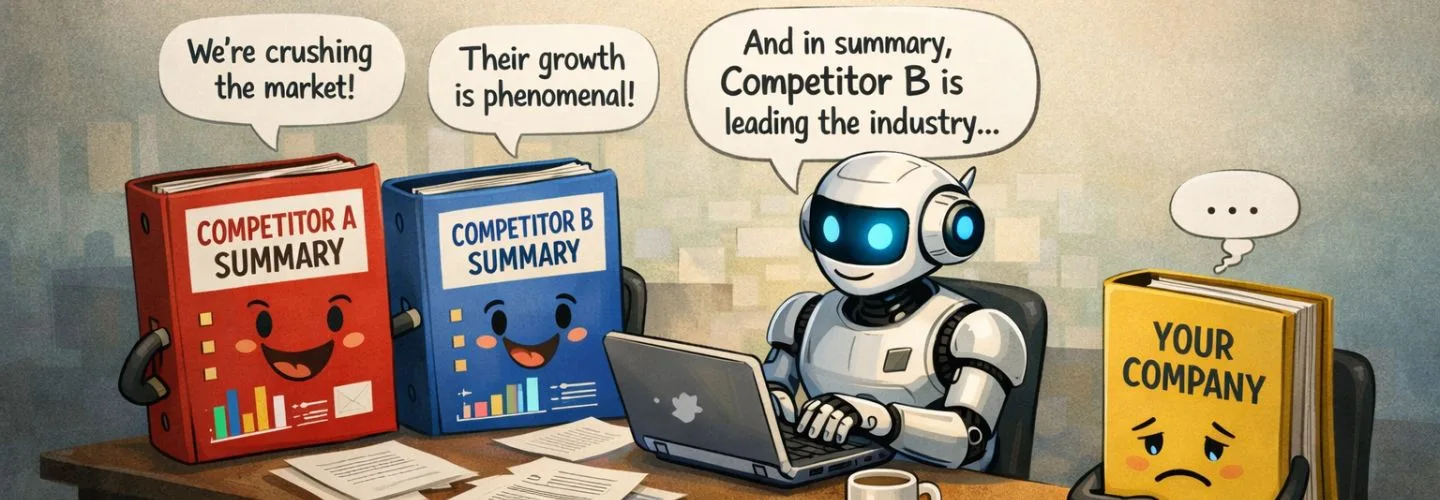
When AI Keeps Summarizing Your Competitors (And Ignoring You)
The Frustrating Reality
You are doing everything right, or at least it feels that way.
You publish thoughtful, well-researched content.
Your blogs rank on Google.
Your team invests hours refining messaging and insights.
Yet when someone asks ChatGPT, Claude, or Perplexity a question in your space, the answer always starts with:
- “According to HubSpot…”
- “As Mailchimp recommends…”
- “Campaign Monitor suggests…”
And your brand?

Completely absent.
This isn’t because your content is bad. In many cases, it’s better.
The real issue is that AI doesn’t choose sources based solely on quality. It chooses based on authority signals that were built long before your article went live.
This article breaks down:
- Why AI tools consistently favor your competitors
- Why ranking on Google isn’t enough anymore
- And how to systematically close the AI authority gap
The Problem: Invisible to AI Despite Good Content
What You are Experiencing
A common scenario looks like this:
User prompt:
“What are the best email marketing strategies for B2B?”
AI response:
“According to HubSpot, effective B2B email marketing includes…”
“As Mailchimp suggests…”
“Campaign Monitor recommends…”
Your company isn’t mentioned.
Your content, often more current and more practical, never appears.
And the pattern repeats:
- The same competitors are cited again and again
- Your brand is missing every time
- Even when your content ranks well on Google
Your frustration is valid.
Why This Matters
This isn’t just an ego issue. It has a real business impact.
When AI tools ignore your brand, you lose:
- Brand awareness among AI-first users
- Thought leadership positioning
- Early-stage buyer consideration
- Trust before the sales conversation even begins
- Inbound demand influenced by AI research
Meanwhile, competitors are quietly building AI-era brand equity.
As AI usage grows, the visibility gap widens.
Why AI Tools Favor Your Competitors
Reason 1: Stronger Authority Signals
AI models prioritize authority over freshness.
Your competitor likely has:
- Higher domain authority
- Tens of thousands of backlinks
- Mentions in major publications
- A Wikipedia page
- A decade-plus of consistent presence
You might have:
- Solid but smaller backlink profile
- Industry-only mentions
- No entity-level validation yet
- Fewer years of history
AI’s conclusion is simple:
The competitor is a safer source to cite.
This gap between content quality and AI visibility is something many practitioners are actively struggling with. In a recent Reddit discussion, marketers pointed out that most teams are still measuring success through rankings and traffic, while AI systems reward entirely different authority signals, causing competitors with broader validation to dominate AI answers even when their content isn’t objectively better.
AI search ROI Frameworks: 73 % track the wrong metrics
byu/Salt_Acanthisitta175 inAISearchLab
Reason 2: They are in AI Training Data
Many established brands published extensively between 2018 and 2022, during key AI training periods.
That means:
- Their ideas are embedded in model memory
- AI can recall their viewpoints without searching
- They feel “known” to the system
If your content launched after 2023:
- You are not baked into training data
- AI relies on real-time retrieval (if enabled)
- You are less likely to be referenced spontaneously
This creates a structural disadvantage, but not a permanent one.
This is why teams often feel blindsided when strong rankings don’t translate into AI visibility. Several SaaS marketers have shared that even brands dominating Google results remain largely invisible to AI tools, because language models rely more on historical presence and third-party validation than current SERP performance.
The Hidden Gap Between SEO and AI Search (and the Tools I’ve Found to Track It)
byu/Bite_Right inSaaS
Reason 3: Content Structure AI Prefers
Competitors tend to publish content that AI can easily extract from:
- Clear hierarchical headings
- Definitive statements
- Data and statistics
- Examples and case studies
- Comprehensive, long-form guides
Ignored content often:
- Is shorter and lighter
- Uses vague or hedged language
- Lacks data or proof
- Isn’t updated regularly
AI prefers content it can cite confidently.
Reason 4: External Validation and Citation Loops
Authority compounds.
Competitors:
- Publish authoritative content
- Get referenced by others
- Earn backlinks and mentions
- Gain industry validation
- Get cited by AI more often
That citation reinforces itself.
If your content isn’t being cited externally, AI sees fewer trust signals and skips you.
Reason 5: Brand Recognition and Entity Status
AI favors entities, not just websites.
Established brands are understood as:
- Clear entities
- Known category leaders
- Recognizable names
Newer brands may appear as:
- Generic sites
- Ambiguous offerings
- Unclear category fit
Without entity recognition, AI treats your content as anonymous.
This lack of entity recognition isn’t theoretical. Growth and SEO practitioners frequently note that brands without strong visibility across communities, discussions, and third-party platforms rarely get treated as “known entities” by AI systems, no matter how good their on-site content is.
AI Search Visibility Isn’t About Your Website Anymore, It’s About Who Mentions You
byu/UBIAI inGrowthHacking
Reason 6: Content Consistency and Volume
Competitors often publish:
- 3-5 times per week
- Hundreds of articles
- Over many years
- Across every subtopic
This builds topical authority.
If you have fewer articles, fewer years, and partial coverage, AI sees limited depth, even if individual pieces are excellent.
How to Diagnose Why You are Not Getting Cited
Step 1: Test Your Brand in AI Tools
Run simple prompts:
- “What is [Your Brand]?”
- “Top companies/resources for [your category]”
- “What does [Your Brand] recommend for [topic]?”
- “Compare [Your Brand] vs [Top Competitor]”
These reveal whether AI:
- Knows you
- Understands your category
- Can recall your insights
Step 2: Compare Authority Signals
Audit:
- Domain authority
- Backlinks
- Media mentions
- Wikipedia presence
- Content library size
- Years in market
Identify where competitors are 2x-5x stronger.
Step 3: Assess Content Quality
Compare your best content against what AI cites:
- Depth
- Structure
- Data
- Examples
- Freshness
This exposes where “good” isn’t yet “definitive.”
The Catch-Up Strategy
If this pattern feels familiar, the underlying issue is rarely content quality; it’s whether AI systems recognize your brand as a credible entity at all. We break down this exact problem, along with the foundational steps to make your brand understandable and referenceable to language models, in How to get your brand visible in LLM results.
Strategy 1: Build Entity Recognition
Make AI understand you are a real brand:
- Complete brand profiles everywhere
- Implement organization schema
- Add SameAs links
- Get external brand mentions
Entity recognition takes time, but it’s foundational.
Strategy 2: Create Citation-Worthy Original Research
AI loves data it can’t get elsewhere.
Instead of generic posts, publish:
- Benchmark reports
- Industry surveys
- Proprietary analyses
- Named frameworks
Original research becomes a natural citation magnet.
Strategy 3: Build External Citations Systematically
Earn validation:
- HARO responses
- Guest articles
- Podcast appearances
- Industry partnerships
Your goal isn’t traffic, it’s mentions.
Strategy 4: Overhaul Content Depth
Turn good posts into definitive resources:
- 3x depth
- Real data
- Multiple examples
- Industry-specific sections
- Visual assets
- Regular updates
Make your content impossible to ignore.
Strategy 5: Become the Data Source
Create:
- Annual benchmark reports
- Living statistics pages
- Named methodologies
When others cite your data, AI follows.
Strategy 6: Optimize Content for Citations
Add:
- Clear, quotable statements
- Data blocks
- Attribution-ready sections
Make it easy for AI to extract and reference you.
Strategy 7: Accelerate With Distribution
Don’t wait:
- Promote aggressively
- Pitch journalists
- Partner with others
- Use paid amplification
Authority doesn’t grow in silence.
Competitive Positioning Framework
If you can’t out-authority competitors yet:
- Go niche
- Leverage recency
- Differentiate formats
- Be radically transparent with data
Smaller, sharper authority wins faster.
Measuring Progress
Track monthly:
- AI citations
- Position in responses
- Accuracy of brand description
- Category presence
Early wins matter more than volume.
Timeline Expectations
- Months 1-3: Foundation
- Months 4-6: First mentions
- Months 7-9: Regular niche citations
- Months 10-12: Competitive parity
- 12+ months: Category authority
This is a marathon, not a sprint.
Common Mistakes
- Expecting fast results
- Publishing only on your site
- Generic, non-data content
- Ignoring distribution
- Not tracking AI visibility
What Actually Moves the Needle in AI Visibility
AI doesn’t reward effort, intent, or volume.
It responds to accumulated trust.

What consistently drives AI citations:
- Authority outweighs freshness
- External validation beats on-site optimization
- Entity recognition matters more than rankings
- Original research accelerates trust faster than opinions
- Niche authority compounds more quickly than broad visibility
What doesn’t:
- Publishing more without distribution
- Ranking without recognition
- “AI-optimized” content without third-party validation
- Waiting for visibility to happen organically
Teams that win in AI search don’t do more.
They do fewer things, deliberately, visibly, and consistently.
Your competitors are cited by AI because they have been accumulating authority for years.
Not because they “optimized for AI,” but because they existed long enough, loudly enough, and consistently enough to become trusted entities.
You can’t shortcut that history, but you can compress the timeline.
Closing the gap means focusing less on publishing more content and more on building signals AI actually trusts:
- Clear entity recognition
- Original, citation-worthy data
- External validation beyond your own website
- Strategic distribution instead of quiet publishing
- Specialization before scale
If this article made you think, “This explains exactly what’s happening to us,” you are not late, you are early.
Most teams still assume rankings and conversions automatically lead to AI visibility.
They don’t.
If you want a reality check on:
- Whether AI tools recognize your brand at all
- Which authority signals that your competitors have that you don’t
- Whether it’s smarter to specialize, research, or distribute first
You can share a bit of context with us here: https://tally.so/r/3EGEd4
No audits. No reports. No AI buzzwords.
Just a short form to understand where you are, what you have built so far, and whether closing the AI authority gap is realistic right now.
If it is, we will tell you how.
If it isn’t, you will still leave knowing why.
FAQs: Why AI Cites Competitors Instead of Your Brand
Because AI doesn’t evaluate content in isolation. It weighs authority signals like external mentions, historical presence, and how often others reference that brand. Quality matters, but validation matters more.
Indirectly, at best. Rankings don’t guarantee AI visibility. Many AI-cited sources rank poorly, or not at all, because AI systems optimize for explanatory usefulness, not keyword performance.
Yes, but not by competing broadly. Newer brands win faster by owning narrow problems, specific industries, or highly current topics where established players are weaker.
For most teams, meaningful progress takes 6-12 months. Early signs show up first as occasional mentions and improved brand understanding, not immediate dominance.
No. Volume without external validation rarely works. A smaller number of deeply researched, widely referenced pieces beats dozens of isolated blog posts.
They favor trusted entities, not size alone. Big brands often win because they have accumulated trust signals over time, but smaller brands can outperform them in specific niches.
Original research combined with external distribution. Data that others cite accelerates recognition far faster than opinion-based content.
Yes, but monthly is enough. Individual responses fluctuate. Trends over time are what indicate whether authority is actually compounding.