AI Search Audits: A Step-by-Step Framework to Diagnose Trust & Visibility Gaps

Your website ranks on page one of Google.
But when someone asks ChatGPT the same question?
You don’t exist.
Welcome to the AI visibility gap, and you are definitely not alone in this.
The Problem We are All Facing
Here’s what’s happening.
Your traditional SEO might be working exactly as expected. Your pages are indexed. Backlinks are strong. Rankings are stable.
Yet when people search inside ChatGPT, Claude, or Perplexity, tools increasingly used for research, shortlisting, and decision-making, you are invisible.
This isn’t niche behavior anymore.
Roughly 40% of searches now happen inside AI tools, and most companies have no reliable way to measure how they perform there.
As a result, teams don’t know:
- Whether AI tools cite them at all
- Why are competitors being recommended instead
- Which trust signals are AI systems missing
- What content AI understands, and what it ignores
We designed this guide to fix exactly that.
What This Guide Covers
In this guide, you will learn:
- A complete AI search audit framework
- How to identify Google vs. AI visibility gaps
- A prioritization system for what to fix first
- A clear rewrite vs. new content decision tree
By the end, you will have a repeatable system to audit any site for AI visibility, and a roadmap to close the trust and citation gaps holding you back.
Why Traditional SEO Audits Miss AI Visibility Issues
Let’s be honest: traditional SEO audits are great at what they measure.
They typically evaluate:
- Technical SEO (crawlability, speed, mobile)
- On-page optimization (titles, headers, keywords)
- Content depth and readability
- Backlink profile
- Keyword rankings
All of that still matters.
But none of those audits answer the questions that actually matter in AI search.
What Traditional Audits Miss
- Are you cited by ChatGPT, Claude, or Perplexity?
- How do AI systems interpret your authority?
- Is your content structured for extraction, not just reading?
- Are your trust signals machine-readable?
- What does AI “know” about your expertise?
This creates a growing disconnect across industries.
You can have a perfect Lighthouse score, strong backlinks, high domain authority, and top-3 Google rankings,
…and still have zero AI visibility.
What We are Seeing in Real-World Discussions
Many practitioners are noticing this first-hand.
In a recent Reddit thread on AI visibility, marketers shared that despite solid rankings and SEO fundamentals, their brands weren’t showing up in AI responses, even when queries were highly relevant. The core insight was that clear, structured explanations and reusable content matter more than traditional authority signals when AI generates answers.
Anyone else experimenting with AI search visibility?
byu/alizastevens inGrowthHacking
Why This Happens
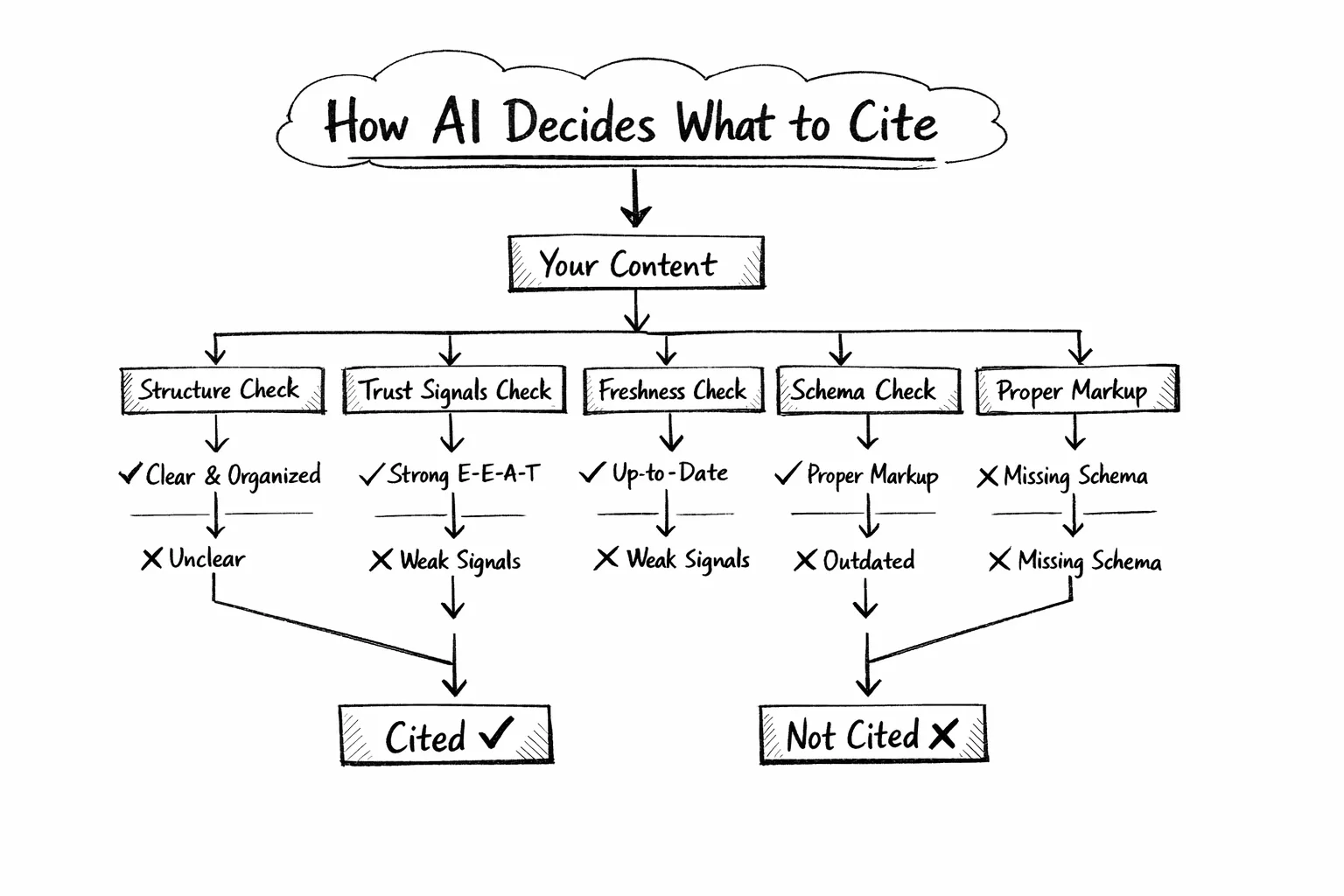
The reason is simple: AI tools don’t rank content the way Google does.
What AI Tools Prioritize
- Explicit clarity
- Strong E-E-A-T signals
- Structured, extractable information
- Freshness and confidence
- Cite-worthy formatting
What They Largely Ignore
- Raw backlink volume
- Keyword density
- Domain authority as a standalone signal
This is also why the question “Does SEO still matter in the era of LLMs?” keeps coming up.
The short answer is yes, but only if SEO evolves beyond rankings.
The AI Search Audit Framework (6-Step Process)
This framework can be completed in 4-6 hours for a full audit, or 1-2 hours if you need directional insights quickly.
Step 1: AI Citation Audit (Manual Testing)
Goal: Determine whether AI tools cite you, and how accurately.
A. Identify Core Questions
List 15-20 questions across:
- Category definitions
- Problem-solution queries
- Comparisons and “best” searches
- Competitor brand searches
B. Test Across AI Tools
Open ChatGPT, Claude, and Perplexity side by side.
Ask the same questions in each and document:
- Whether you are cited
- Where you appear
- Accuracy of the information
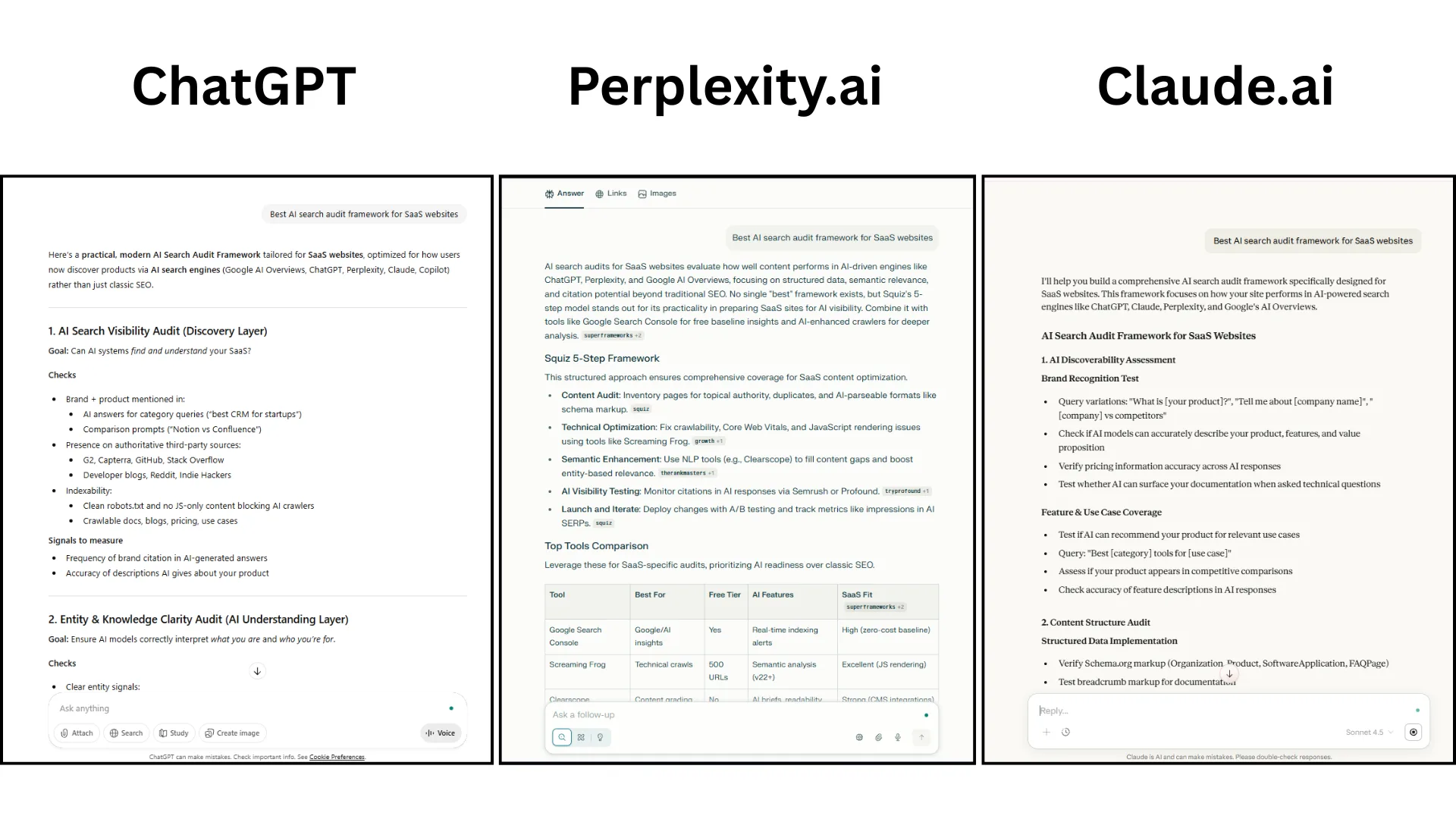
To make this tangible, we tested the query:
“Best AI search audit framework for SaaS websites”
Across ChatGPT, Claude, and Perplexity. The results highlight exactly why AI visibility audits are critical; each tool surfaces completely different information, cites different sources, and prioritizes clarity and structure in unique ways.
What to Look For
Good signs
- Top-3 mentions
- Accurate descriptions
- Perplexity linking to your site
- Use-case-specific recommendations
Warning signs
- Buried mentions
- Outdated information
- Hedging language like “may” or “might.”
Red flags
- No mention at all
- Competitors cited instead
- Hallucinated or incorrect brand details
Key Metric: AI Citation Rate
- Under 20% → Critical issue
- 20-40% → Needs improvement
- 40-60% → Healthy
- 60%+ → Strong AI presence
Step 2: E-E-A-T Signal Audit
AI systems heavily weigh Experience, Expertise, Authoritativeness, and Trust, but they look for very specific signals.
Author Signals
- Named authors (not “Admin”)
- Detailed bios with credentials
- Author schema markup
- Linked professional profiles
- Topic consistency across content
Organization Signals
- Clear About page
- Team page with real people
- Organization schema
- Contact details
- Linked social profiles
Content Signals
- Visible publish and update dates
- Sources cited
- Original insights or data
- Real examples or case studies
Technical Trust
- HTTPS
- Privacy policy
- Easy-to-find contact information
Scoring guide
- 15-20: Strong trust
- 10-14: Moderate
- 5-9: Weak
- 0-4: Critical
Step 3: Content Structure Audit
AI doesn’t read content the way humans do.
It scans for structure, hierarchy, and extractable facts.
Audit your top 10 pages for:
- Clear H1 and logical H2/H3 flow
- Short paragraphs
- Lists and tables
- Explicit definitions
- Numbered processes
- FAQs
Pages scoring under 7/15 usually need a rewrite, not just a tweak.
Step 4: Schema Markup Audit
A schema is a direct, machine-readable input for AI systems.
Think of it as speaking AI’s native language.
Check for:
- Article schema
- Author schema
- Organization schema
- Product or Service schema
- FAQ schema
- HowTo schema
Common issues
- No schema at all
- Missing author credentials
- Outdated dates
- Incomplete or broken markup
If you fix only one thing from this entire guide: Add proper author schema.
Step 5: Content Freshness Audit
AI strongly favors recent content, more than most teams realize.
Observed citation trends
- 0-6 months: ~68%
- 6-12 months: ~41%
- 12-24 months: ~18%
- 24+ months: ~7%
Audit your top pages for:
- Published date
- Last updated date
- Visible freshness signals
- dateModified in schema
Even minor updates matter. AI notices recency.
Step 6: Competitive AI Visibility Analysis
Run the same citation audit on 3-5 competitors.
Compare:
- Who AI cites
- How content is structured
- Author credentials
- Freshness
- Use of data and examples
Patterns emerge quickly, and so do your gaps.
Google SERPs vs. AI Answers: The Gap Analysis
Many teams discover that what wins on Google often loses in AI search.
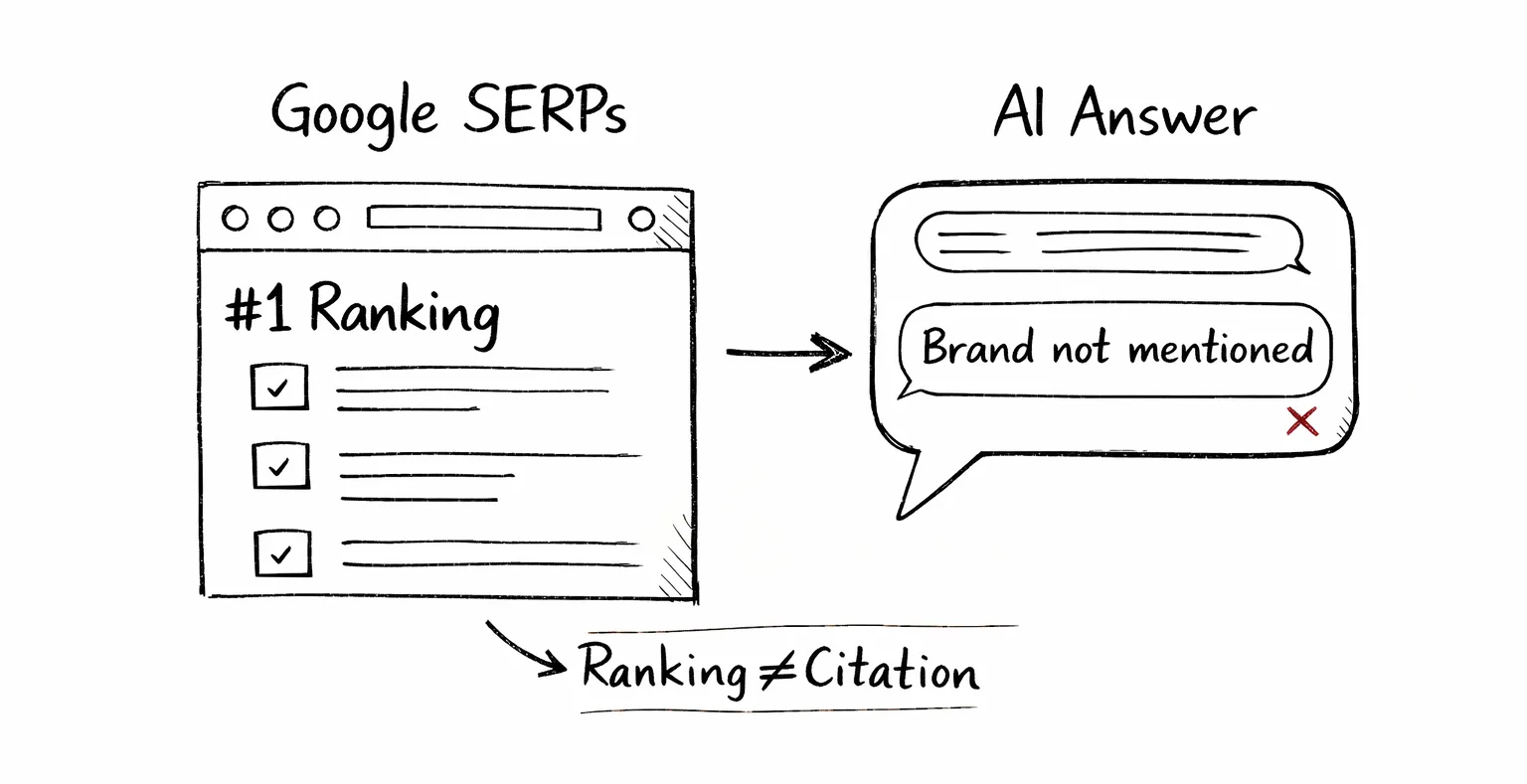
Audit 10 keywords you already rank well for.
For each:
- Note your Google ranking
- Check AI citations
Look for patterns such as:
- Authority disconnect (backlinks ≠ AI trust)
- Structure disconnect (listicles vs. guides)
- Freshness disconnect (old content still ranking)
- Intent mismatch
Prioritize pages where:
- You rank top 10 on Google
- AI doesn’t cite you
- Commercial intent is high
These are your highest-leverage fixes.
Prioritization Matrix: What to Fix First
Score issues by impact and effort.
Priority 1- Quick Wins
- Add author bios and credentials
- Implement author schema
- Update visible dates
- Fix outdated statistics
Priority 2- High-Value Projects
- Rewrite the top pages for clarity
- Expand schema coverage
- Refresh content older than 12 months
Priority 3- Nice-to-Haves
- Improve About page
- Formatting refinements
- Internal linking
In practice, 80% of AI visibility comes from just five actions: Author credentials, fresh dates, core schema, structured rewrites, and specific data.
Rewrite vs. New Content: The Decision Tree
Rewrite when
- You already rank
- Content has traffic
- The topic is still relevant
Create new when
- You don’t rank
- A data void exists
- Competitors dominate AI answers
Start with rewrites.
Then fill the gaps.
What Happens If You Don’t Audit for AI
Here’s the uncomfortable truth.
Your competitors are adapting.
While your rankings look fine, they are being cited, recommended, and trusted inside AI tools, where more and more decisions now begin.
You can’t optimize what you don’t measure.
Ready to Close Your AI Search Trust & Visibility Gaps?
AI visibility is no longer driven by rankings alone.
It depends on whether AI systems can clearly understand, trust, and confidently reuse your content when generating answers.
When brands fail to appear in AI responses, the issue is rarely content volume.
It’s usually unclear positioning, weak trust signals, or content that isn’t structured for extraction and citation.
An AI search audit helps identify where these gaps exist, showing which pages AI ignores, why competitors are being cited instead, and what to fix first.
If you want a clear view of how your site currently performs across AI search tools, start by sharing a few details about your website and content footprint.
Start here: https://tally.so/r/3EGEd4
FAQs
AI tools don’t weigh authority the way Google does. Instead of backlink volume, they prioritize clarity, structured explanations, and visible trust signals like authorship and use cases. A clearly defined, well-structured page is easier for AI to confidently cite.
Yes. AI systems ingest schema markup independently of Google’s SERP display. Author, article, organization, FAQ, and product schema still act as machine-readable trust signals, even when no rich snippets appear.
Each AI tool uses a different retrieval logic. Perplexity favors citation-ready, linkable sources, while ChatGPT prioritizes clarity, confidence, and consistency across sources. Being cited by one usually means you’re close, but missing signals elsewhere.
Yes, indirectly. Phrases like “might,” “often,” or “depends” reduce AI confidence when selecting sources. AI prefers precise, scoped, and context-specific statements that can be reused without uncertainty.
You only find this by testing brand and category queries inside AI tools. Signs include outdated features, wrong positioning, or “limited information” statements. The fix is clearer, schema-backed content that removes ambiguity.