The Real Reason Review Sites Outrank Your Comparison Pages

By the end of this article, you’ll know when comparison pages can actually outperform review sites, how to write them so users trust you, and where to stop wasting effort on pages that will never rank.
The Comparison Page Problem
You did everything that usually works.
- You created detailed “X vs Y” pages.
- You compared features, pricing, benefits, and use cases.
- You optimized titles, headings, and internal links.
And yet, the same pattern keeps repeating.
G2, Capterra, TrustRadius, and Reddit threads outrank your pages every time.
Your comparison content sits on page two or three, while review sites dominate the top results.
This is not a content quality problem.
It is not a keyword problem.
It is a trust problem.
In this article, we will break down why comparison pages struggle to rank, why review sites consistently win comparison searches, and what actually works if your goal is visibility, trust, and conversions.
The Trust Problem: Why Google Favors Review Sites
When Google evaluates comparison content, it is not just analyzing keywords or structure. It is evaluating source credibility.
A typical comparison page looks like this to Google:
- Source: Single brand or publisher
- Perspective: Involved in the outcome
- Objectivity: Limited
- Trust level: Cautious
A review site comparison looks like this:
- Source: Independent third party
- Perspective: Aggregated experiences
- Objectivity: Higher
- Trust level: Strong
Google’s conclusion is straightforward.
For comparison queries, third-party sources are more likely to satisfy user intent.
This same trust-first logic is also shaping Google’s broader shift toward AI Overviews, where credibility and independence increasingly matter more than traditional rankings, a change explored in Behind AI Overviews: Why Google’s Change Isn’t About Ranking, It’s About Trust Signals.
Real-world search behavior reinforces this. In SEO discussions on Reddit, practitioners frequently point out that community-driven comparison threads and user-generated discussions now outrank traditional comparison pages because they reflect lived experience rather than controlled messaging.
In one such thread, an SEO shared how Reddit threads routinely appear on page one for technical and comparison queries while polished blog content drops several positions lower.
Follow-up: Looks like Google favors Reddit and forums over blogs in tech SERPs post-core update
byu/easyedy inSEO
Google is not guessing. It is responding to how users behave.
The E-E-A-T Gap in Comparison Content
Comparison pages are heavily influenced by E-E-A-T signals.
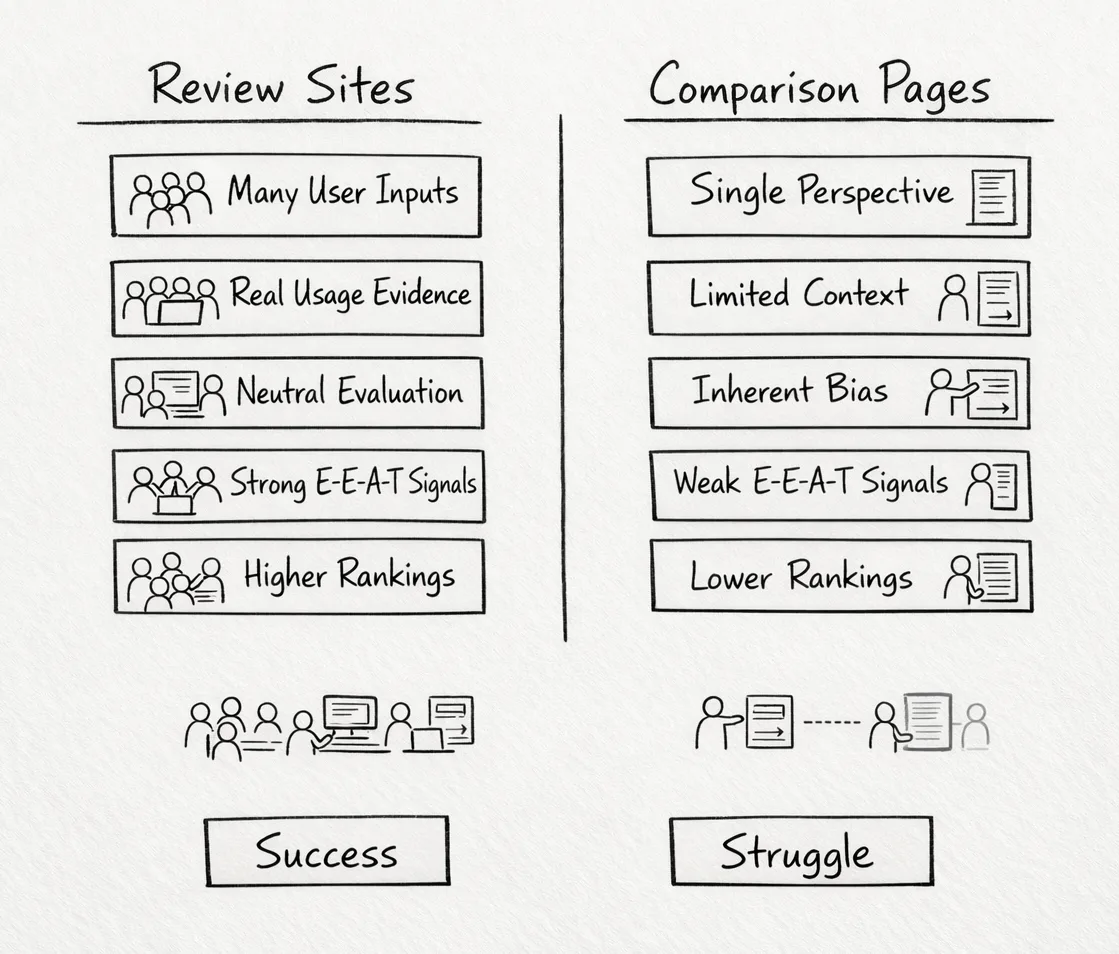
| E-E-A-T Factor | Review Sites | Comparison Pages |
|---|---|---|
| Experience | Aggregated feedback from hundreds or thousands of real users across industries, use cases, and company sizes | Single-source perspective based on internal knowledge, demos, or curated examples |
| Expertise | Combines professional analysis with real-world user experiences and long-term usage patterns | Deep product knowledge, but limited visibility into how alternatives perform in diverse environments |
| Authoritativeness | Established as category-level destinations for comparisons, with strong brand recognition and backlinks | Authority typically limited to a single product, brand, or niche |
| Trustworthiness | No direct incentive to push one outcome, reinforced by transparency and mixed opinions | Inherent conflict of interest, even when the content is accurate and well-written |
| Content Freshness | Continuously updated through new reviews, ratings, and verified feedback | Updates are manual and infrequent, leading to slower trust decay over time |
| User Validation Signals | High engagement, multiple page views, filtering, and cross-comparison behavior | Shorter sessions and quicker exits when neutrality or trade-offs are missing |
Most comparison pages, even well-written ones, struggle to match that combination.
The result is predictable. Review sites win three or four out of four E-E-A-T signals, and Google follows.
The User Preference Reality
Users approach comparison searches with skepticism.
They actively look for signals of independence and real-world experience.
When researching software or services, people gravitate toward:
- Independent review platforms
- Verified customer reviews
- Community discussions
- Analyst opinions
Comparison pages published by brands or single publishers are usually the last stop, not the first.
Google learns from this behavior.
- Users bounce faster.
- They reformulate searches with “reviews” or “Reddit.”
- They spend more time on platforms that aggregate multiple perspectives.
Search engines do not just evaluate content in isolation. They observe what actually satisfies users.
Why Comparison Pages Don’t Rank
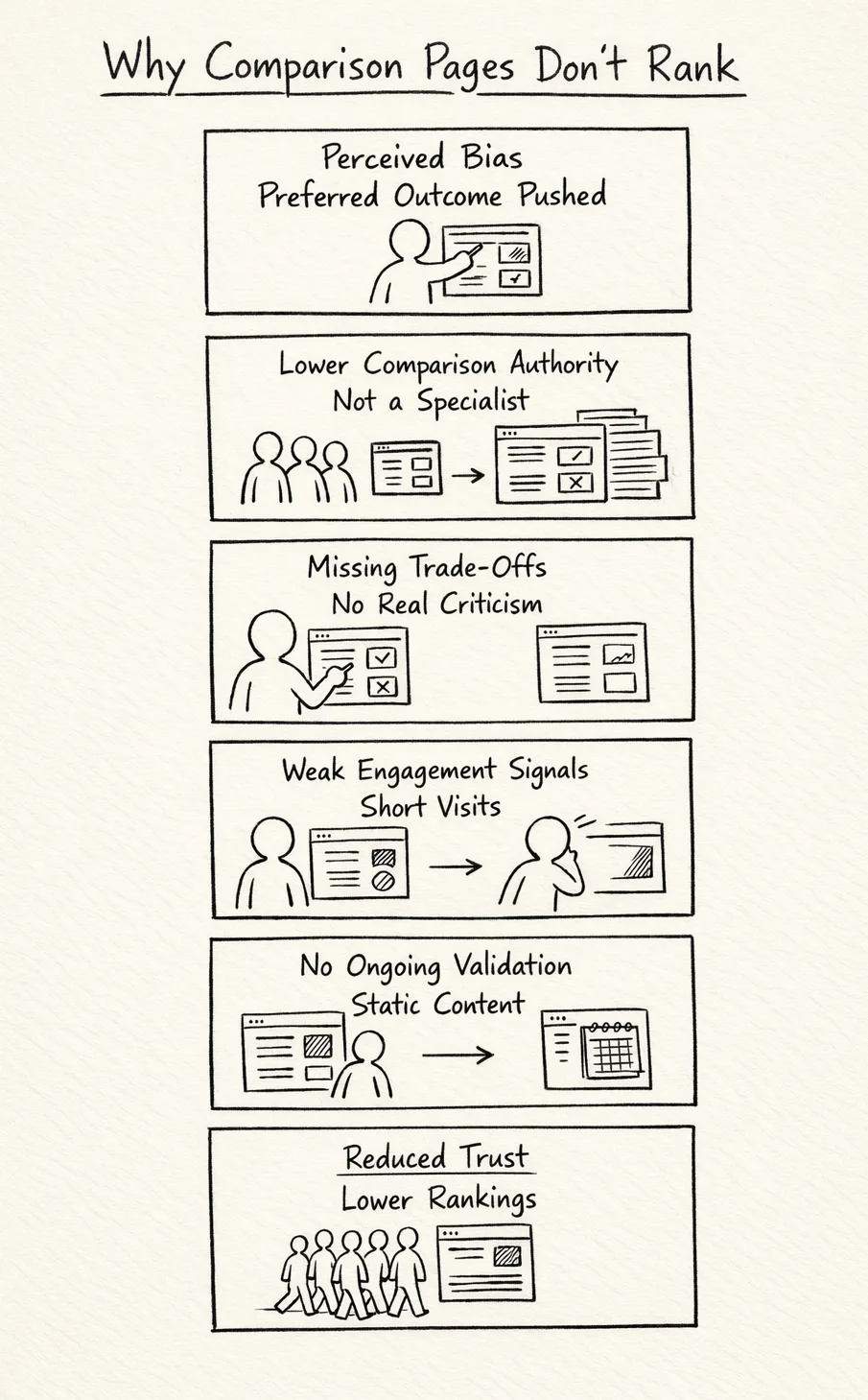
Reason 1: Perceived Bias
Most comparison pages follow a predictable structure. One option is framed as clearly superior, trade-offs are minimized, and the conclusion pushes a preferred outcome.
Users recognize this immediately.
So does Google.
When intent is comparison, perceived bias reduces trust.
Reason 2: Lower Authority in the Comparison Space
Review sites are built specifically for comparisons.
They have high domain authority, massive backlink profiles, thousands of comparison pages, and constantly refreshed content.
Most comparison pages are published by sites where comparison is only one small part of the content mix.
Google understands the difference between a comparison specialist and a general publisher.
Reason 3: Missing Trade-Offs and Criticism
Many comparison pages avoid uncomfortable truths.
- They downplay competitor strengths.
- They avoid real criticism.
- They rarely explain when another option might be better.
That makes the content less useful.
And usefulness is what comparison searches demand.
Reason 4: Weak Engagement Signals
Typical behavior on underperforming comparison pages looks like this:
- Short time on page
- High bounce rate
- Return to search results
On review platforms, users scroll, filter, read multiple perspectives, and click between options.
Google learns which results actually satisfy intent and adjusts rankings accordingly.
This pattern is frequently discussed in SEO communities. In one Reddit thread, marketers noted that smaller forums and discussion posts often outperform well-optimized pages because engagement and perceived usefulness outweigh structure and keywords.
Reason 5: Lack of Ongoing Validation
Review platforms update constantly with new reviews, ratings, and verified feedback.
Most comparison pages remain static.
Freshness and validation compound trust over time. Static content slowly loses it.
When Comparison Pages Can Still Work
Comparison pages are not useless. They are just misused.
They perform best when:
- The query is branded or semi-branded
- The comparison is highly specific or niche
- The depth goes beyond surface-level feature lists
In technical or narrow scenarios, depth and clarity can outperform neutrality.
What Actually Works Against Review Sites
The goal is not to beat review sites at independence. That is not realistic.
The goal is to complement how buyers research.
Comparison pages that perform well tend to:
- Acknowledge trade-offs clearly
- Reference third-party data openly
- Help users decide, not persuade them
- Act as decision support, not sales pages
The most effective comparison pages read like buying guides, not arguments.
The Truth About Comparison Pages And What To Do Next
You cannot beat review sites at being independent, and you should not try.
Review platforms exist to aggregate perspectives and reduce bias. Comparison pages exist to support evaluation once initial trust is already forming.
The mistake is not creating comparison pages.
The mistake is expecting them to outrank review platforms.
What actually matters is whether your page shows up when buyers compare, whether it builds trust instead of defensiveness, and whether the right prospects move forward while the wrong ones opt out early.
The best comparison pages do not try to win.
They help people decide.
If you want a grounded reality check on which of your comparison pages are worth fixing, where review sites will always win, and where they will not, you can share some context with us here: https://tally.so/r/3EGEd4
No audits.
No rewrite everything advice.
Just clarity on what role comparison pages should realistically play in your growth strategy.
If there is a real opportunity, we will tell you.
If there is not, you will still leave knowing what not to spend time on.
Common Questions About Comparison Pages
Comparison pages usually represent a single perspective, while review sites aggregate many independent experiences. Google favors sources that reduce bias for comparison intent. User behavior reinforces this, as people often leave comparison pages to seek reviews elsewhere.
Review sites perform best for broad, exploratory searches like “best tools,” “X vs Y,” or “top alternatives.” These queries signal a need for neutrality and social proof. Aggregated reviews match that intent better than single-source comparisons.
Comparison pages work best for branded, niche, or technical queries. When users want implementation details, constraints, or deep context, specificity and depth can outperform neutrality.
Users expect trade-offs, limitations, and independent validation. When pages avoid criticism or read like persuasion, visitors return to search results to find more balanced information.
Yes. They often capture long-tail branded queries, support internal linking, and strengthen topical relevance. Their main value is supporting evaluation and conversion, not driving top-of-funnel traffic.
Effective pages clearly define who each option is for, acknowledge where alternatives perform better, and reference third-party data. They function as decision guides rather than arguments.
At least quarterly. Pricing, features, and user sentiment change quickly, and stale comparisons lose credibility with both users and search engines.
Treating them as ranking assets instead of evaluation assets. Pages written to “win” rarely rank or convert as well as pages written to clarify trade-offs.
No. Treat comparison pages as sales-enablement and evaluation assets that sometimes rank, not as your primary strategy for ‘best’ and ‘vs’ keywords.