Content Velocity Trap: Why Publishing More Content Doesn’t Mean More Rankings
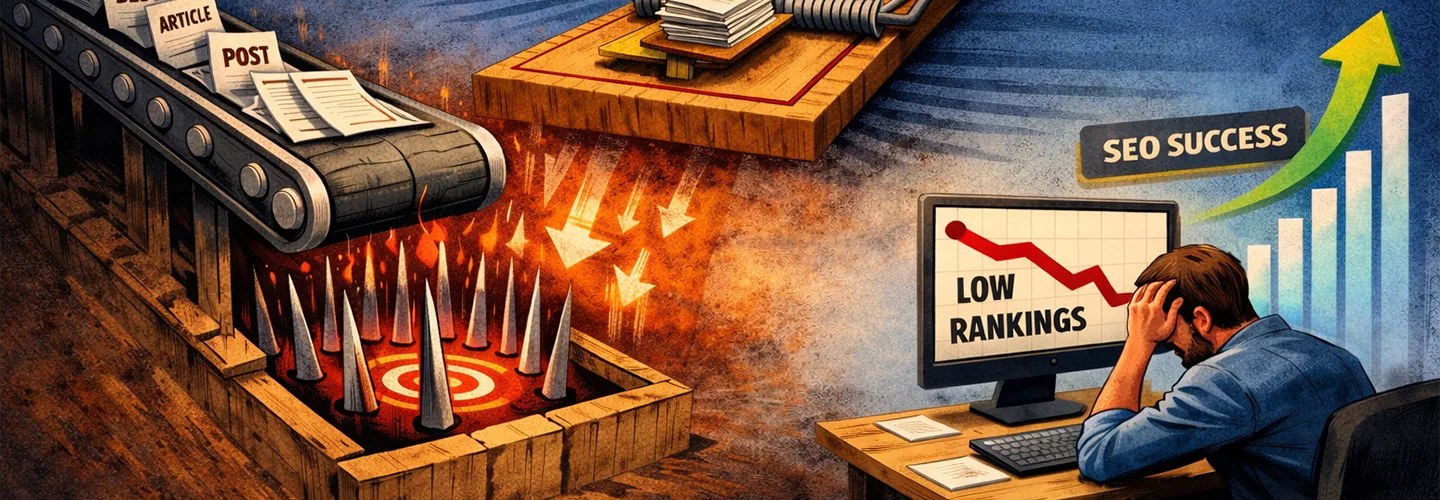
“We published 100 articles this year. Traffic is flat.”
If you have said this or heard it in a marketing meeting, you are not alone.
Your content calendar looks impressive. Your writers are busy. Your CMS is packed with published URLs. From the outside? You look productive as hell.
But your rankings? They are not moving. Your leads aren’t scaling. And growth feels… stuck.
Welcome to the content velocity trap.
The Lie We All Believed
For years, everyone in marketing repeated the same mantra:
Publish consistently.
More content = more chances to rank.
Increase your publishing frequency and watch traffic follow.
That advice worked once. It doesn’t anymore.
Here’s the uncomfortable truth: Over 90% of published content gets little to no traffic (Ahrefs) or be specific with “96.55% of published content gets no traffic from Google (Ahrefs, 2023). Most content never ranks, never compounds, and never pays back the effort you put into it.
The math is brutal:
100 mediocre articles- about 5,000 total visits
10 great articles- about 50,000 total visits
It’s not about working harder. It’s about volume without leverage.
Where This Whole Velocity Thing Started
The obsession with pumping out content didn’t come out of nowhere. It traces back to HubSpot’s early playbook between 2010 and 2015.
The rule was simple: publish daily to win SEO.

And you know what? At the time, it actually worked.
Why did it work then
Between 2010 and 2015, the internet was a different place:
- The competition was way lower
- Google heavily rewards freshness
- Thin content could still rank
- Massive topic gaps existed everywhere
Publishing frequently meant covering ground nobody else had touched. Even average content ranked because the bar was low and the web was still underdeveloped.
Why doesn’t it work now?
That environment is gone.
Today, every basic topic already has 50+ articles ranking. Google explicitly prioritizes quality through its Helpful Content Update. AI-generated spam has flooded the web. And Google’s gotten really good at detecting thin, redundant content.
Volume stopped being a competitive advantage. In many cases, it became a liability.
What Actually Happens When You Publish Too Much

Here’s the pattern we see over and over:
Writers rush- quality drops
Keyword research gets shallow (or skipped entirely)
No time for promotion or distribution
Pages start cannibalizing each other
Google detects a pattern of thin content
Your domain gradually loses trust
And the data backs this up. Multiple studies show:
- 1-2 high-quality posts per week: ~180% traffic growth
- Daily, medium-quality posts: ~40% traffic growth
Quality doesn’t just win. It compounds.
The 7 Ways High Velocity Kills Your SEO
Content velocity shows up repeatedly as a root cause in failed SEO efforts, something we have seen firsthand across dozens of audits, including patterns identified in SEO Not Working? 7 Mistakes from 127 Failed SEO Projects.
Problem 1: Your quality tanks
You can’t create truly exceptional content every single day. It’s just not possible.
Under pressure, writers default to “good enough.” And “good enough” is invisible in modern search. The web doesn’t need another generic “10 tips” post, especially not your 347th one.
Problem 2: You cannibalize yourself
High velocity creates overlap. You end up with multiple pages targeting similar keywords. Google doesn’t know which one to rank, so it ranks none of them well.
Five separate posts about “email marketing tips” will usually lose to one authoritative, consolidated page.
Problem 3: No time to promote
The cycle becomes: publish- move on immediately.
No outreach. No sharing. No link building. No amplification.
Even strong content dies quietly without distribution. A great post with 50 views is still a failure.
Problem 4: Your research gets shallow
Velocity kills depth.
There’s no time for original insights, expert interviews, or data collection. Content becomes aggregation, just summarizing what everyone else already said.
When every article starts with “According to HubSpot…”, nothing stands out. And nothing earns links.
Problem 5: You run out of good topics
Eventually, the well runs dry.
By month six, teams are scraping the bottom of the barrel, targeting peripheral keywords nobody searches for or converts from.
More content. Less impact.
Problem 6: Your resources get drained
Entire teams get locked into churn mode.
The time that could have gone into one exceptional piece, plus promotion, gets split across 20 mediocre ones. The opportunity cost is massive.
Here’s something interesting: there’s a widely discussed Reddit thread where multiple marketers shared that publishing more didn’t move traffic at all, but deleting, merging, and consolidating low-performing pages actually improved rankings. Google responded positively once thin and overlapping content was reduced.
The Most Boring SEO Fix We Made This Year… Increased Traffic by 60%
byu/globials indigital_marketing
Problem 7: Your brand gets diluted
You publish a lot, but stand for nothing.
Hundreds of articles. Zero thought leadership. Nothing memorable.
Volume without perspective erases brand identity.
Let’s Talk Real Numbers
Here’s the math that should scare you:
High Velocity Approach:
- Writer cost: $150/article
- 100 articles/year = $15,000
- Average traffic: 50 visits/month per article
- Total: 5,000 visits/month
- Cost per visit: $3
Quality-First Approach:
- 20 articles/year = $3,000
- Deeply researched, 10x quality
- Average: 500 visits/month per article
- Total: 10,000 visits/month
- Cost per visit: $0.30
Velocity loses, financially and strategically.
How to Actually Win: The Quality-First Framework
Time to flip the script.
From: Publish on a fixed schedule
To: Publish only when you have something worth saying
Step 1: Pick High-Value Topics Only
Only write if you can realistically be a top-3 result.
Every topic must have:
- Proven search demand
- Weak or beatable competition
- A clear, unique angle
If you can’t outperform what’s ranking, don’t write it.
Instead of 15-20 topics per month, identify 3-5 high-impact topics.
Step 2: Actually Do Deep Research
Before you write a single word:
- Spend 4-8 hours researching
- Interview customers or experts
- Find original data or examples
- Do a competitive gap analysis
Ask yourself one question: What’s missing from every other result?
Step 3: Create 10x Content
The goal isn’t “comprehensive.” It’s differentiated.
Give them:
- Original frameworks
- First-hand examples
- Unique insights
- Clear positioning
Time investment: 8-12 hours per piece, not 3-4.
Step 4: Promotion = Half the Work
This is where most people fail. Half your effort should go into distribution:
- Outreach to the people you mentioned
- Share in relevant communities
- Send to your email list
- Promote on social
- Build links
Publishing is the midpoint, not the finish line.
Step 5: Track and Optimize
Track each piece for 90 days:
- Double down on winners
- Improve underperformers
- Kill content that doesn’t justify its existence
This aligns with what experienced SEOs are saying in real discussions. In one Reddit thread, professionals explicitly recommended pausing new content creation and focusing entirely on improving existing pages. Updates and consolidation often drive faster SEO gains than publishing yet another article.
Please STOP publishing new blog posts.
byu/Rich-Independent1202 inSEO_Digital_Marketing
When Does Velocity Actually Make Sense?
Look, content velocity isn’t always wrong. It just works in very specific cases.

Velocity makes sense if:
You are covering news or trends where freshness is the differentiator.
You have massive resources, like 10+ person teams with researchers, editors, and promoters. HubSpot and Moz can do this. You probably can’t.
You are doing programmatic SEO with template-driven pages powered by structured data (think Zillow or Indeed). This is a different model entirely.
You are updating existing content. Refreshing and improving old posts is valuable velocity.
For everyone else:
Small teams, limited budgets, competitive industries, B2B with long sales cycles…
Quality beats velocity every single time.
If This Sounds Familiar
If your content calendar is packed but organic growth feels stuck, the issue might not be effort; it might be direction.
Many teams assume slow SEO results mean they need to publish more. In reality, the opposite is often true. Too much content, created too quickly, can quietly weaken focus, create overlap, and spread authority thin.
Not every website needs more pages. Some need fewer, stronger ones.
Some need to slow down long enough to understand why existing content isn’t compounding.
If you are trying to figure out:
- Whether your current publishing pace is helping or hurting
- How much of your content actually contributes to rankings
- Where depth and consolidation would matter more than output
- What a realistic content strategy looks like at your stage
You can share some context with us here: https://tally.so/r/3EGEd4
There’s no pitch. No automated analysis. No “SEO audit” promises.
Just a short form to understand what you are publishing, what results you are seeing, and whether a conversation would help.
If it makes sense to continue, we will say so. If it doesn’t, you will still leave with clearer next steps.
Frequently Asked Questions About Content Velocity & Publishing Frequency
Nope. Google has repeatedly said that publishing more often doesn’t guarantee better rankings. What matters is whether your page adds meaningful value compared to what already exists. High publishing frequency only helps if quality stays high, which is rare in practice.
Yes. Excessive publishing leads to keyword cannibalization, thin pages, crawl budget waste, and lower domain trust. In many audits, traffic improved after content was removed or consolidated, not added.
For most B2B teams, 2-4 high-quality posts per month outperform daily or near-daily publishing. This gives you time for research, differentiation, and promotion, where real SEO gains happen.
Often, yes. Updating existing pages preserves rankings and links, improves relevance without starting from zero, and sends stronger quality signals to Google. Many SEO wins come from refreshing content, not expanding your URL count.
Look for these signals:
- Traffic is flat despite consistent publishing
- Multiple pages rank for the same keyword
- Most posts get under 100 visits/month
- Deep impressions but low clicks in Search Console
If you see this pattern, velocity is likely working against you.
Yes, when it’s used for speed instead of insight. AI increases volume but often removes originality. Google’s Helpful Content system is specifically designed to devalue scaled, repetitive, low-value pages, no matter how fast you produce them.
Early-stage teams benefit more from a few authoritative, conversion-focused pages with clear positioning and depth. Content should tie directly to buyer intent. Velocity without authority rarely compounds.