The Homepage Dilemma: Brand Story vs. Search Visibility

The Homepage Nobody Finds
You spent weeks crafting your homepage copy.
It beautifully tells your brand story.
It converts visitors who land on it.
And yet, almost nobody lands on it organically.
This is one of the most common (and expensive) problems in modern SEO. The homepage feels right. It sounds polished, aspirational, and on-brand. But when you open Google.
Search Console, reality hits:
- No non-branded rankings
- Minimal organic discovery
- Traffic mostly from people who already know you
This article breaks down why homepages struggle with SEO, why brand-first messaging often ranks for nothing, and how to build a homepage that balances search visibility with brand storytelling, without sacrificing conversions.
The Homepage Reality Check
What Your Homepage Probably Says
Most homepages fall into one (or more) of these patterns.
Pattern 1: The Mission Statement
We believe in transforming the way businesses grow.
Empowering teams to achieve their full potential.
Revolutionizing how companies connect with customers.
Pattern 2: The Vague Value Proposition
We help businesses succeed.
Solutions for modern teams.
Technology that works for you.
Pattern 3: The Feature Dump
Powerful | Intuitive | Scalable
Award-winning platform with innovative features.
Trusted by leading companies worldwide.
What These Have in Common
They sound good, but they fail SEO for the same reasons:
- No clear keywords
- No specific value proposition
- Could describe almost any company in any industry
- Written for people who already know you
- Zero alignment with search intent
Result: Your homepage ranks only for branded terms. New users never discover you through organic search.
This frustration shows up repeatedly in SEO communities. In one widely upvoted Reddit discussion, a marketer described how their homepage looked “clean, modern, and brand-aligned,” but ranked for nothing beyond the company name because there was no clear indication of what the business actually did.
The consensus reply was blunt: if a human can’t tell your category in five seconds, Google won’t either.
Why Your Homepage Is Killing Your SEO (And How to Fix It in Under 30 Minutes)
byu/globials indigital_marketing
What Homepage SEO Usually Looks Like
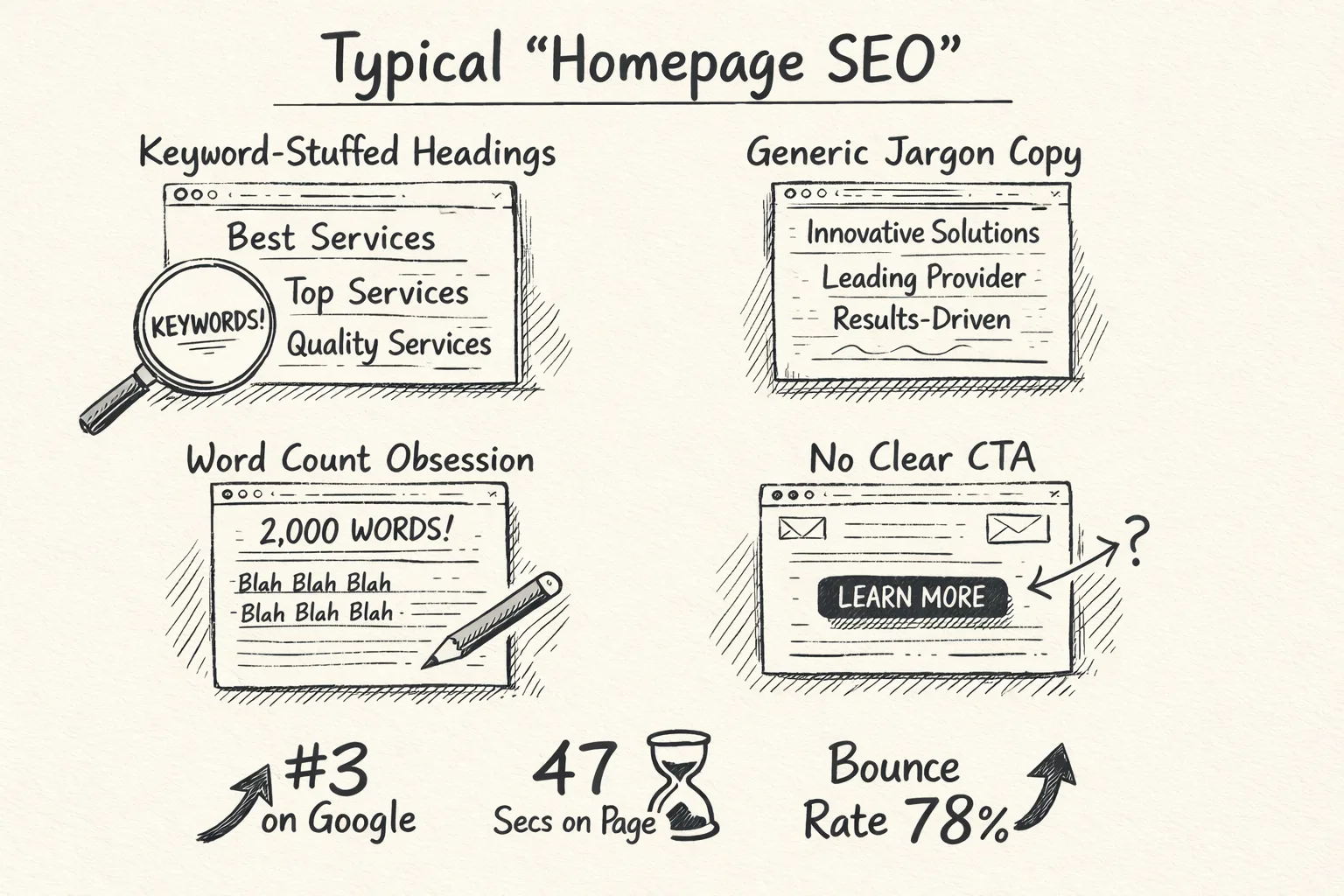
Across SaaS, services, and e-commerce, homepage performance is remarkably consistent.
Typical Homepage Rankings
- The homepage typically ranks first for the brand name.
- It often ranks in the top three positions for brand-plus-service queries.
- For non-branded keywords, it usually ranks beyond position fifty or does not rank at all.
Organic Traffic Breakdown
- 80-95% branded searches
- 5-20% non-branded searches
Translation: People who already know you can find you. Everyone else can’t.
This imbalance between brand and non-brand traffic is often the clearest signal that SEO isn’t driving discovery yet, which is why tracking brand vs non-brand search separately matters far more than total traffic numbers.
In fact, some teams don’t even realize how invisible their homepage is until they test it. One SEO thread details a site where internal pages were ranking, but the homepage didn’t appear, even for brand-adjacent queries, because it lacked a clear topical focus. The homepage wasn’t “bad,” it was just irrelevant from a search perspective.
Homepage Not Ranking For The Brand Name
byu/animemkd inbigseo
Why Homepages Struggle With SEO
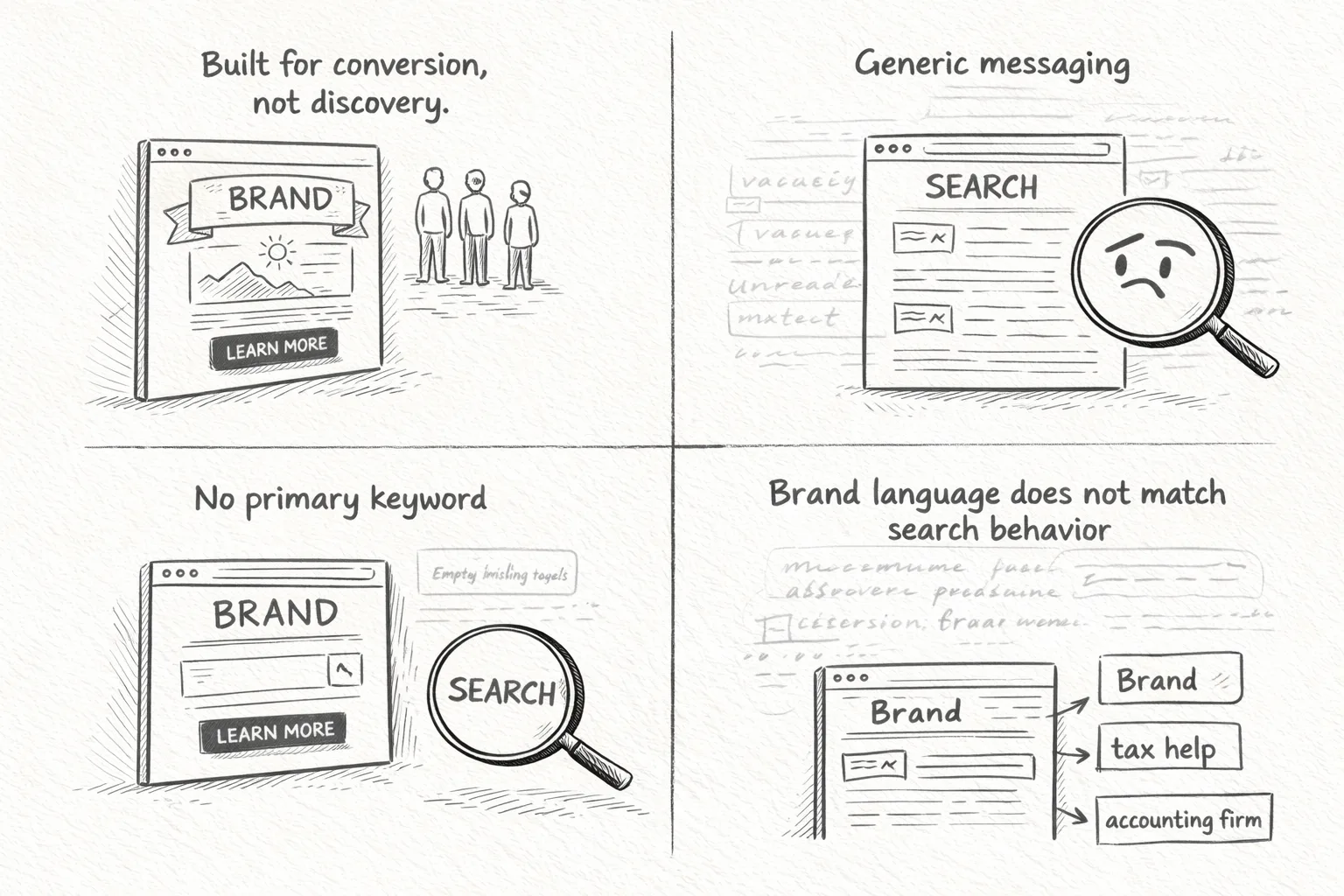
Reason 1: Designed for Conversion, Not Discovery
Most homepages are built to:
- Convert visitors from ads or referrals
- Build trust and credibility
- Guide users to product or service pages
- Tell the brand story
What’s missing?
Any consideration of how someone without awareness might discover you.
SEO is about being found before trust exists. Conversion-focused homepages assume trust already exists. That tension is the root problem.
This same misalignment shows up across many sites that technically “rank” but don’t perform, which we explored in more depth in You Optimized for Google, Not for Buyers, where visibility exists, but intent alignment doesn’t.
Reason 2: Generic Messaging Targets Nothing
Take a common line:
“We help businesses grow.”
Ask three questions:
- Nobody actively searches for this language.
- The problem it solves is unclear.
- There is no visible differentiation.
From Google’s perspective, there is no clear category, no identifiable intent, and no strong relevance signal.
There’s nothing to rank.
Reason 3: No Primary Keyword Target
Most homepages can’t answer these basic questions:
- What category are we in?
- What problem do we solve?
- What would someone search for if they needed us but didn’t know we existed?
Without a primary keyword focus, the homepage has no SEO purpose.
Reason 4: Brand Story Doesn’t Match Search Behavior
Brand-first messaging sounds like this:
“We’re reimagining productivity.”
Search behavior looks like this:
- project management software for small teams
- best CRM for real estate agents
- email marketing platform comparison
The disconnect is simple: Your story isn’t how people search.
The Three Homepage Approaches
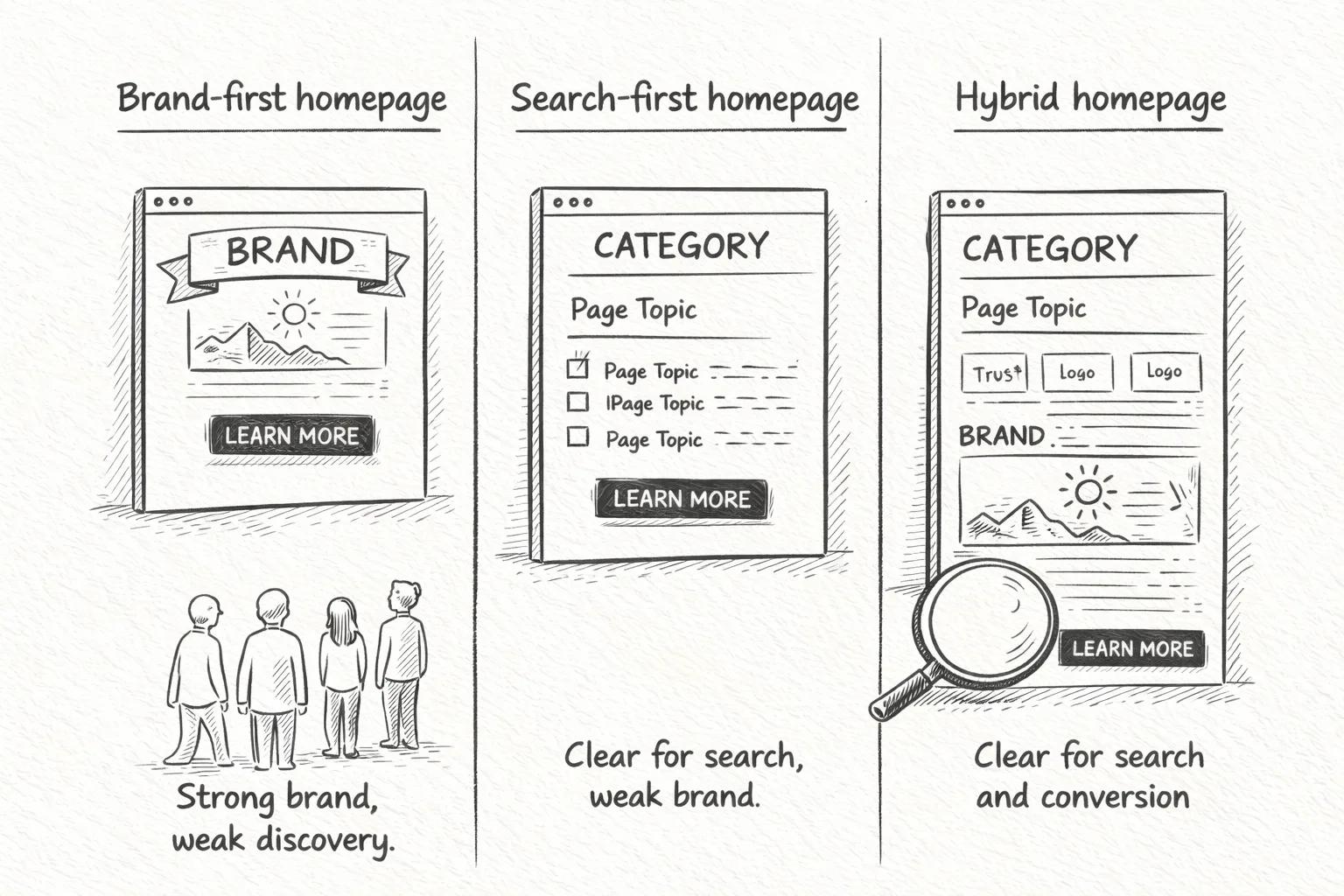
1. Brand-First Homepage (Most Common)
Characteristics
- Mission and vision are focused
- Emotional, aspirational language
- Minimal text, beautiful design
- No keyword optimization
Works for
- Well-known brands (Apple, Nike, Airbnb)
- Companies with heavily paid acquisitions
- Businesses with strong referral traffic
Fails for
- New or growing brands
- Organic-first growth strategies
- Competitive categories
2. Search-First Homepage
Characteristics
- Clear keyword targeting
- Explicit category and audience
- Functional, sometimes bland copy
Works for
- New businesses
- Highly competitive niches
- Companies dependent on SEO
Fails for
- Strong brand-building plays
- Category creators
- Established brands with awareness
3. The Hybrid Homepage (What Actually Works)
This is the model most businesses should use.
Characteristics
- Keyword-rich value proposition in the hero
- Clear problem/solution framing
- The brand story is placed lower on the page
- Strong trust signals and differentiation
Works for
- Most companies
- Growing brands
- Businesses needing discovery and conversion
The Hybrid Homepage Framework
Hero Section: Discovery + Conversion
Bad (Brand-Only)
Transform Your Team’s Potential
We believe in empowering modern businesses.
Good (Hybrid)
Project Management Software for Remote Teams Under 20 People
Simple task tracking, team communication, and progress visibility, without enterprise complexity. Set up in 15 minutes.
Why this works
- Clear category
- Specific audience
- Real benefits
- Searchable language
Section 2: Problem & Solution Clarity
H2: Why Remote Teams Struggle With Project Management
Remote teams often juggle Slack, email, spreadsheets, and docs, leading to missed deadlines and constant confusion.
H2: Everything Your Team Needs in One Place
- Task management
- Team communication
- File organization
- Progress tracking
This section educates users and reinforces keyword relevance naturally.
Section 3: How It Works
H2: Get Started in 3 Steps
- Create your workspace
- Assign tasks and deadlines
- Track progress in real time
This reduces perceived complexity and answers early objections.
Section 4: Social Proof
- Customer logos
- Testimonials with specifics
- Case study links
Trust accelerates conversion, but only after relevance is established.
Section 5: Brand Story (Where It Belongs)
This is where mission, origin, and values live.
Not in the hero.
People care about your story after they know you’re relevant.
Keyword Strategy for Homepages
How to Identify Homepage Keywords
Ask:
- What category are we in?
- Who is our primary audience?
- What would someone search for if they didn’t know us?
Example research:
- project management software- high competition
- project management for small teams- manageable
- Simple project management for remote teams- strong intent, lower competition
Choose:
- Primary keyword → Hero section
- Secondary keywords → Supporting sections
Where Keywords Belong (Naturally)
- Page title & meta description
- H1 headline
- Subhead and section headers
- Body copy (variations, not repetition)
This is about presence, not keyword stuffing.
The Rewrite Process
Step 1: Audit Your Homepage
Score clarity, keyword focus, audience specificity, and searchability.
Step 2: Define One Primary SEO Goal
Example: Rank top 10 for “project management for remote teams.”
Step 3: Rewrite the Hero
Use: [Category] for [Specific Audience]
Step 4: Add Problem/Solution Depth
Speak directly to real pain points using real language.
Step 5: Preserve Brand, But Move It Down
Brand story still matters. It just shouldn’t block discovery.
What Teams Get Wrong About Homepage SEO
We don’t want to look generic.
Clarity first. Differentiation second.
Our story is what makes us special.
Only after someone finds you.
This feels salesy.
Clear is not salesy. Vague is.
Won’t this hurt conversions?
Usually the opposite.
Key Takeaways
- Brand-first homepages rarely rank
- Clear value propositions do
- You can be discoverable and differentiated
- Hero sections should answer “What is this and who is it for?” in 5 seconds
- Discovery comes before story
Your Homepage Needs to Be Found Before It Can Be Felt
Your homepage doesn’t need to choose between telling a brand story and being discoverable in search.
It needs to sequence them correctly.
Discovery comes first.
Story comes second.
Right now, most homepages do the opposite. They lead with aspiration, mission, and brand language, then wonder why only people who already know the brand ever find them.
If nobody finds your homepage, your story never gets read.
The good news is you don’t need to abandon the brand to fix this. You just need clarity upfront:
- What category are you in?
- Who is the product or service for?
- What specific problem does it solve?
Differentiation and brand story still matter, but they work after relevance is established, not before.
To assess this, consider the following:
- Whether your homepage has any real non-branded search potential
- What Google likely understands (or misunderstands) about what you do
- Whether your brand story is helping conversions but blocking discovery
- And what’s realistically worth changing at your stage
You can share a bit of context with us here: https://tally.so/r/3EGEd4
No audits.
No redesign pitches.
No SEO theatre.
Just a short form to understand what your homepage is actually communicating to search engines and to people, and whether leading with clarity would unlock more discovery.
Common Questions About Homepage SEO and Brand Messaging
Because homepages are usually written for conversion, not search intent. Blog posts answer specific questions. Homepages often don’t clearly state a category, problem, or audience, which leaves Google nothing concrete to rank.
It should do both, but in the right order. Keywords establish relevance and discovery. A brand story builds trust after relevance is established. One without the other limits growth.
Yes, but usually for category + modifier terms (audience, use case, industry). Trying to rank a homepage for broad, generic head terms without clarity almost always fails.
Not if done correctly. Being clear about what you do is not salesy. Vague, inflated language is. Specificity actually makes messaging feel more confident and grounded.
Only if the problem is truly shared. Otherwise, pick a primary audience for the homepage and create separate landing pages for secondary audiences. Trying to speak to everyone usually means ranking for no one.
Assuming Google understands its business without being told explicitly. If your homepage doesn’t clearly state what category you’re in and who it’s for, Google won’t infer it correctly.
In most cases, it improves them. Clearer messaging filters out wrong-fit visitors and helps right-fit visitors decide faster. Confusion converts worse than clarity.
Typically 4-12 weeks. Homepage SEO is less about quick wins and more about establishing correct relevance signals that compound over time.
Less, but not never. Established brands can afford vagueness because demand already exists. Growing brands cannot. If organic discovery matters, clarity matters.