Why Your Content Ranks on Google but Still Doesn’t Create Business Results
Summary
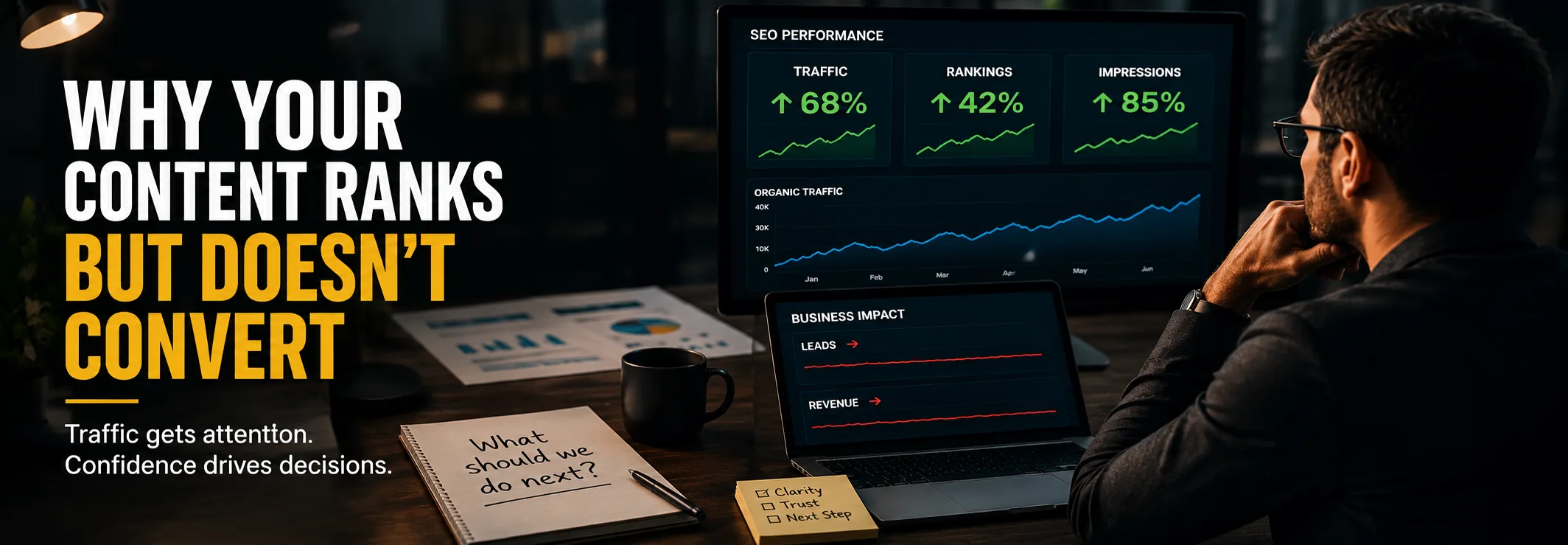
Content can rank on Google and still fail to convert when it gives information but does not reduce buyer doubt. Ranking brings attention. Conversion happens when the content gives clarity, judgement, trust, and a clear next step. The real problem is often not traffic. It is confidence.
Why So Many Ranking Pages Fail
You hit page one.
Traffic grows.
The SEO report looks good.
But leads stay weak.
This is where many businesses get confused.
They assume that if a page ranks, the content must be working.
But ranking only proves that people found the page.
It does not prove that the page helped them decide.
A buyer does not move forward because the article has the right keywords. A buyer moves forward when the article helps them understand the problem better, compare choices, reduce risk, and know what to do next.
The content may be visible. But is it useful enough to influence a decision?
The Hidden Assumption Behind Most SEO Content
Most SEO content is built on one weak assumption:
If we give people enough information, they will take action.
That sounds logical.
But in real business situations, people are not usually stuck because they lack information.
They are stuck because they have too much information and not enough clarity.
They have read five articles.
They have opened ten tabs.
They have compared three vendors.
They still do not know what is right for them.
This is where most content fails.
It explains the topic, but it does not help the reader think better.
That is why many pages rank, get traffic, and still do not create business results.
This same frustration appears in real marketer discussions, where people talk about pages ranking well but failing to convert because the content explains the topic without helping the reader decide what to do next.
Reddit discussion on pages that rank but do not convert
Information Does Not Create Decisions
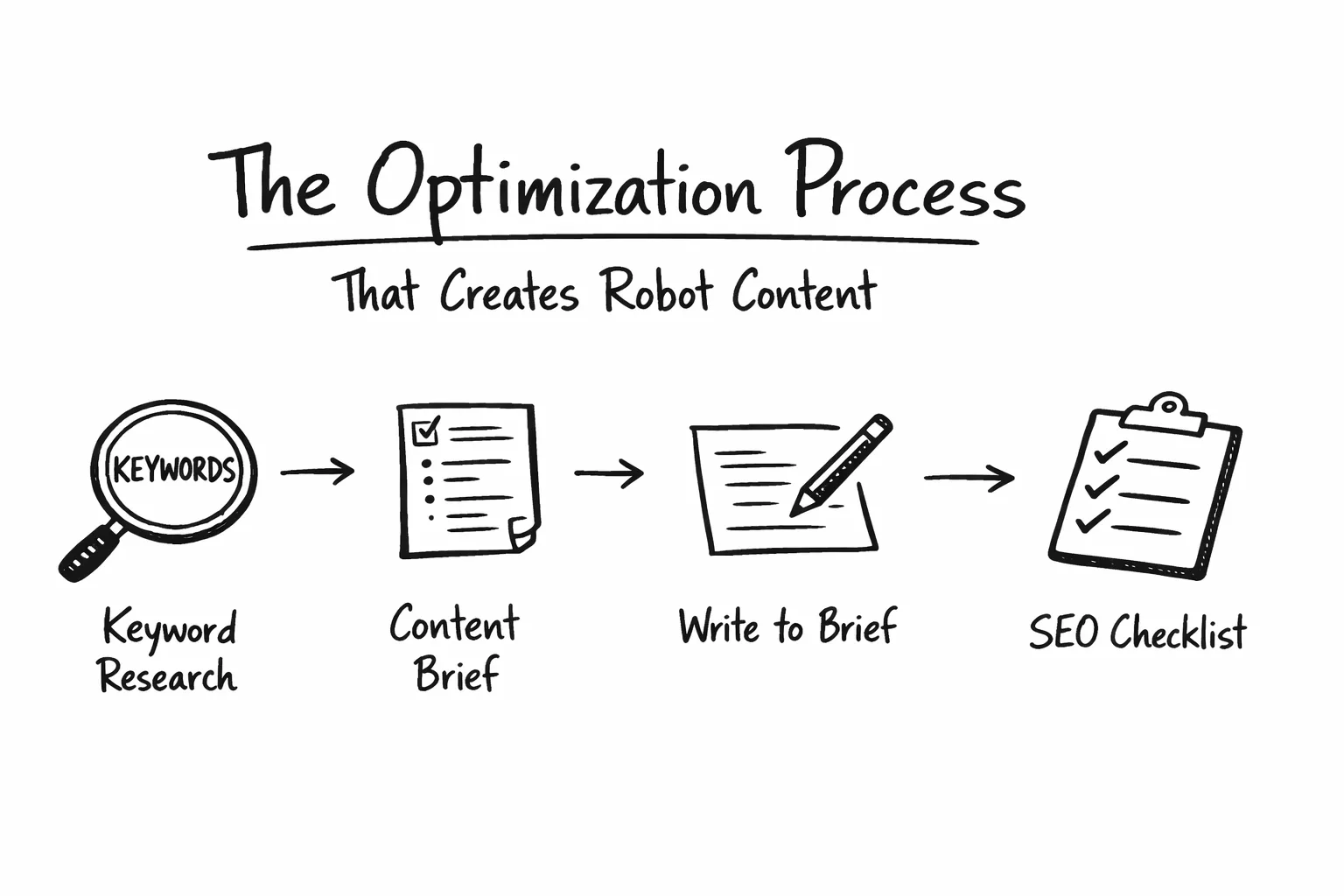
Most content teams are trained to create complete articles.
They add definitions.
They add benefits.
They add steps.
They add FAQs.
Everything looks complete.
But completion is not the same as usefulness.
A business owner searching for lead generation does not need every possible tactic.
They need to know what will work for their stage, budget, team size, and timeline.
A marketing head searching for SEO support does not need another long list of ranking factors.
They need to know what is worth fixing first and what can wait.
This is the difference between information and judgement.
Information tells the reader what exists.
Judgement helps the reader choose what matters.
People are not searching for more information. They are searching for confidence.
Search Intent vs Decision Intent
Search intent tells us what someone typed.
Decision intent tells us what they are trying to resolve.
That difference changes how content should be written.
Search intent: Email marketing best practices
Decision intent: Our emails are not working. What should we fix first, and should we do this ourselves or get help?
Search intent: Best CRM software
Decision intent: Which CRM can our team actually use without creating more confusion?
Search intent: SEO strategy for startups
Decision intent: What should we do first when we have limited time, limited budget, and no strong domain authority?
The keyword is only the surface.
The real business concern sits underneath it.
Content that converts does both. It answers the search query and helps the reader make a better decision.
This is also why many funnels break. We explain this further in Your Funnel Is Backwards: The Search-to-Sale Alignment Model.
A Practical Example: The Lead Generation Article That Did Not Generate Leads
Imagine a company has a blog on lead generation.
The article ranks well.
Traffic grows every month.
But leads remain weak.
On the surface, the article looks useful.
It explains:
- SEO
- Email marketing
- LinkedIn outreach
- Paid ads
- Webinars
- Landing pages
But from a buyer’s point of view, it misses the real questions:
- Which channel should we start with?
- Which one works fastest?
- Which one needs the lowest budget?
- Which one gives better quality leads?
- Which one is risky for a small team?
- What should we avoid wasting money on?
The article gives information.
The buyer needs judgement.
That gap decides whether a page becomes a business asset or just another traffic page.
What AI Search Changes
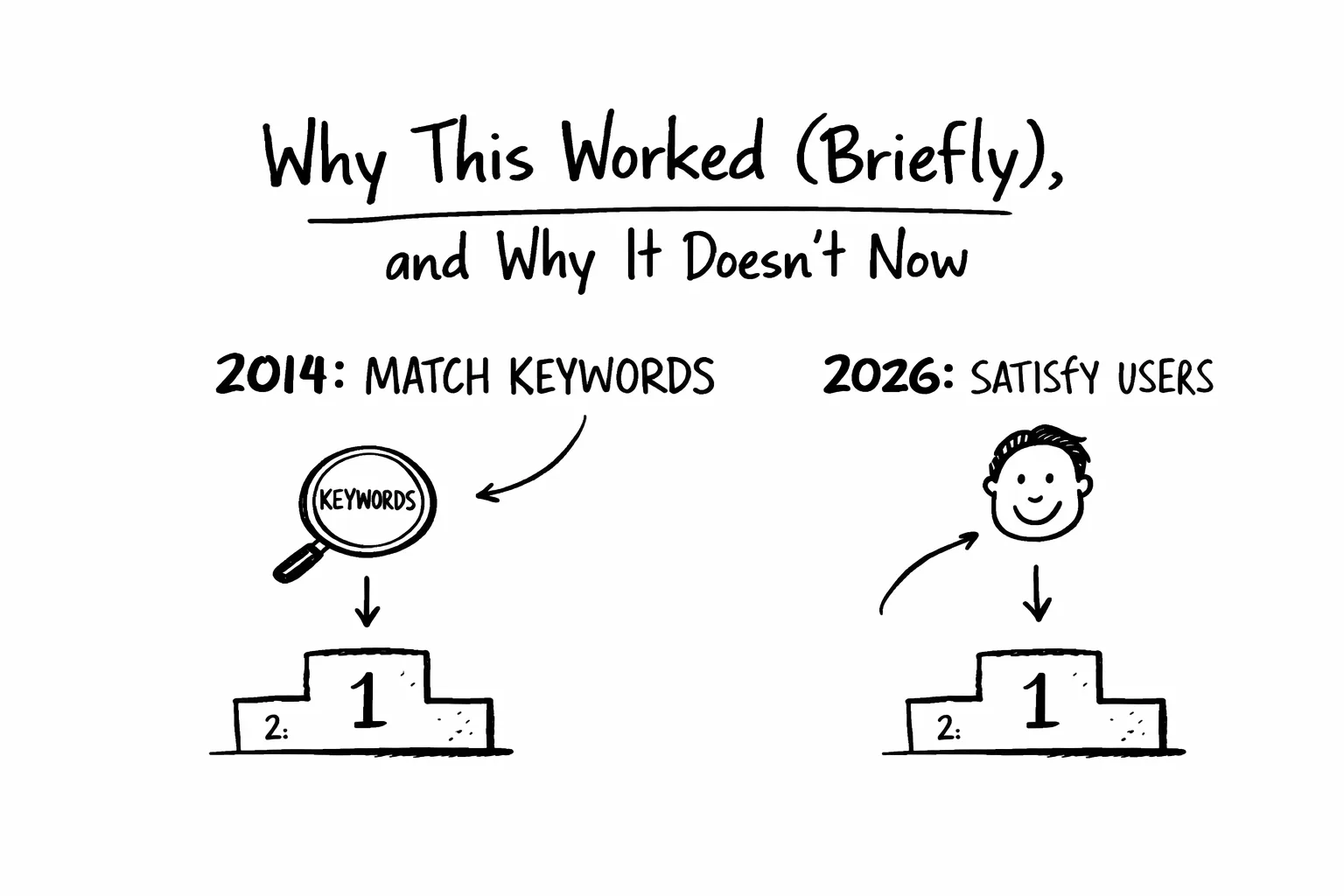
Search is no longer only a list of blue links.
AI systems now read, summarize, compare, and recommend.
This changes the value of content.
It is not enough for a page to contain keywords.
It must be easy to understand.
It must give clean answers.
It must show context.
It must help people decide.
AI search rewards content that can be clearly interpreted and trusted.
Generic content becomes easier to ignore.
Clear, useful, experience-led content becomes easier to cite, summarize, and recommend.
This shift is also discussed in SEO communities where rankings are no longer treated as success if users leave without clarity or confidence.
Reddit discussion on good rankings but poor conversions
For businesses, the message is simple.
If your content does not reduce uncertainty, it may still get traffic, but it will lose influence.
The New Content Test
Instead of asking only whether a page is optimized, ask three sharper questions.
1. Does this reduce uncertainty?
After reading the page, the buyer should feel clearer than before.
If the content only adds more options, more terms, and more noise, it is not doing enough.
2. Does this provide judgement?
Good content does not only explain what something is.
It helps the reader understand what matters, what does not, and what to do first.
3. Does this make the next step obvious?
The reader should not finish the article and think, “Now what?”
A strong page creates a natural next step based on the reader’s stage.
That next step may be a checklist, a comparison, a form, a consultation, or another deeper article.
This is where content starts supporting business outcomes, not just search visibility.
How to Rewrite Ranking Content for Buyers
Start with the real problem, not the keyword
A keyword gives you direction.
It should not control the whole article.
Before rewriting, ask:
- What is the reader worried about?
- What decision are they trying to make?
- What would make them trust this answer?
- What would help them move forward?
Replace generic advice with useful judgement
Weak content says:
“Create high-quality content regularly.”
Stronger content says:
“Start by rewriting your top five high-traffic, low-conversion pages before publishing more blogs. Those pages already have attention. The missing part is usually clarity, trust, or the next step.”
The second version is more useful because it gives direction.
Use business context
Buyers care about impact.
They want to know how the topic affects revenue, time, budget, risk, team effort, and growth.
This is why content should not stop at explanation.
It should connect the topic to real business decisions.
This pattern also connects with what we explain in Organic Traffic but No Conversions.
Write like a person who has seen the problem before
This is where trust is built.
The writing should feel calm, clear, and experienced.
Not dramatic.
Not over-polished.
Not filled with buzzwords.
Just useful thinking.
The Shift Businesses Need To Make
The shift is not from SEO content to non-SEO content.
That is the wrong debate.
The real shift is this:
From answering questions to reducing uncertainty.
That is the new standard.
Google still matters.
Keywords still matter.
Structure still matters.
But they should support the buyer’s decision, not replace it.
The strongest content today serves three needs at once:
- Google needs structure and relevance.
- AI systems need clear answers and context.
- Buyers need trust, judgement, and confidence.
When content serves all three, it becomes stronger than a ranking page.
It becomes a decision asset.
Traffic Does Not Equal Trust
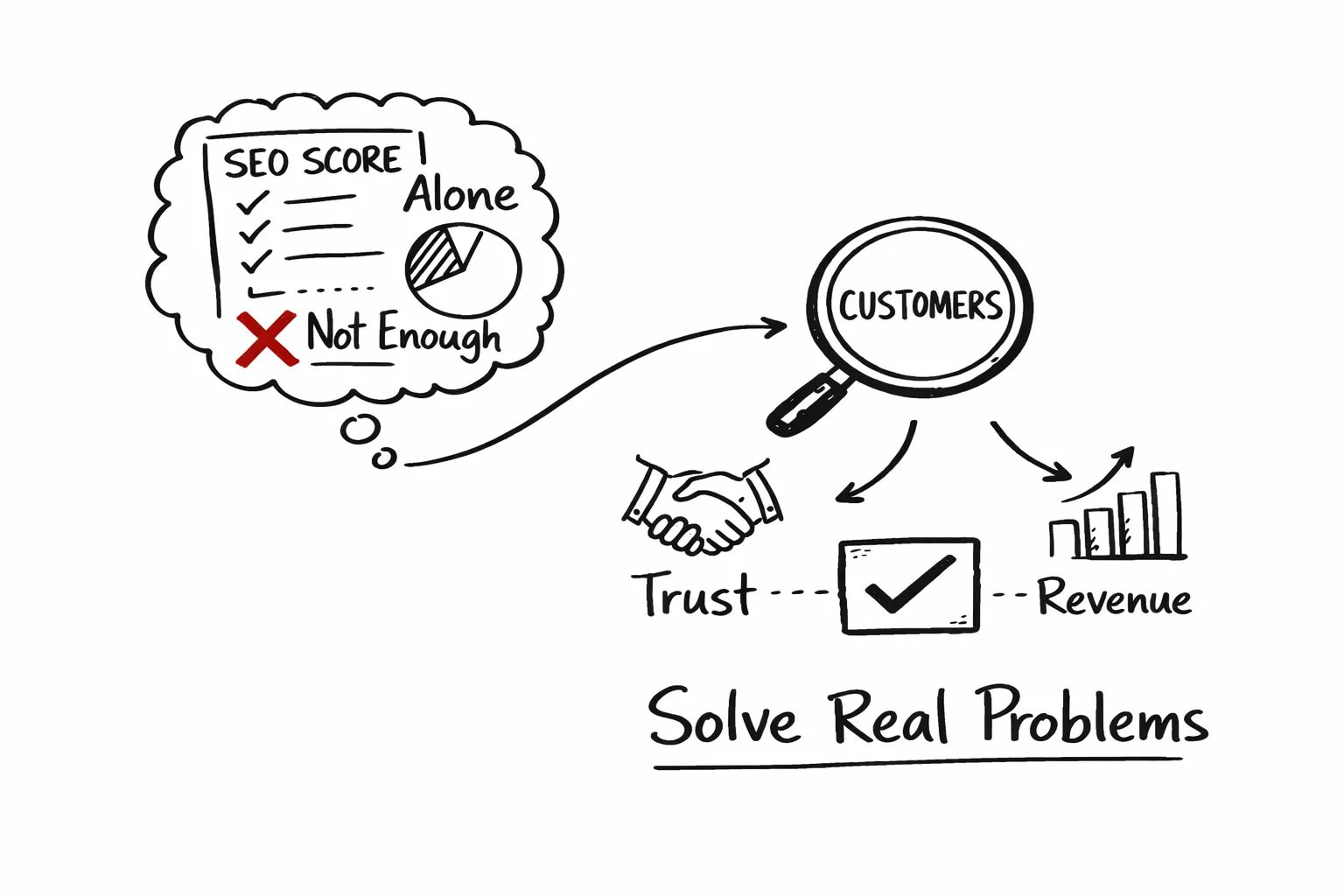
You did not start a business to rank on Google.
You started it to grow trust, demand, and revenue.
SEO is the vehicle.
It is not the destination.
Traffic tells you people arrived.
Engagement tells you whether they cared.
Conversions tell you whether the content helped them move.
If your best-ranking pages are not creating any real business impact, the answer may not be more content.
It may be clearer content.
Sharper content.
Content that helps people decide.
If This Feels Familiar, You Are Not Alone
Most businesses do not have a traffic problem.
Many have a confidence problem.
Their content attracts attention but fails to remove doubt.
And in a world where information is unlimited, the companies that win will not be the ones publishing the most content.
They will be the ones helping buyers make better decisions.
So the real question is simple:
Is your highest-traffic content helping someone decide, or is it only helping Google index another article?
If you want a simple reality check, you can share a bit of context with us here:
No heavy audit.
No SEO scorecard.
No pressure to rewrite everything.
Just a practical look at whether your content is attracting attention or actually shaping decisions.
FAQs
Content ranks but does not convert when it gives information but fails to reduce buyer doubt. The page may bring traffic, but it does not help the reader compare options, trust the business, or take the next step.
Search intent is what someone types into Google. Decision intent is the real problem they are trying to solve. Strong content answers the search query and also helps the reader make a better decision.
Yes. Buyer-first content can rank well when it is clear, structured, useful, and relevant. In many cases, it performs better over time because readers engage with it more and find real value in it.
No. Keywords still matter, but they should not control the writing. The better approach is to answer the buyer’s real concern first, then add keywords naturally where they fit.
Start with high-traffic, low-conversion pages. These pages already have attention, so the biggest opportunity is usually improving clarity, trust, examples, positioning, and the next step.
AI search rewards content that is easy to understand, summarize, and trust. Generic content becomes easier to ignore. Clear content with useful judgement becomes easier for AI systems to cite and recommend.
Ask whether the page reduces uncertainty, provides judgement, and makes the next step obvious. If it does not, it may be ranking without creating real business value.