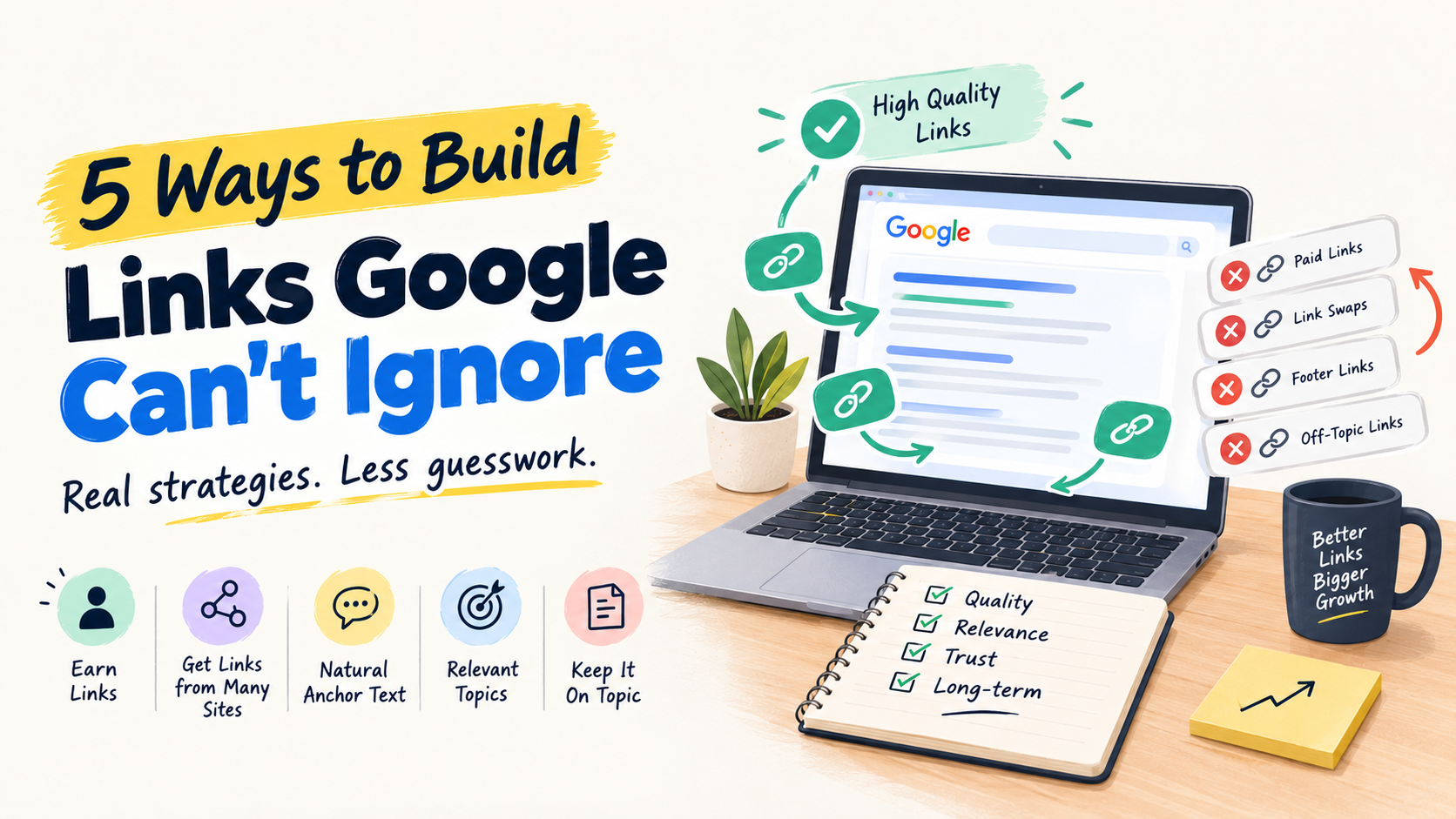
Most people count backlinks. Google doesn’t count them all.
You can have 80 links in your report and still see nothing move. The links are real and they’re live. But Google may be giving most of them very little credit.
Here are five ways to create links that Google can’t ignore, and the mistake behind each one.
How sure are we?
Google never publishes a list of which links count, so nobody outside Google knows exactly. I’ve split the evidence into two kinds, and each section below carries a label:
Google says The point comes from Google’s own documentation or statements.
Research suggests, not confirmed The point comes from patents, leaked documents and SEO research. It’s a careful reading, not Google’s word.
A note on where this post comes from: I got an email from Cyrus Shepard of Zyppy on this topic, and I wanted to rewrite it in simple words for my readers. Big credit to him for the research behind it.
1. Earn the link. Don’t arrange it
Google says
Google calls links made mainly to move rankings “link spam”. Its list includes paid links, link swaps, and guest posts or press releases sent out in bulk to pass credit. Even a free product sent in return for a review with a link counts.
Google has also said its systems aim to cancel these links out. They’re not always penalised. They’re often just not counted, and there’s no warning in Search Console.
A dentist pays for 30 blog links. The report shows 30 new links. Google’s rules treat paid links meant to pass ranking credit as link spam, so most may count for nothing.
Do this: Pay only for ads and sponsorships, and mark those links rel=”sponsored”.
2. Get links from many sites, not many links from one
Google says Research suggests, not confirmed
Google lists widely spread footer, template and widget links as link spam. Research adds that Google likely counts only a limited number of links from one site, so thousands of repeats add very little.
A web agency adds “Website by us” to the footer of every client site. That’s one idea repeated everywhere, so it’s worth about one link, at best.
Do this: Judge a site by whether it links to you once, in the right place. If you build sites for others, use a plain brand name and mark it nofollow.
3. Let the anchor read like a person wrote it
Google says Research suggests, not confirmed
Google’s advice on anchor text is simple. Keep it descriptive, short and relevant to both pages. Don’t stuff keywords, and don’t chain links one after another.
Research suggests Google may also watch patterns over time, such as many links with the same wording, or the same phrase said five slightly different ways. You don’t need a pie chart of exact-match percentages. You need links that read like a person wrote them.
“best cheap plumber Ahmedabad” on ten sites looks arranged. “this checklist for choosing a plumber” inside a helpful sentence looks like someone recommending you.
Do this: Don’t hand out anchor text. Give people a page worth linking to and let them word it.
4. Get links from pages on your topic
Research suggests, not confirmed
Research suggests Google checks that the page linking to you, the words of the link, and the page it lands on all talk about the same thing. Google’s own guide says good anchor text is relevant to both pages.
A cooking blog links to a roofing company with the anchor “best roofer”. Neither page has anything to do with the other, so there’s little reason for Google to trust it.
Do this: Before you chase a link, ask one question. Would that page’s readers care about mine?
5. Keep the page on topic after it earns links
Google says Research suggests, not confirmed
Google calls it abuse to buy an expired domain and fill it with content that doesn’t serve users. That part is confirmed. Research also suggests that when a page’s subject changes, the links it earned earlier may count for less.
A popular guide on wedding photography is turned into a sales page for tax filing. The links were earned for photography, so they no longer fit.
Do this: Keep pages on the same topic the links were about. In a site move, redirect each old page to its closest match, not everything to the homepage.
beats a hundred you arranged.
What to do next
- Earn links. Don’t buy, swap or send them in bulk.
- Count one link per site, not one per page.
- Let others word the anchor.
- Go after sites your readers would actually visit.
- Keep each page on the same topic over time.
One more thing. Don’t rush to disavow links you think look bad. Google’s John Mueller has said you don’t need to disavow random spammy links. Keep it for a serious problem, such as a manual action.
For a quick check, open your backlink report and look at your 20 newest links. For each one, ask: did I pay for it, is it repeated on every page, is the topic wrong, and would a real person click it? The ones that fail are the ones to stop chasing.
Want links that count?
The Thrillax team will look at your links and tell you which help, which don’t, and what to build next.
No long contracts. Just an honest look.
FAQ
Does Google ignore some backlinks?
Yes. Google says links made mainly to manipulate rankings are link spam, and its systems aim to cancel them out. Research suggests repeated and off-topic links may also get little value.
Will Google warn me if my links are ignored?
Usually not. Google has said its link spam updates aren’t manual actions, so Search Console won’t tell you. The links just stop counting.
Are footer links bad?
Google lists widely spread footer, template and widget links as link spam. A normal link in your own site menu is fine.
Should I disavow bad links?
Not for random spammy links, as Google’s John Mueller has said. Use it for a serious problem, such as a manual action.
Is link building still worth it?
Yes, when you earn links by being useful and relevant. Shortcuts are what Google’s systems are built to cancel out.
Sources