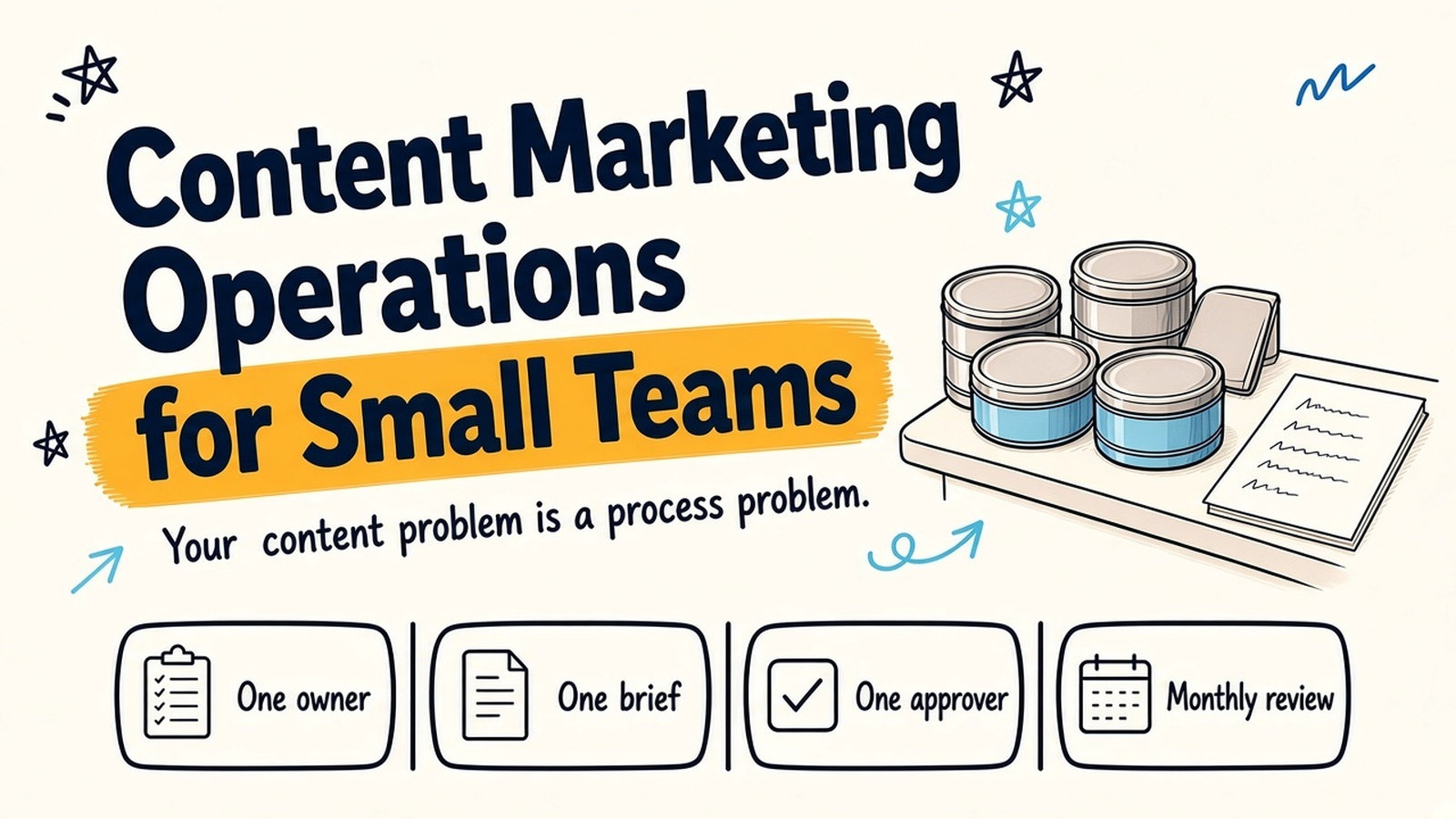
Content marketing operations is the system that moves content from idea to published post to measured result.
It covers who does what, the steps every piece goes through, the tools you use and how you check results.
Strategy decides what to say.
Operations makes sure it actually gets out, on time, every time.
Here is what it looks like for a founder with one marketer and a couple of freelancers, which is most Indian businesses we talk to.
What is content marketing operations?
Think of the Mumbai dabbawalas.
A tiffin leaves a kitchen in the morning and reaches the right office desk by lunch.
Every person in the chain knows their one leg, and they know who to hand it to next.
Nobody waits for a meeting to decide who carries the box.
Each stage has one owner, and one next stop.
Content marketing operations is that same idea for your blogs, posts, emails and videos.
Contentoo describes it as the system of people, processes, technology and governance that moves content from idea to published asset to measured outcome.
Governance just means the rules everyone follows, like brand tone and who can approve.
HubSpot puts it in three words: people, process and technology.
Content strategy vs content operations
These two get mixed up a lot.
Content strategy is what you make, who it is for and why.
Content operations is how it gets made, checked, published and measured.
At the Content Marketing Institute, strategist Andi Robinson explains that strategy sets the direction, and content operations is the engine that makes the strategy work.
Here is a simple way to tell them apart.
“We will write for clinic owners about getting more bookings” is strategy.
“Priya writes the draft by Tuesday and the founder approves by Thursday” is operations.
The real problem is usually not ideas
Most founders we meet have plenty of ideas.
They sit in a notes app, a WhatsApp chat or someone’s head.
The problem is what happens after the idea.
Contentoo’s State of Content study, shared in the same guide, found that internal review and approvals were the most cited bottleneck, at 45%.
Unclear briefs came next at 41%, and the first draft at 40%.
The same guide says 65% of teams already have a process document.
The trouble is that the document does not match how work really moves.
Reviews still happen by word of mouth.
So writing a process is not enough.
People have to actually use it.
Stuck in chat, or one owner per stage.
The 3 parts of content marketing operations
People
Every stage needs one owner.
Not two.
Not “whoever is free”.
Contentoo makes a point we agree with.
In a team of one, the roles still exist, they just sit with one person.
Here is an illustration for a team of three.
The founder approves.
The marketer briefs, publishes and shares.
The freelancer writes the draft.
Process
This is the path every piece of content follows.
We share a simple version below.
Tools
You need very little to start.
A shared doc for drafts, a calendar for dates and a tracker for status.
That can be Google Docs, Google Sheets and your website.
Contentoo’s advice is to add a tool only when it fixes a real, written down friction point.
A new tool will not fix a broken process.
A simple content workflow you can copy
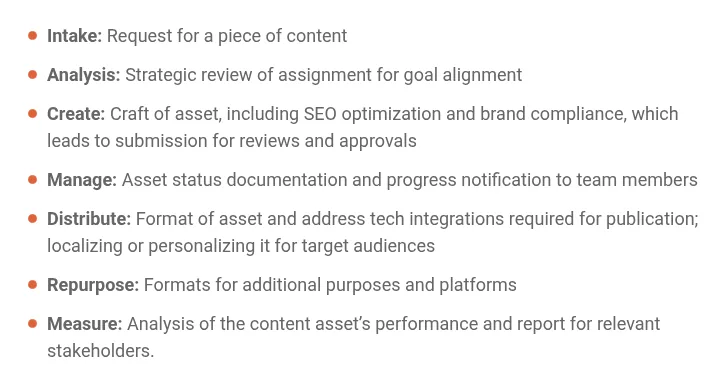
The Content Marketing Institute shares a seven stage lifecycle from Andi Robinson: intake, analysis, create, manage, distribute, repurpose and measure.
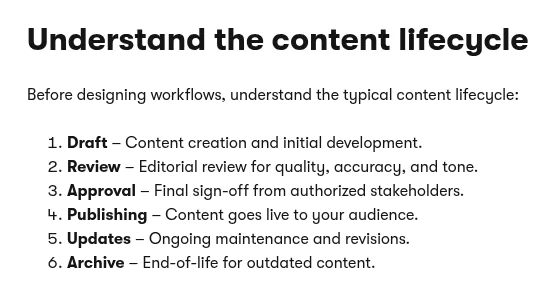
Kentico’s workflow guide keeps it even simpler: draft, review, approval, publishing, updates and archive.
For a small team, we cut it down to seven plain steps.
Idea.
Add it to one shared list, not a chat.
Brief.
One page, filled in before anyone writes.
Draft.
Written by one person, by a set date.
Review.
One reviewer checks facts, tone and links.
Publish.
One person puts it live with the title, meta and images.
Share.
Post it on the channels your buyers use, and send it to your sales team.
Measure.
Look at it again after 30 days.
Kentico says it plainly: every extra approval step adds time.
So keep one approver.
The screenshots in this post are from public pages, cropped to the list.
The brief makes or breaks it
Most rework starts with a weak brief.
Write a blog on GST.
For: kirana shop owners in Gujarat.
One point: how to file GSTR 1 without missing the due date.
Proof: link to the official GST portal page.
Keyword: how to file GSTR 1.
Next step: download our checklist.
The first one makes the writer guess.
The second one tells them exactly what good looks like.
That is an illustration, but it is the kind of brief we use every day.
Five lines. That is the whole brief.
Write a one page brief for the next piece you plan to publish.
Fill in five lines: who it is for, the one point, the proof, the keyword, and what they should do next.
Do not start the draft until those lines are filled in.
Where AI fits, and where it does not
AI makes the draft step fast.
That means the slow step moves to review.
Contentoo’s study found 85% of content teams use AI regularly.
It also found that teams who changed their workflow around AI reported 54% high confidence in output quality, against 34% for teams who just used AI to go faster inside the old process.
So AI works best inside a clear process, with a human checking the result.
Here is how we split it.
AI can help with research outlines, first drafts and turning one blog into social posts.
A human must check facts and numbers, add real examples, keep the brand voice and give the final approval.
Before anything goes live, our reviewer asks four questions.
Is every number linked to its source?
Are any client names in it that should not be?
Do all the links work?
Does it sound like us?
If you want to know how AI detectors judge writing, we covered that in why AI detectors flag your writing.
How to measure content operations
There are two kinds of numbers to watch.
The first kind is about the process.
How many days from idea to live?
How many pieces went out on the planned date?
The second kind is about results.
Enquiries, leads, sales calls and rankings.
Contentoo says to set your targets before the quarter starts, and tie them to business goals, not just page views.
We suggest one short review every month with three questions.
What went out?
What worked?
What do we stop doing?
Common bottlenecks we see
These are patterns we see often, not stories about any one business.
Approvals sit for days.
Fix it with one approver and a fixed reply time, like 48 hours.
There is no brief.
Fix it with the one page brief above.
Posts go live and nobody shares them.
Fix it with a share checklist for every post.
Only one person knows how to publish.
Fix it by writing the publishing steps down once, so anyone can do it.
Pick one approver for your next post and give them a fixed reply time, like 48 hours.
Write your publishing steps down once, so more than one person can take a post live.
Our take
Content marketing operations is not software.
It is a few clear habits.
One owner per stage.
One brief format.
One approver.
One monthly review.
Get those right, and even a team of two can publish every week without chaos.
FAQ
What is content marketing operations?
It is the system of people, process and tools that moves content from idea to published post to measured result.
What is the difference between content strategy and content operations?
Strategy decides what to make, for whom and why.
Operations decides how it gets made, approved, published and measured.
What does a content operations manager do?
HubSpot says they run the day to day operations of the content team, pick the tools, set the processes, and hire and train staff.
In a small business, this is often the founder or the main marketer.
Do small businesses need content operations?
Yes, just a lighter version.
One owner per stage, one brief format and one approver is enough to start.
What tools do I need to start?
A shared doc, a calendar and a simple tracker.
Add more tools only when something keeps breaking.
How do I use AI in content operations safely?
Use AI for outlines and first drafts.
Keep a human for facts, examples, brand voice and final approval.
Content stuck in drafts and approvals?
We can help you set up a simple content system that gets posts out every week. Use our form, or message us on WhatsApp at +91 99131 53530.