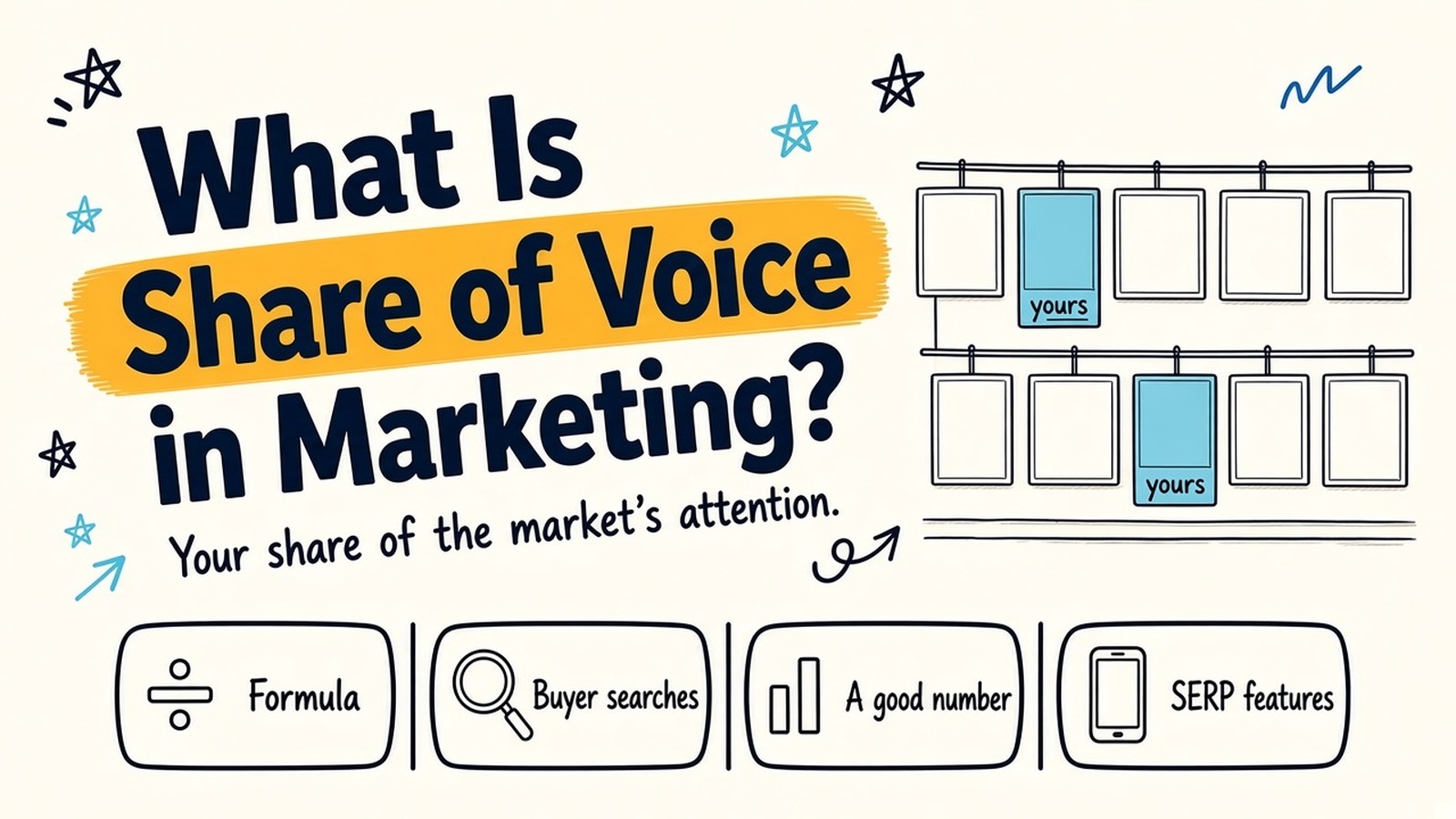
Share of voice is how much of the attention in your market you get, compared with your competitors.
You work it out as your number divided by the total for your whole market, times 100.
A good share of voice is one that is higher than your share of the market, because that is when brands tend to grow.
Now let us make it useful for a founder, a marketing manager or a SaaS team in India.
What is share of voice in marketing?
Picture a busy market lane on a Saturday evening.
There are 10 shop signboards a shopper can see from the corner.
If 2 of them are yours, you own 2 out of 10.
That is your share of voice in that lane.
The market lane.
Marketing works the same way, just across Google, Instagram, news sites and now AI answers.
The idea started with advertising.
Nielsen still defines share of voice as a brand’s media spend as a percentage of all media spend in its category, market and channel.
Today people also measure it in search results, social mentions, press coverage and AI chat answers.
Nielsen also makes a point we like.
Every brand, big or small, gets to pick its own field of play.
You do not need to measure all of India.
You need to measure the place where your buyers decide.
How to calculate share of voice
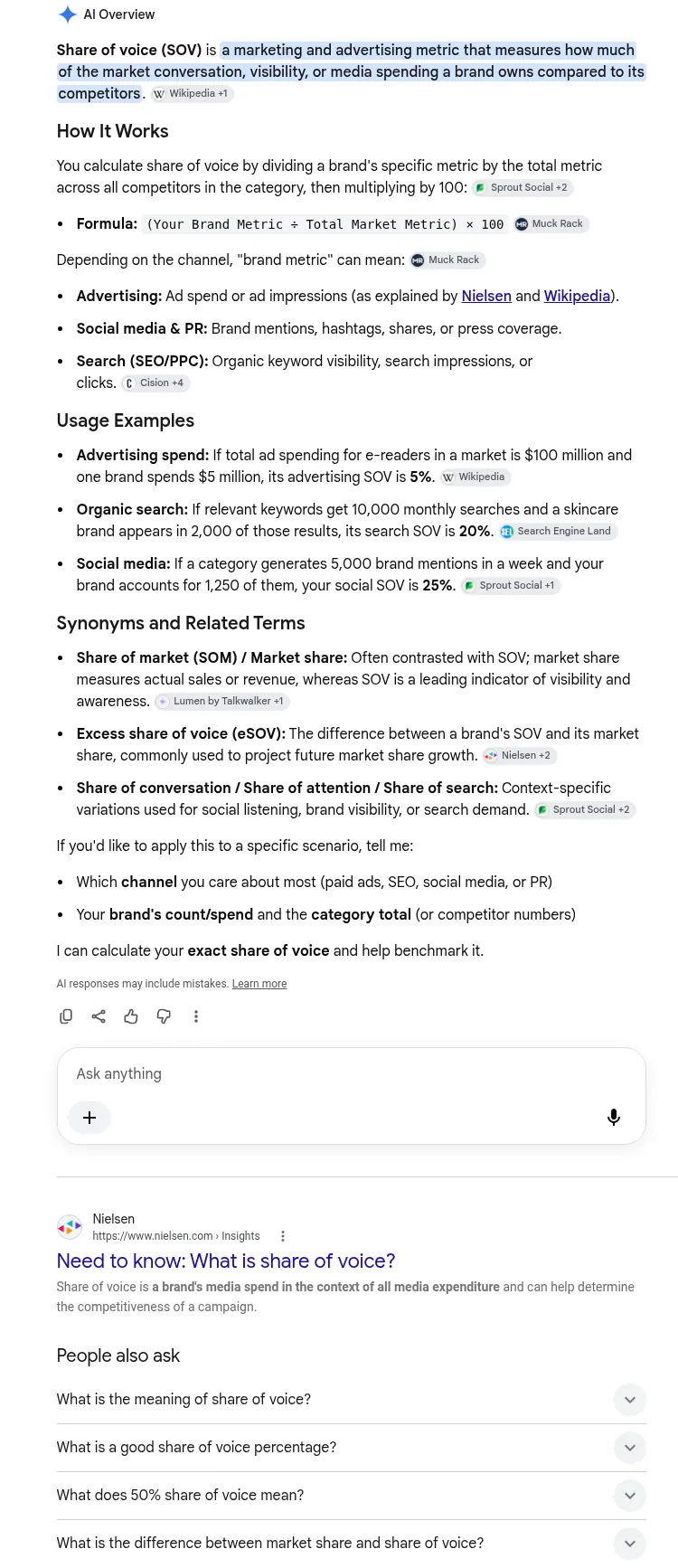
The formula is simple.
Share of voice = your number divided by the market total, times 100.
The only question is which number you count.
That depends on the channel.
Share of voice in ads
In ads, you count spend or impressions.
An impression is one time your ad was shown to someone.
HubSpot points out that Google Ads has an Impression Share column, which shows how often your ads were shown compared with how often they could have been shown.
Share of voice in social media and PR
Here you count mentions.
Add up how many times people mention you, then add up mentions of your competitors.
Divide yours by the total.
Share of voice in AI answers
This is the newest one, and most small businesses skip it.
Write down 10 questions your buyers would ask, like “best GST billing software for small shops”.
Ask them in ChatGPT, Gemini and Perplexity.
Count how many times each brand gets named.
Here is an illustration with made up numbers.
Across 10 answers, brands get named 40 times in total.
Your brand is named 6 times.
6 divided by 40, times 100, gives you a 15% share of voice in AI answers.
Share of voice in SEO
Share of voice in SEO means your share of the visibility on Google for a fixed list of searches.
There are two common ways to measure it.
The first way counts spots.
If you track 20 searches and look at the top 10 results for each, there are 200 spots.
If you hold 20 of them, your share is 10%.
It is quick, but a number 9 ranking on a tiny search counts the same as a number 1 on your biggest one.
The second way weighs spots by estimated clicks.
Ahrefs explains that its Rank Tracker divides the clicks your site gets by the clicks going to all results, across the keywords you track.
A higher ranking gets more clicks, so it counts for more.
The free way to do it
You do not need a paid tool to start.
Pick 20 searches your buyers actually type.
Pick the 3 competitors you actually lose deals to, not the biggest names in India.
Search each one in a private browser window and note who shows up in the top 10.
Count your spots against theirs.
Do the same 20 searches every month.
The mistake we see most
Most people let a tool pick the keywords.
The tool picks searches you already rank for.
So the number looks great and means nothing.
[your brand name]
[your brand name] reviews
[your brand name] contact number
SEO agency in Ahmedabad
Google Ads agency for manufacturers
how to get more enquiries from website
The first list is about you.
The second list is about what buyers search before they pick someone.
Keep the second kind of list fixed for a year.
If the list keeps changing, the number keeps changing, and you learn nothing.
Pick 20 searches your buyers actually type, and the 3 competitors you actually lose deals to.
Search each one in a private window and note who shows up in the top 10.
Keep that list fixed, and do the same 20 searches again next month.
What is a good share of voice percentage?
There is no single good share of voice percentage.
A good share of voice is one that is higher than your share of the market.
The gap between the two has a name.
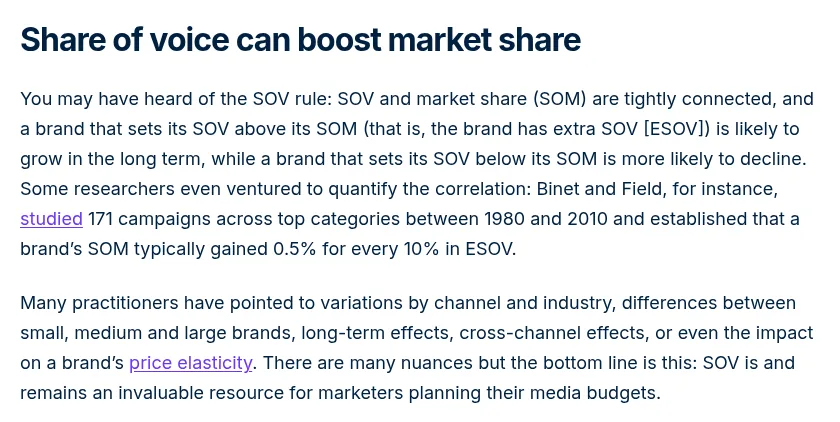
Excess share of voice means your share of voice minus your share of market.
Brands with a positive gap tend to grow.
Brands with a negative gap tend to shrink.
The gap that grows you.
Here is what the research says.
Nielsen’s 2009 analysis looked at 123 brands across 30 categories.
On average, a 10 point gap between share of voice and share of market led to 0.5% extra market share growth over a year.
Brand leaders got about 1.4% of share growth for every 10 points of extra share of voice.
Challenger brands got about 0.4%.
Nielsen also says to measure your own relationship, because results varied a lot across categories and brands.
Les Binet and Peter Field studied B2B brands for LinkedIn’s B2B Institute, using the IPA databank of advertising effectiveness cases.
They found that 10% extra share of voice was linked to 0.7% market share growth a year for B2B brands, and 0.6% for consumer brands, as LinkedIn summarised and as the full report shows.
LinkedIn’s summary also gives a small brand example.
A challenger with 1% of the market is still likely to grow with 2% of the category’s ad spend.
Now the honest part.
These studies are about ad spend, mostly from bigger brands.
Binet and Field call their B2B findings tentative, because the sample was under 50 cases.
So use the rule as a direction, not a target to copy for SEO.
Here is simple arithmetic to show the idea.
If you hold about 5% of your market, a 10% share of search visibility puts you 5 points ahead.
That is a healthy sign.
It is not a sales forecast.
How to find SERP features opportunities
A SERP is the search engine results page.
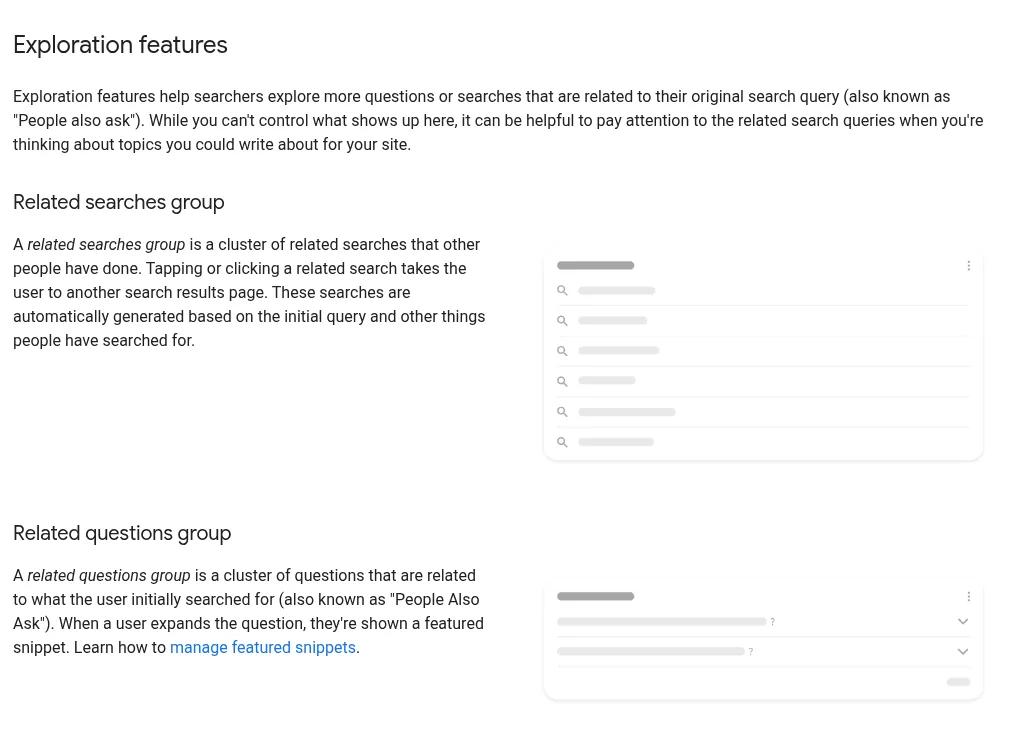
SERP features are the boxes on it that are not plain blue links.
Think People Also Ask, videos, images, the map pack and AI Overviews.
These boxes often sit above the blue links.
So this is where share of voice in search is won or lost.
The crowded results page.
Here is how to find the ones you can win.
Start with searches where you already rank.
Open Google Search Console and look at the Performance report.
Filter for searches where your average position is between 1 and 20.
Serplify notes that Google fills most features from pages it already ranks, which is why this list comes first.
Look at the real results page.
Search each one in a private window, the way a buyer would.
Check it on your phone too, because many buyers search on mobile.
Write down every box and who owns it.
Make a simple sheet with four columns.
Search, features on the page, who owns each one, and whether it is you.
Mark what you can realistically win.
Not every box can be won.
A map pack spot needs a complete Google Business Profile.
A People Also Ask spot needs a short, direct answer under a heading that matches the question.
An AI Overview can cite you, but nobody owns it.
Google itself says you cannot control what shows up in People Also Ask, but the questions are useful when you plan what to write.
Score and pick.
Give each opportunity a score for three things.
How high the box sits on the page.
How much work it takes.
How strong the current owner is.
Start with high boxes, low effort and weak owners.
One thing older guides get wrong
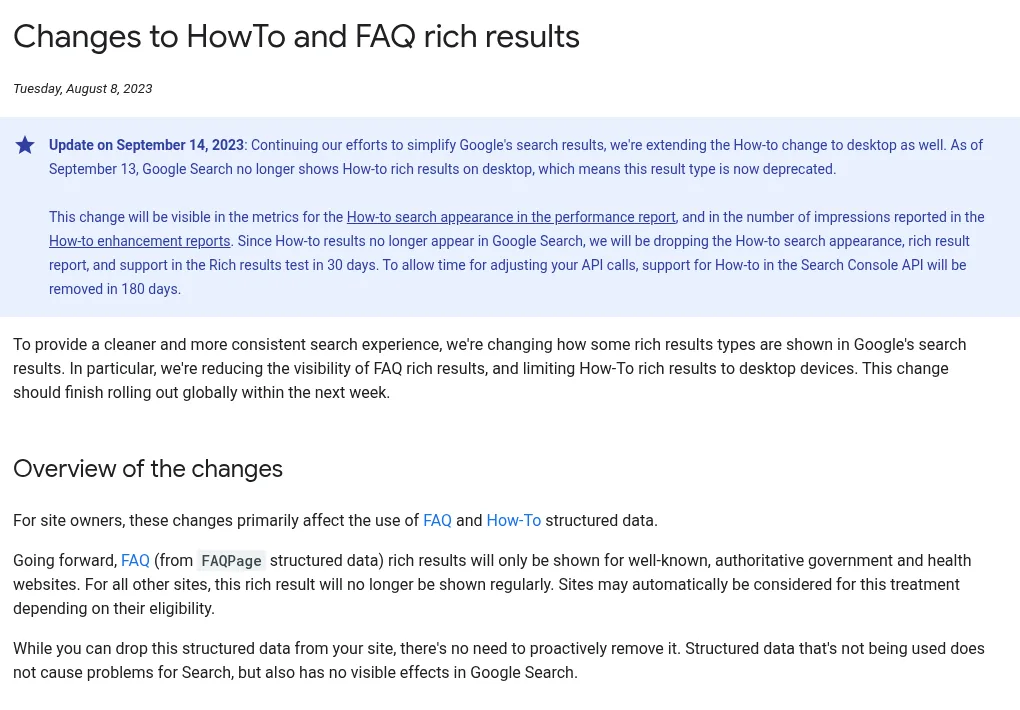
Many older guides still tell you to add FAQ schema to win more space.
Schema is code that tells Google what is on your page.
But in August 2023, Google limited FAQ rich results to well known, authoritative government and health websites.
It later dropped HowTo rich results completely.
So FAQ schema alone will not win you extra space for most business websites.
Clear answers on the page still matter.
Our take: where share of voice actually matters
We look at share of voice as a reality check, not a vanity number.
A bigger slice of the wrong searches does nothing for sales.
A bigger slice of the 20 searches your buyers make before they call someone can change your month.
So here is what we suggest.
Measure against the 3 rivals you lose deals to.
Use the same 20 buyer searches every month.
Count AI answers too, because many buyers now ask ChatGPT as well as Google.
Go after SERP features on searches where you already rank.
And compare your share of voice with your share of the market, not with 100%.
Open Google Search Console and list the searches where your average position is between 1 and 20.
Search each one in a private window, on your phone too, and write down every box and who owns it.
Start with the high boxes that take little work and have a weak current owner.
Share of voice is your share of the attention in your market compared with competitors.
Formula: your number divided by the market total, times 100.
In SEO, use a fixed list of buyer searches and your 3 real competitors.
A good share of voice is higher than your share of the market.
Research links 10 points of extra share of voice to about 0.5% to 0.7% extra market share growth a year.
Win SERP features on searches where you already rank.
What is a good share of voice percentage?
There is no single number.
Aim for a share of voice higher than your share of the market.
Nielsen found a 10 point gap led to about 0.5% extra market share growth a year on average.
What is the difference between share of voice and market share?
Market share is your share of sales in your category.
Share of voice is your share of attention, like ad spend, mentions or search visibility.
What is excess share of voice?
It is your share of voice minus your share of market.
A positive number is linked to growth.
A negative number is linked to decline.
How do I measure share of voice for free?
Pick 20 buyer searches and your 3 real competitors.
Search each one in a private window, count who holds the top 10 spots, and repeat every month with the same list.
Can I measure share of voice in ChatGPT or Google AI Overviews?
Yes, by hand.
Ask 10 buyer questions, count how often each brand is named, and divide your count by the total.
Which SERP features can a small business realistically win?
People Also Ask, the map pack with a complete Google Business Profile, images and videos are the most realistic.
AI Overviews can cite you but cannot be owned.
Want to know your real share of voice?
We can check the searches your buyers make, see who shows up, and tell you where you can win. Use our form, or message us on WhatsApp at +91 99131 53530.