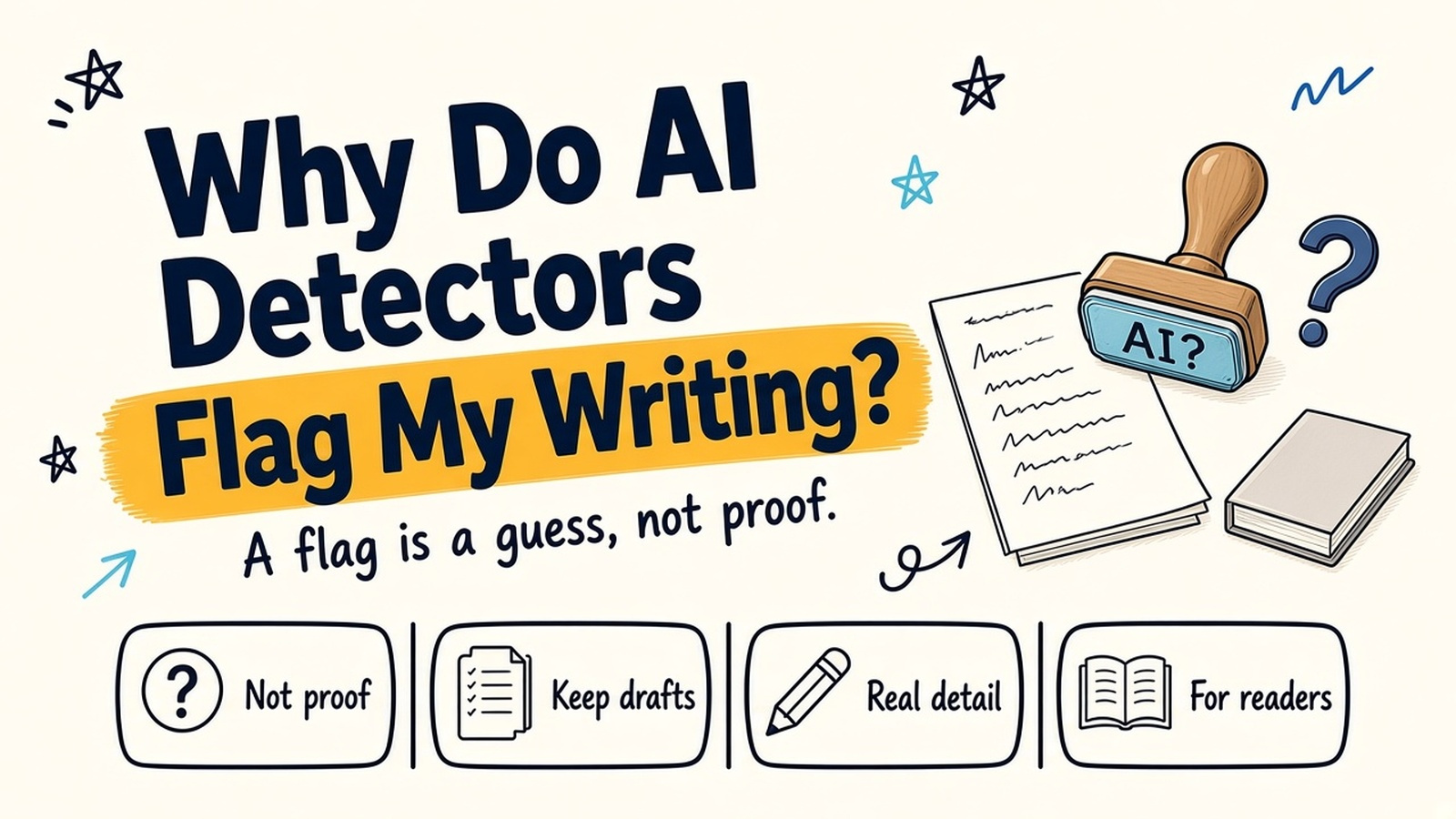
AI detectors flag your writing because it looks predictable to them, not because they caught you using AI.
They check how easy your next word is to guess and how even your sentences feel.
Clear, formal, carefully edited writing can look exactly like that, so a flag is a guess, not proof.
Now let me show you what is really going on, and what we do about it when we write for clients.
They only see the finished page.
What an AI detector actually checks
An AI detector does not see how you wrote something.
It only sees the finished text.
Then it asks one question.
Does this look like the kind of text a language model would produce?
Older tools did this with two simple ideas.
The first is perplexity.
GPTZero explains it as how likely an AI model would have picked the exact same words you used.
Their own example: “Hi there, I am an AI” is easily finished with “assistant.”
That is low perplexity, so it looks like AI.
If the next word was “potato,” that is a surprise, so it looks more human.
The second is burstiness.
That means how much your writing changes across the whole piece.
People usually mix short lines with long ones.
AI tends to keep the same steady rhythm.
Newer tools have moved on from these two simple scores.
GPTZero itself says it stopped using perplexity and burstiness in autumn 2023 and moved to a deep learning model.
Turnitin says its model is not programmed to check burstiness or perplexity directly, and learns patterns from training data instead.
But the core idea is the same.
They are all judging patterns in the text.
None of them can see your drafts, your notes or your thinking.
Why your own writing gets flagged
Your writing is very clean and very safe.
Safe phrases are easy to predict.
A research paper in AI and Ethics uses this sentence as an example: “The findings of this study have important implications for future research in this field.”
The authors point out it may score as predictable no matter who wrote it.
Every sentence has the same shape.
Same length, same rhythm, same start.
That is the low burstiness pattern detectors were built to notice.
English is not your first language.
This one is serious.
Stanford researchers led by Weixin Liang and James Zou tested seven popular detectors on 91 TOEFL essays written by students who learned English as a second language.
The detectors wrongly marked more than half of them as AI written, with an average false positive rate of about 61%, as Stanford HAI reported.
On essays by US eighth graders, the same detectors were close to perfect.
In the published paper, the authors explain why.
Writers working in a second language often use a smaller range of words, so their text is easier to predict.
When the team used ChatGPT to make the word choices richer, the false positive rate dropped from 61.3% to 11.6%.
Think about that.
The detectors trusted the AI polished version more than the real student’s own writing.
Turnitin was not part of that study, and it has said it included second language learners when building its own dataset.
Still, if you write in English as your second or third language, like most of us in India, this is worth knowing.
The piece is short.
Less text means less evidence.
OpenAI said its own classifier was very unreliable on texts under 1,000 characters.
Turnitin will not even score a document with fewer than 300 words of prose.
Your words are already out there.
A computer science professor at the University of Pennsylvania told NPR that language models tend to find text from their training data unusually predictable.
Science blogger Janelle Shane tested excerpts from her own 2019 book.
One detector said it was 98.7% sure a passage was machine generated.
She had written it herself.
You use common writing habits.
In the same NPR piece, he named habits that can push a score toward AI.
The word “delve,” lots of em dashes, ideas grouped in threes, and opening lines with words like “notably” or “crucially.”
He also said detectors weigh patterns across the whole piece, so one word alone does not mean a bot wrote it.
A simple example: weak sentence vs. fixed sentence
Here is the kind of line that reads as generic, to people and to detectors.
In today's fast paced digital world, it is important for businesses to leverage social media to enhance their online presence.
Nothing in it is wrong.
But anyone, or any tool, could have written it.
There is no person, no place, no detail.
Last month a bakery owner asked me why his Instagram had 2,000 followers but zero enquiries. We looked at his bio. There was no phone number.
This is an illustration, not a real case, but notice what changed.
There is a real situation.
There is a specific problem.
The sentences are short, then shorter.
It sounds like someone who has actually done the work.
That is the fix.
Not tricks.
Real detail from real experience.
Generic is easy to guess. Detail is not.
Open one page on your site.
Highlight any line that could sit on a competitor’s website.
Rewrite it with a real detail only you can add: a number, a process step, a place or a problem you actually saw.
The tools themselves say they are not proof
This is the part most people miss.
The companies that make these tools have said it clearly.
OpenAI launched an AI text classifier in January 2023.
In its own announcement, it said the tool correctly caught only 26% of AI written text and wrongly labelled human text as AI 9% of the time.
On July 20, 2023, OpenAI took it down “due to its low rate of accuracy.”
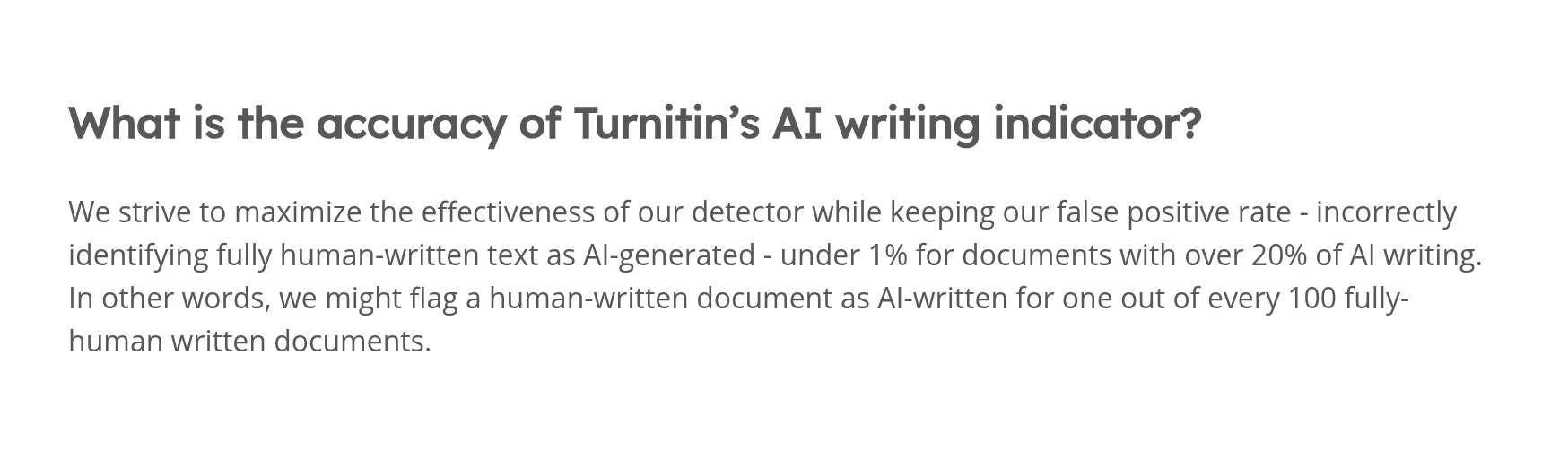
Turnitin says it aims to keep false positives under 1% for documents with over 20% AI writing.
In its own words, that means it might flag one out of every 100 fully human written documents.
It also says its score “should not be used as the sole basis for action.”
And it hides scores between 1% and 19%, showing only an asterisk, because low scores are more likely to be false positives.
Tools also disagree with each other.
A 2026 study of 135,389 edited manuscripts found that false positive rates on human writing ranged from 0% to 100% across 13 detectors, according to the EMNLP paper.
The same edits raised the AI score in some tools and lowered it in others.
So if one tool says 80% AI and another says 5%, both are just guesses.
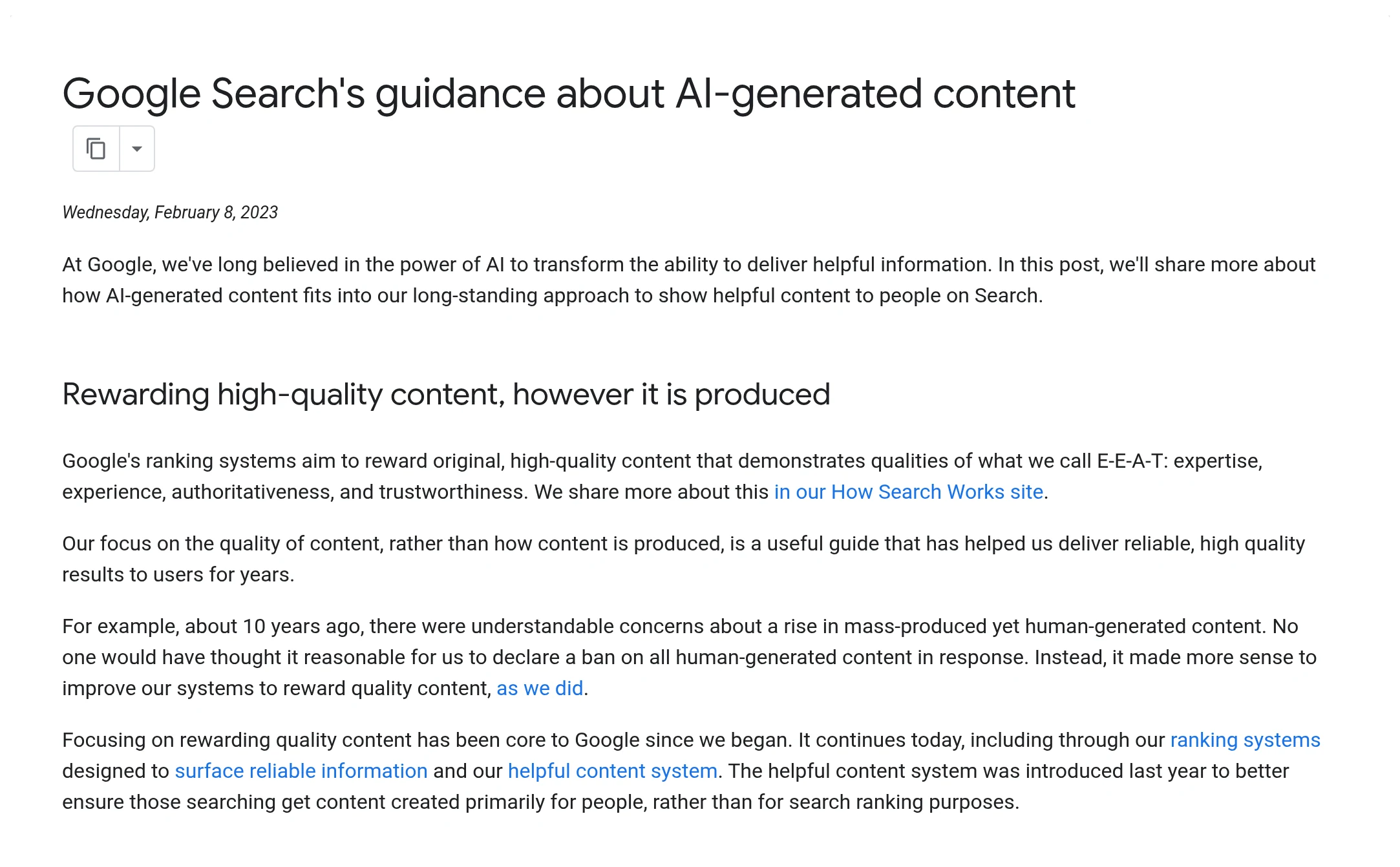
The screenshots in this post are from public pages, cropped to the article.
What Google thinks about AI content
If you run a business, this is the question that actually matters.
You are not writing for a detector.
You are writing for customers and for Google.
Google’s official guidance says its focus is on “the quality of content, rather than how content is produced.”
It also says appropriate use of AI is not against its guidelines.
What Google does treat as spam is using automation to make content mainly to manipulate rankings.
And it is blunt about the rest: “Using AI doesn’t give content any special gains. It’s just content.”
So a detector score is not a Google score.
Google says it rewards original content that shows experience, expertise, authority and trust.
Our take at Thrillax
We use AI in our work every day.
It helps us research faster and draft faster.
But we never ship a page just because a detector said it looks human.
We ask one question instead.
Would a real customer find this useful, and does it sound like someone who has done the job?
If the answer is yes, the detector score does not matter much.
If the answer is no, a “100% human” score will not save it.
Chasing detector scores leads to strange writing.
People add random words, break grammar on purpose or run text through “humanizer” tools.
That makes the page worse for the people reading it.
Write for the reader, not for a score.
What to do if your writing gets flagged
If you are a student or writer
Keep your drafts, notes and version history.
Google Docs and Word both save versions over time.
Be ready to talk through how you wrote it.
Ask which tool was used, and remind them that even the tool makers say the score is not proof.
If you are a business owner
Do not panic about a detector score on your website or blog.
Check the page like a customer would.
Add things only you can add: your real numbers, your real process, your photos, your opinion.
Name the people you are writing for.
Cut lines that could sit on any company’s website.
If you use AI to help you write
Use it for the first draft or the outline, then put yourself in it.
Add the story from last week.
Add the mistake you made once.
That is what makes writing useful, and it also happens to make it read less like a machine.
Turn on version history in Google Docs or Word, and keep your notes with the draft.
If you run a business, add one thing only you can add to a page: a real number, a photo of the work, or a short note on how you actually do the job.
FAQ
Why is my essay flagged as AI when I wrote it myself?
Detectors judge patterns, not authorship.
Formal, predictable, evenly paced writing can match what they think AI looks like, especially in short pieces or when English is your second language.
Can AI detectors be wrong?
Yes.
OpenAI shut down its own classifier for low accuracy, and Turnitin says it may flag about one in every 100 fully human documents.
Can using Grammarly get my writing flagged as AI?
Turnitin says normal spelling and grammar fixes from Grammarly were not flagged in most of its tests.
But it says text made with Grammarly’s generative features, like drafting or paraphrasing, will likely be flagged.
Are AI detectors biased against non native English speakers?
A Stanford study found seven detectors wrongly flagged more than half of TOEFL essays as AI written.
Turnitin says it accounted for second language learners in its own dataset.
Does Google penalize AI content?
Not just for being made with AI.
Google says it rewards helpful, original content however it is produced, and treats content made mainly to game rankings as spam.
How do I prove I wrote something myself?
Show your drafts, notes, sources and version history.
Explaining your process out loud is often the strongest proof you have.
Should I use an AI humanizer tool?
We would not.
It tends to make writing worse for readers, and readers are the ones who matter.
Want content that sounds like you?
If your website or blog sounds like everyone else’s, we can help you fix it with real detail and a clear voice. Use our form, or message us on WhatsApp at +91 99131 53530.