A creator says yes.
You send the product.
The reel goes up.
And there is no Ad label on it.
ASCI influencer guidelines say every paid or gifted post needs a clear label.
The brand is responsible too, not only the creator.
This post covers a simple influencer contract in India and the disclosure rules under ASCI and the Department of Consumer Affairs.
It is not legal advice.
We are not your lawyers.
If your campaign is large, if you want to reuse the content as ads, or if you sell in finance or health, ask a qualified lawyer to review your agreement.
If you are new to creators, start with our influencer marketing playbook for Indian founders.
Think of getting a new signboard painted for your shop.
You agree the size, the wording, whether the painter can show your board in their work, and when you pay.
A creator agreement is that same paper, just for a reel.
You agree the signboard in writing first. A creator agreement is that same paper, just for a reel.
What to put in a simple influencer agreement
Write these influencer agreement clauses down, and get a clear yes, before anything is shot.
A one page note or an email is enough for a small campaign.
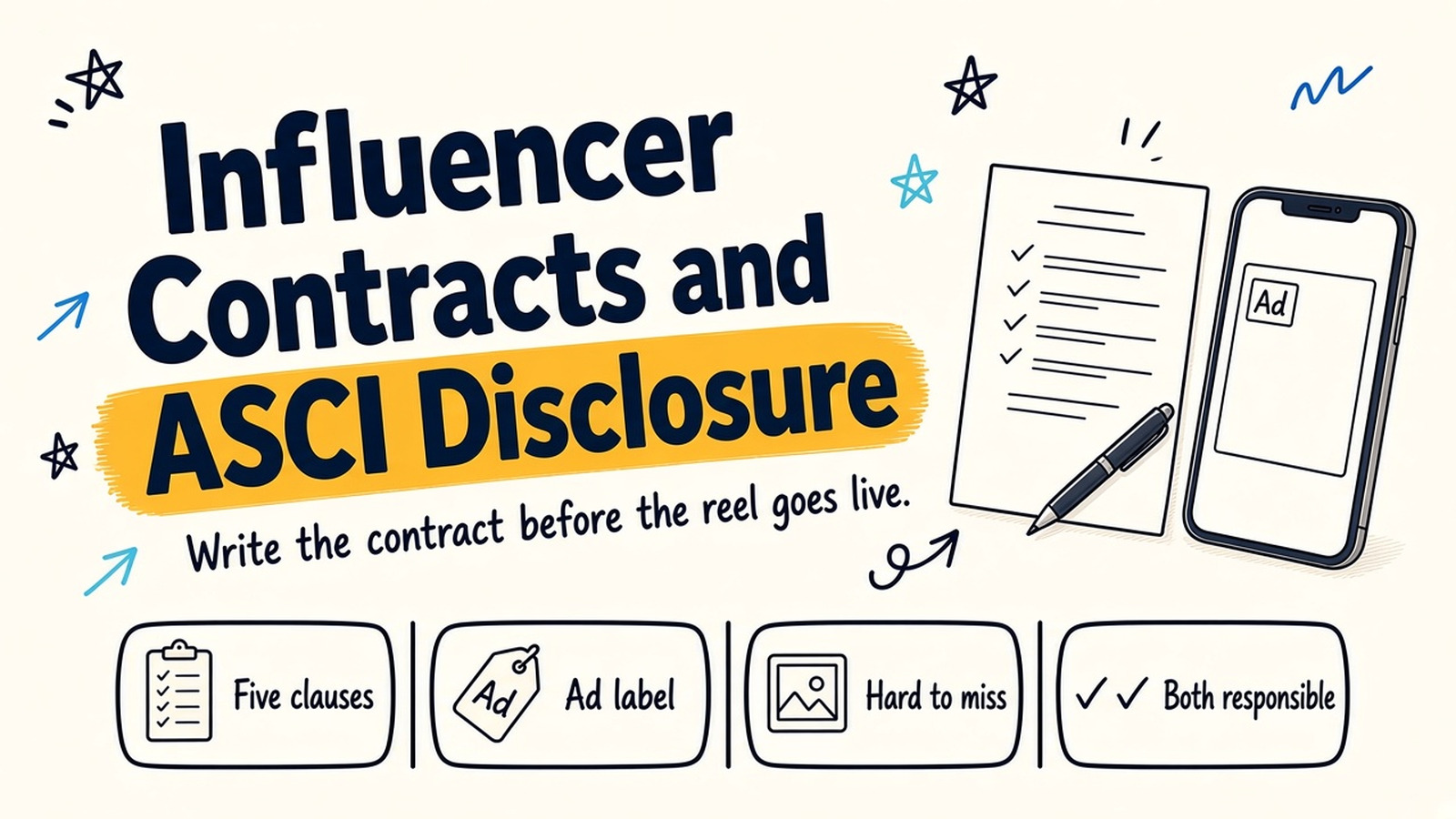
Five clauses on one page: deliverables, usage rights, payment, approvals and disclosure duty.
Deliverables.
How many reels, stories or posts?
On which platform?
By which date?
What should they show, and what must they not claim?
Usage rights.
Can you repost their reel?
Can you use it on your website?
Can you run it as an ad?
For how long?
If you want to reuse the content, say so in writing before they shoot.
Payment.
Write the fee, the free product, or both, when you pay, and what happens if the post is late or never goes up.
Approvals.
Write whether you see the post before it goes live, and how fast you will reply.
Disclosure duty.
Write the exact label you expect, such as Ad, Collaboration, or Instagram’s Paid Partnership tag, and that it must be upfront and hard to miss.
ASCI says the advertiser and the influencer are both responsible. (ASCI)
The influencer makes the disclosure.
The advertiser makes sure the post follows ASCI’s code, and can ask the influencer to delete or edit the post or the label.
ASCI influencer guidelines: when a label is required
ASCI, the Advertising Standards Council of India, publishes the Guidelines for Influencer Advertising in Digital Media. (ASCI)
The test is a “material connection” between you and the creator.
That includes money, free products (even unsolicited ones), discounts, gifts, trips, hotel stays, coverage, awards, or a family or employment relationship.
If one exists, the post needs a label, even if the review is unbiased and even if you never asked them to mention you.
If a creator bought your product themselves and there is no material connection, ASCI says no disclosure is required.
What the #ad disclosure rules in India require
ASCI says the label must be upfront and prominent, so an average consumer does not miss it.
Do not leave it only in the bio, only at the end, or behind a “more” click, and do not bury it in a group of hashtags or links.
On a picture or story with no caption, put the label on the image itself.
Put the label on the image, upfront and hard to miss, not in a pile of hashtags.
For videos, ASCI sets timings:
- 15 seconds or less: at least 3 seconds on screen.
- Longer than 15 seconds but under 2 minutes: a third of the video’s length.
- 2 minutes or longer: the whole section where the brand is mentioned.
In live streams, announce the label at the beginning and the end, and add it to the caption if the video stays up afterwards.
On audio, announce it at the beginning and the end, and before and after every break.
You may also use the platform’s disclosure tool, in addition to the creator’s own label.
Permitted labels include Advertisement, Ad, Sponsored, Collaboration, Partnership, Employee, Free gift, Affiliate, Instagram’s Paid Partnership tag and YouTube’s Includes Paid Promotion tag.
ASCI’s own guideline page shows the label as #Ad.
The label should be in English or in the language of the ad.
A virtual influencer must also say upfront that it is not a real human.
What the Department of Consumer Affairs asks for
The department released “Endorsements Know-hows!” on 6 March 2023 for celebrities, influencers and virtual influencers. (Department of Consumer Affairs)
It says disclosures must be “clear, prominent, and extremely hard to miss”, and not mixed with a group of hashtags or links.
On a picture, the disclosure should be superimposed over the image.
In a video or live stream, it should be in both audio and video, and displayed continuously and prominently during the entire stream.
That is stricter wording than ASCI’s video timings, so the safer course is to keep the label on screen throughout and say it out loud.
For paid or barter endorsements, it lists advertisement, ad, sponsored, collaboration or partnership, as a hashtag or headline text.
It also says individuals must not endorse a product or service they have not personally used or experienced, or on which they have not done due diligence.
We will not guess at penalties here.
If a claim could mislead a buyer, keep it out of the brief.
Extra rules for finance and health
ASCI says creators giving advice on banking, financial services and insurance, or on health and nutrition, must hold relevant qualifications and show them upfront.
For stock or investment advice, that means SEBI registration, with the number shown beside their name.
For other financial advice, ASCI mentions qualifications such as an IRDAI insurance licence, a CA or a CS.
For health and nutrition, it lists a medical degree, or a certified nurse, nutritionist, dietician, physiotherapist or psychologist, depending on the advice.
Creators without these qualifications may still share generic information that is not technical advice, such as a chef talking about a meal service.
When to bring in help
A one page agreement works for a small first test, though a lawyer should check your template once.
Help is useful when you brief many creators, reuse content as ads, or work in finance or health.
That is what our influencer marketing work is built for.
The short version
- This is practical guidance, not legal advice.
- Agree deliverables, usage rights, payment, approvals and disclosure in writing first.
- Any material connection, even a free product, needs a clear, upfront label.
- On videos of 15 seconds or less, ASCI wants the label on screen for at least 3 seconds.
- Consumer Affairs says disclosures must be clear, prominent and extremely hard to miss.
- Finance and health creators must show their qualifications upfront.
FAQs
What are the ASCI influencer guidelines?
ASCI’s rules for influencer ads in digital media.
Any post with a material connection, including a free product, needs a clear, upfront label.
Do influencers in India have to use #ad?
They need a clear label.
#Ad is one option; Collaboration, Sponsored, Partnership and Instagram’s Paid Partnership tag are others.
What should an influencer contract in India include?
Deliverables, usage rights, payment, approvals and the disclosure duty.
It is a checklist, not legal advice.
Who is responsible if the label is missing?
ASCI says both the advertiser and the influencer.
The advertiser can ask the influencer to delete or edit the post or the label.
Do I need a lawyer for a small campaign?
A one page agreement is a sensible start.
Ask a lawyer to review your template if the campaign is large, if you want to run the content as ads, or if you are in finance or health.
This post is not legal advice.
Want a second look at your creator agreement and disclosure plan?
Book a free 20 minute growth review. We will look at your agreement, your label and your tracking, and tell you honestly what to fix before the first post goes live. Use our form, or message us on WhatsApp at +91 99131 53530. The first conversation is free.