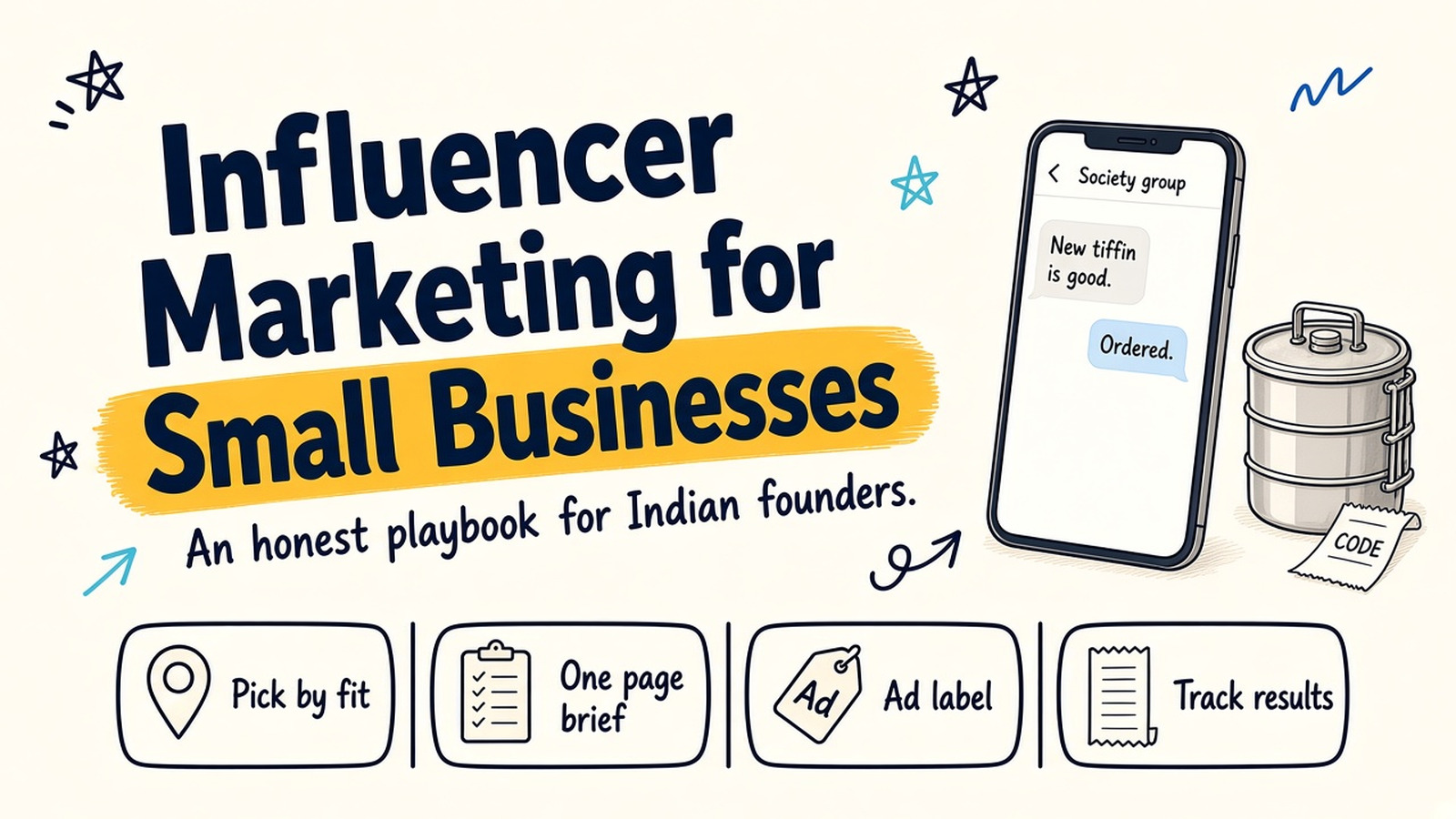
Influencer marketing for small businesses is simple to start.
It is also easy to waste money on.
A creator posts a reel.
The views look good.
And you wonder if anyone bought.
This playbook is for Indian founders and marketing managers who are not experts.
Think of your housing society WhatsApp group.
When a neighbour you trust says a new tiffin service is good, people order.
Influencer marketing is that same trust, borrowed from someone your buyers already follow.
A neighbour’s tip in the society WhatsApp group is the same idea as a creator your buyers already follow.
When influencer marketing makes sense, and when it doesn’t
It tends to make sense when:
- Your product is easy to show on camera, like food, fashion, beauty, home goods or a gadget.
- Your buyer needs to see it in use before trusting it.
- You can deliver to, or serve, the people who watch that creator.
It usually does not make sense when:
- Your buyer is a purchase manager at a factory, not someone scrolling reels.
- Your website, Google profile or reply time is still broken.
- You cannot track a single sale from it.
Some industries have extra rules.
ASCI says creators who give advice on finance or on health and nutrition must hold relevant qualifications, and show them upfront. (ASCI)
For stock market and investment advice, ASCI asks for SEBI registration.
Doctors and hospitals have their own limits too, under the National Medical Commission guidelines of October 2026, so check with your advisor first.
Pick the creator size by the job, not the follower count
You will hear the words nano, micro and macro.
They are rough labels for small, medium and large creators by follower count.
There is no official line between them, and the bands differ from source to source.
What matters more than the label:
- Where their audience lives. A Surat food page with a local audience can beat a national page for a Surat restaurant.
- Who comments. Read the comments. Are they real people asking real questions?
For a first campaign, we would rather start with a few smaller, local creators than one big name.
We will compare creator sizes in detail in the next posts in this series.
A Surat food page with a local audience can beat a national page for a Surat restaurant.
Find and vet creators before you pay anyone
Good places to start looking:
- Your own tagged posts and mentions.
- Hashtags and locations your buyers use.
Before you say yes, check:
Do the views look steady, or do a few posts spike and the rest sit flat?
Do the comments read like real people, or like the same three words repeated?
Do they already add “Ad” or “Paid partnership” on brand posts?
A creator who already discloses properly is a good sign.
Write a simple brief
A brief is a short note that tells the creator what you need.
Include:
- The product and one thing you want people to remember.
- What to show, such as unboxing, a real use, or a visit.
- What not to say, especially claims you cannot prove.
- The disclosure label you expect.
- The next step for viewers: a link, a code or “visit us”.
- Dates, and whether you can reuse the content.
Leave room for the creator’s style.
For restaurants, a creator meal works best with a brief like this, and we cover when we would say yes in our restaurant social media playbook.
Disclosure basics in India: ASCI and the consumer guidelines
ASCI, the Advertising Standards Council of India, says every paid or gifted post must carry a clear label. (ASCI)
“Material connection” is the key phrase.
It means anything of value, such as money, free products, discounts or perks.
If you sent it free, the post needs a label.
Labels ASCI accepts include Ad, Advertisement, Sponsored, Collaboration, Partnership and Free gift, plus the “Paid Partnership” tag on Instagram.
The label must be upfront and hard to miss.
It should not be hidden in a pile of hashtags, at the end of the post, or only in the bio.
For short videos of 15 seconds or less, ASCI says the label must stay on screen for at least 3 seconds.
ASCI also says the brand is responsible too, not only the creator.
The government’s “Endorsements Know-hows!” from the Department of Consumer Affairs says the same thing in simple words: disclosures must be clear, prominent and extremely hard to miss. (Department of Consumer Affairs)
We will cover contracts and ASCI in more depth later in this series.
What it costs, briefly
Payment usually takes one of three forms: free product (often called barter), a fixed fee, or both.
Prices vary a lot by creator, city, platform and how much content you want.
We will break down influencer marketing cost in India in the next post, with sources.
For now, decide your test budget before you speak to anyone, not after.
How to tell if it worked
Views and likes are easy to see.
They are not sales.
Before the post goes live, set up one way to count results:
- A unique discount code for each creator.
- A tracked link, called a UTM link, which tells your analytics where a visitor came from.
- A simple question at the counter or on WhatsApp: “How did you hear about us?”
Then compare:
What did you spend, including free product?
How many orders, bookings or enquiries came from that creator?
If one creator brings buyers and another brings only likes, you have learned something worth the money.
We will cover ROI, meaning return on what you spent, in its own post.
Give each creator a unique code or a tracked link, and ask new buyers how they heard about you.
When to bring in help
You can run a small first test on your own.
Help is useful when you want to work with many creators at once.
Or when you are in a category with extra rules, like finance or health.
That is what our influencer marketing work is built for.
The short version
- Influencer marketing works best when your product is easy to show and your buyers follow creators.
- Pick creators by audience location, real comments and fit, not by follower count alone.
- Keep the brief to one page, with the disclosure label in writing.
- In India, any paid or gifted post needs a clear, upfront label under ASCI rules.
- Finance and health creators need relevant qualifications under ASCI rules.
- Judge results by codes, tracked links and “how did you hear about us”, not likes.
FAQs
Is influencer marketing worth it for a small business?
It can be, when your product is easy to show and your buyers follow creators.
Start with a small test, track every sale, and only scale what brings buyers.
Do influencers in India have to disclose paid posts?
Yes.
ASCI says any post with a material connection, including free products, needs a clear label such as Ad or Collaboration, placed upfront.
What is the difference between nano and micro influencers?
They are rough labels for smaller creators by follower count.
There is no official cutoff, so judge each creator by audience, comments and fit.
How much does influencer marketing cost in India?
It varies by creator, city, platform and the content you need.
Payment is usually free product, a fixed fee or both.
Our next post covers cost in detail.
How do I measure influencer marketing results?
Give each creator a unique code or tracked link, and ask new buyers how they heard about you.
Compare what you spent with the orders that came in.
Thinking about creators for your business?
Book a free 20 minute growth review. We will look at your product, your audience and your tracking, and tell you honestly whether influencer marketing is the right next step. Use our form, or message us on WhatsApp at +91 99131 53530. The first conversation is free.