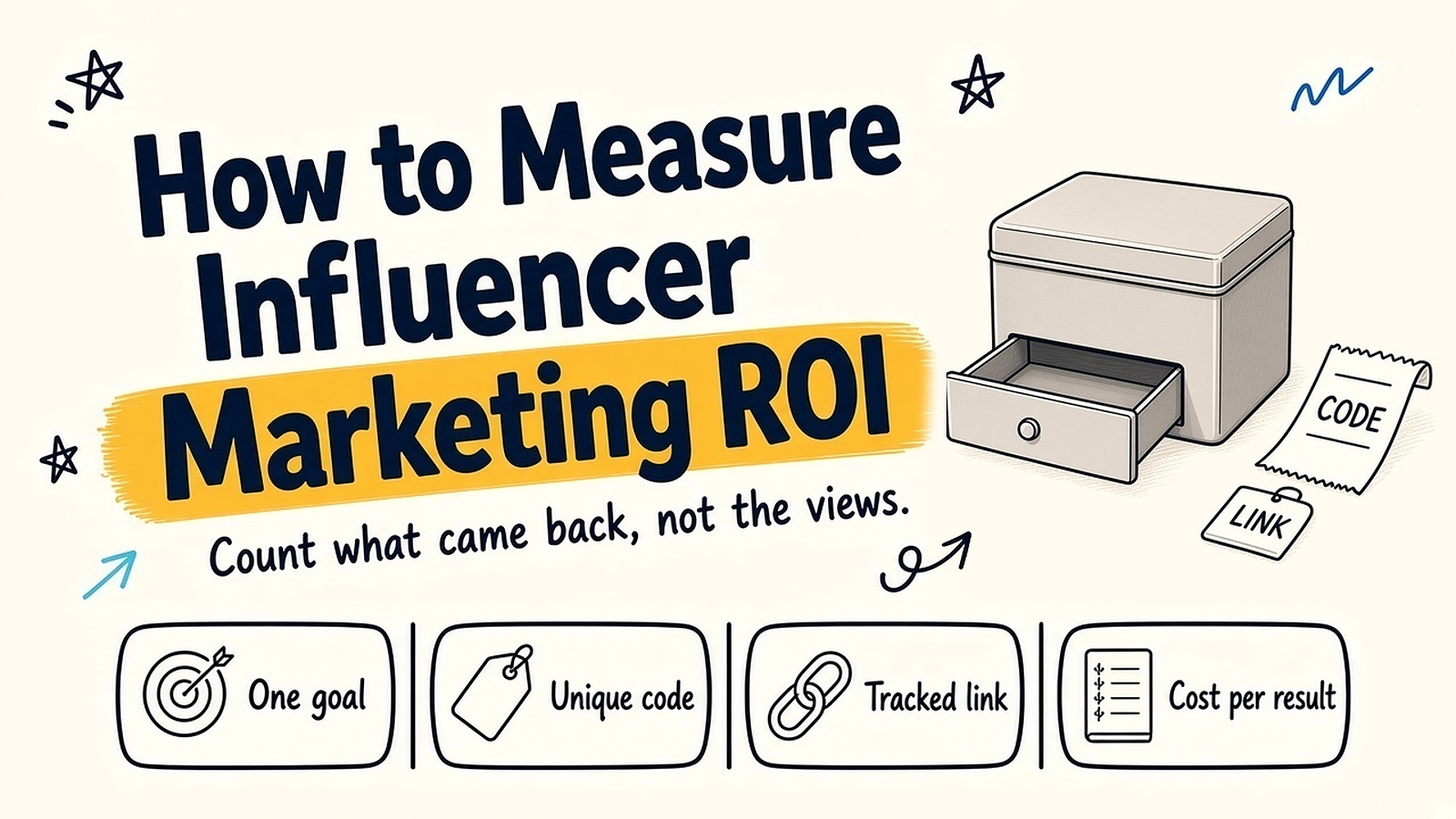
Influencer marketing ROI is a simple question.
What did you get back, compared with what you spent?
Views will not answer it.
A reel can look busy and still bring no orders.
In our influencer marketing playbook for Indian businesses, we said likes are not sales.
This post shows how to measure influencer campaign results in a way you can run yourself.
Think of the kirana shop at the end of your street.
A queue at the door looks like a good day.
The owner still counts the till at night, not the queue.
That is the idea behind influencer marketing ROI.
A queue at the kirana looks busy.
The owner still counts the till at night.
Set the goal first
If you do not pick a goal, you will judge the post by whatever number looks big.
Usually that is views or likes.
Pick one goal before anyone films.
What would make this spend worth it?
Is it orders?
Bookings?
Enquiries on WhatsApp?
People walking into the shop?
Write that goal in one line, and write the number you will judge it by.
Those numbers are your influencer KPIs, meaning the few figures you will actually watch.
A useful KPI is tied to the goal, such as orders or enquiries.
A weak KPI is a number that can rise while sales stay flat, such as likes.
If two creators are part of the same test, judge them on the same goal.
Write one goal and one number before anyone films.
Give each creator a tracked link and a unique code
Set this up before the post goes live.
Once the reel is out, you cannot go back and add a clean count.
Give each creator their own coupon code, such as ANU10 or VEER10.
When someone uses that code at checkout, or tells you on WhatsApp, you know which creator sent them.
A code still works in a shop, on a call, or in a chat, even if the buyer never clicked a link.
For people who do click, use a tracked link.
Google Analytics calls the tags on that link UTM parameters. (Google Analytics)
UTM is just a short label added to your web address, so your reports can show which campaign sent the visit.
Google says you should always include three of them: utm_source, utm_medium and utm_campaign.
You can add utm_content as well, to tell two creators or two posts apart.
Here is an example link, not a live campaign:
https://www.example.com/?utm_source=instagram&utm_medium=influencer&utm_campaign=diwali_sale&utm_content=anuKeep the words in lowercase every time.
Google’s documentation says these values are case sensitive, so Instagram and instagram would show up as two different sources.
When someone clicks, Google Analytics can show that source, medium and campaign in the Traffic acquisition report.
A tracked link only counts people who click it.
A unique code only counts people who use it.
Some people will see the post, do nothing that day, and come back later by searching your name.
So also ask a simple question at the counter or on WhatsApp: “How did you hear about us?”
Use all three together, and accept that you still will not catch every sale.
An honest count that misses some buyers is still more useful than judging the post by views.
A unique code, a tracked link and one simple question all feed the same sheet.
A simple cost per result sheet
ROI means return on what you spent.
A simple way to see it is cost per result.
Add up everything you spent on that creator, including the fee and the cost of any free product you sent.
Then divide that total by the results you can tie to them, such as orders or enquiries.
The figures below are an example only, not real results, and not a benchmark for India or for any industry.
| Creator | Fee | Free product | Total spent | Orders | Cost per order |
|---|---|---|---|---|---|
| Anu (example) | Rs 8,000 | Rs 2,000 | Rs 10,000 | 20 | Rs 500 |
| Veer (example) | Rs 20,000 | Rs 2,000 | Rs 22,000 | 8 | Rs 2,750 |
In this example, Veer might have had more views.
Anu still brought a lower cost per order.
Say Anu’s 20 orders brought in Rs 24,000 in this same example.
You spent Rs 10,000, so the sales you could tie to her covered the spend, with Rs 14,000 left over.
If the revenue you can tie is less than the spend, the test lost money on the sales you could count.
Keep the sheet to one row per creator.
Do not count the same order twice if a buyer both clicked the link and used the code.
What not to treat as a result
Likes are easy to see.
Views are easy to see.
A sudden jump in followers is easy to see.
None of those is a sale.
A like can be a polite tap.
A view can be a short pause, or the same person watching twice.
A follower spike can include people who will never buy from you.
We cannot tell you what share of views turn into buyers, because that is not a number we can verify from public data.
If the sheet shows spend and no orders, the views did not pay for the post.
Watch those platform numbers as context, not as the score.
They can tell you if people stopped to look.
They cannot tell you if the spend was worth it.
When you have enough to decide
After a small test, you should know which creators brought buyers.
Keep the ones that brought a cost per result you can live with, and pause the ones that did not.
If the tracking was missing, fix the tracking first, then test again.
You can run this first sheet on your own.
Help is useful when you want to compare many creators at once, or when the numbers are messy.
That is what our influencer marketing work is built for.
The short version
- Set one goal and one number before any creator posts.
- Give each creator a unique code and a tracked UTM link, and ask “How did you hear about us?”
- Google Analytics needs utm_source, utm_medium and utm_campaign on that link.
- Judge the spend with a cost per result sheet, and include free product in the cost.
- Likes, views and follower spikes are not results.
FAQs
What is influencer marketing ROI?
It is what you got back from a creator campaign, compared with what you spent, including fees and free product.
Views and likes are not that return.
How do I measure influencer campaign results?
Pick one goal first, such as orders or enquiries.
Give each creator a unique code and a tracked link, ask new buyers how they heard about you, then compare the spend with those results.
How do UTM and coupon codes help with influencer tracking?
A unique coupon code shows you who sent a buyer, even if they never clicked.
A UTM link tells Google Analytics which source, medium and campaign sent a visit.
What influencer KPIs should I watch?
Watch the numbers tied to your goal: orders, bookings, enquiries and cost per result.
Treat likes, views and follower counts as context only.
Do likes, views or a follower spike mean the campaign worked?
No.
Those numbers can rise while sales stay flat.
Use them to see if people looked, then judge the campaign on the sales or enquiries you can actually tie to it.
Want help reading your first creator test?
Book a free 20 minute growth review. We will look at your goal, your tracking and your sheet, and tell you honestly whether the numbers support another campaign. Use our form, or message us on WhatsApp at +91 99131 53530. The first conversation is free.