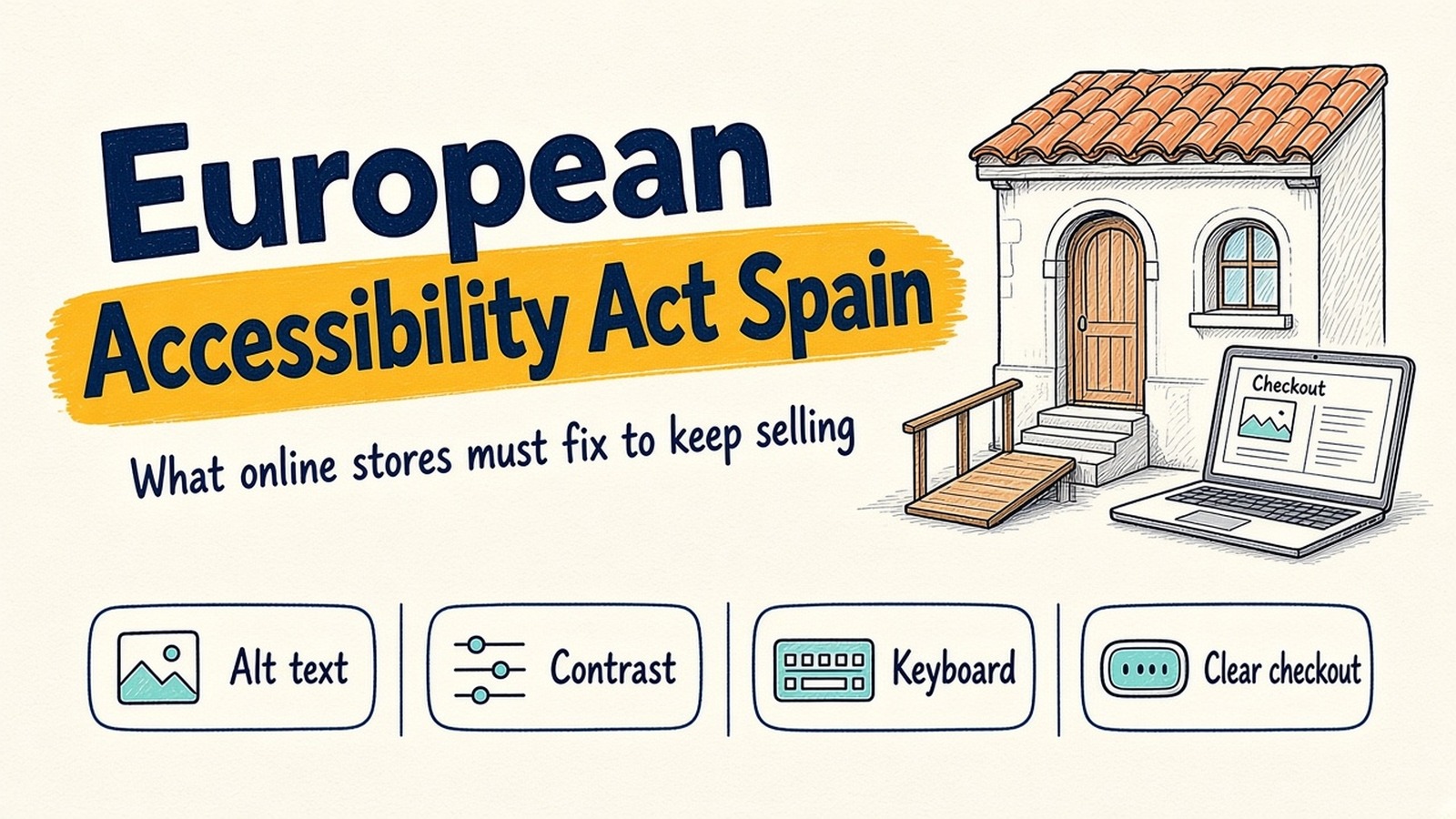
Picture a lovely little shop in an old street in Seville. Good products, friendly staff, and three stone steps at the door with no ramp. A customer in a wheelchair cannot get in, so they buy from the shop next door. The owner never even knows the sale was lost.
Many online stores have the same three steps. A checkout button a screen reader cannot read. Grey text too pale to see. A size picker that only works with a mouse. In Spain, this is now more than lost sales. Since 28 June 2025, online stores selling to consumers in Spain have had to meet accessibility rules under the European Accessibility Act.
If you run an online store or a brand that sells into Spain, this guide explains what the law covers, who is exempt, and the common gaps to fix first. This is a plain summary, not legal advice.
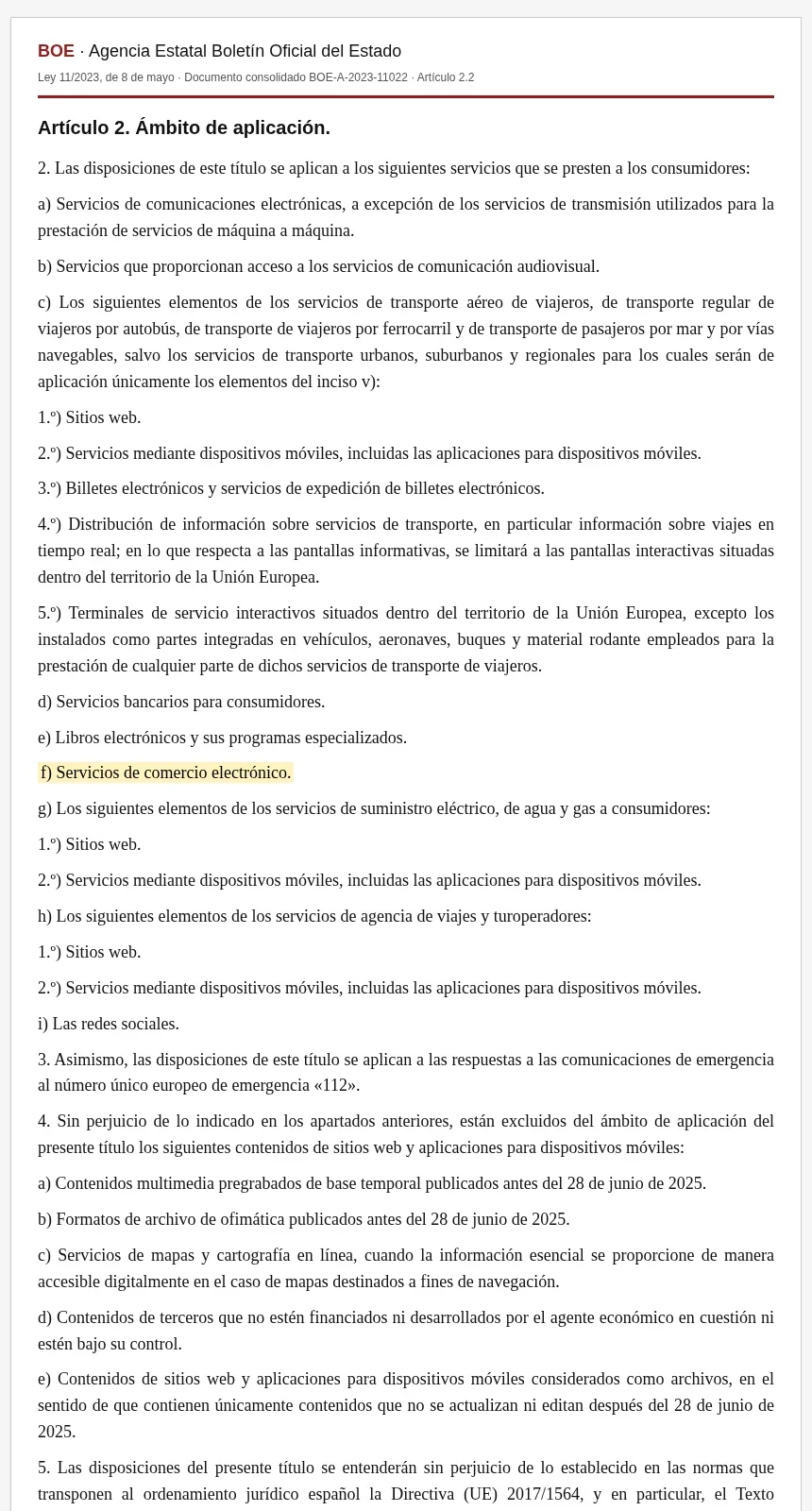
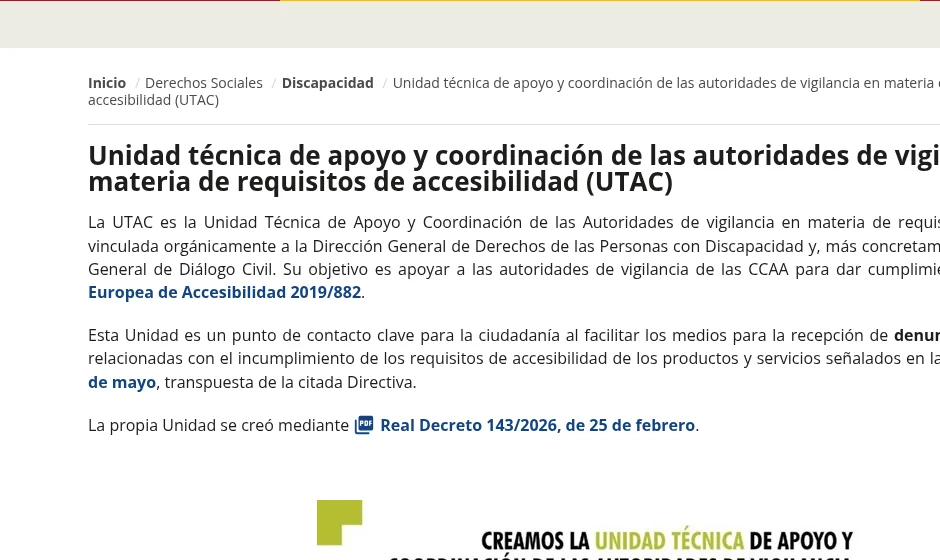
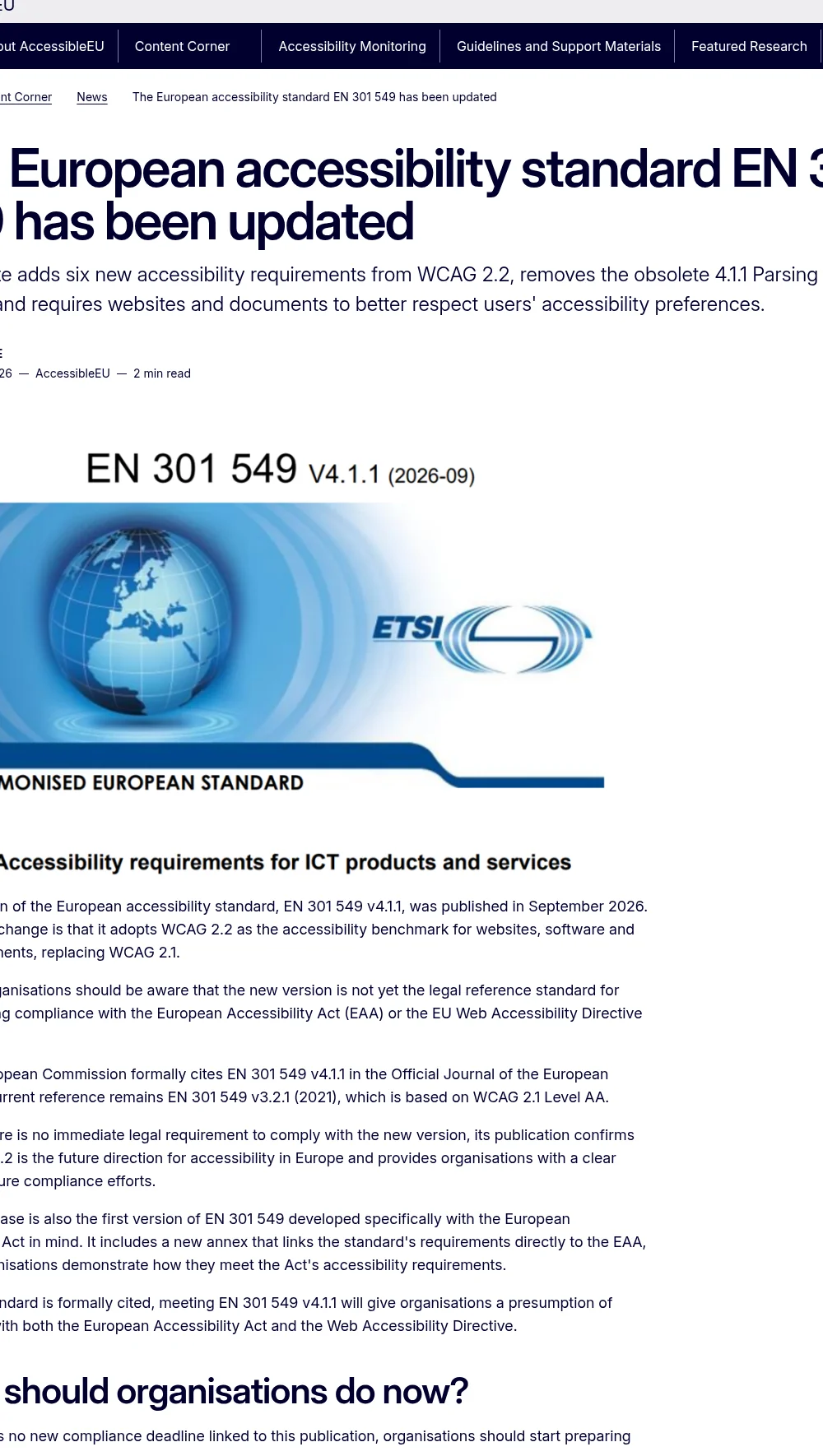
The screenshots in this post are from public government and EU pages: the Spanish Official State Gazette (BOE), the Ministry of Social Rights UTAC page, and AccessibleEU, as they appeared on 20 November 2026.
Three steps at the door, online as well as on the street.
What the European Accessibility Act means in Spain
The European Accessibility Act is EU Directive 2019/882. Spain brought it into national law through Title I of Ley 11/2023 (Law 11/2023 of 8 May). That part of the law came into force on 28 June 2025.
The law lists the products and services it covers. Ecommerce services offered to consumers are on that list. The law defines them as services provided at a distance through websites and mobile apps, at the request of a consumer, to conclude a contract. In plain words: your online store and your shopping app.
The law also asks service providers to explain, in their general terms or an equivalent document, how the service meets the accessibility requirements. Many stores do this through an accessibility page.
Who is exempt, and what about older contracts
Microenterprises that provide services are exempt from these accessibility requirements. Ley 11/2023 defines a microenterprise as a business with fewer than 10 staff and an annual turnover or balance sheet of no more than EUR 2 million. Both parts matter: the staff count and the money test.
There are also limited transition rules. Service contracts signed before 28 June 2025 can continue unchanged until they expire, for up to five years from that date. Separately, a provider can claim an exception where a requirement would be a “disproportionate burden”, but it must assess and document that, and keep the records.
If you are close to the microenterprise line, or you sell into Spain from outside the EU, ask a lawyer how the law applies to you.
Are you covered? A quick path through the microenterprise test.
What can happen if your store is not accessible
Ley 11/2023 says breaches are sanctioned under the relevant sector rules, and where those are silent, under Title III of Royal Decree Legislative 1/2013, Spain’s general disability rights law. Under that law, fines for serious breaches can be up to EUR 90,000, and fines for very serious breaches can be up to EUR 1,000,000.
Spain has also set up a national unit to support the regional authorities. The Ministry of Social Rights says the unit, called UTAC, was created by Royal Decree 143/2026 of 25 February, and that it is a contact point for complaints about products and services covered by Ley 11/2023.
The bigger everyday cost is quieter, though. A shopper who cannot finish checkout does not complain. They leave.
The common store gaps to fix first
The practical reference today is the European standard EN 301 549, version 3.2.1, which is based on WCAG 2.1 Level AA. A newer version based on WCAG 2.2 was published in September 2026, but AccessibleEU says it is not yet the legal reference until the European Commission cites it.
In our experience, these are the gaps we see most often on online stores:
- Missing alt text. Product photos with no text description, so screen readers say nothing useful.
- Low colour contrast. Light grey prices or buttons that are hard to read.
- Keyboard traps. Menus, filters or size pickers that cannot be used without a mouse.
- Unlabelled forms. Checkout fields with no clear labels or error messages.
- Videos with no captions.
- No accessibility page explaining how your store meets the requirements.
One more point. Some stores add an accessibility widget or overlay and stop there. A widget can help some visitors, but it does not change the underlying code of your theme, checkout or apps, so fix the site itself as well.
Why these fixes also help SEO, AI search and sales
Accessibility work and search work overlap more than most owners expect. Google’s own image guidance says alt text is the most important attribute for image metadata, and that it also improves accessibility. Clear headings, labelled buttons and plain text help search engines and AI tools understand your pages, just as they help screen readers.
And a checkout that works with a keyboard and has clear error messages is easier for everyone, including someone on a phone in a hurry. We cover the search side in our technical SEO checklist and our guide to Core Web Vitals.
Fixes that help twice: accessibility work that also supports search and sales.
When it is time to get help
Some fixes are quick, like alt text and an accessibility page. Others need developers or accessibility specialists: theme code, checkout flows and third-party apps. A full audit and any claim of conformance should come from an accessibility specialist.
What we do is review your store for search, AI visibility and conversion, and flag the accessibility gaps we find along the way, so you know what to fix and who should fix it.
The short version
- Spain applies the European Accessibility Act through Ley 11/2023, in force for online stores since 28 June 2025.
- It covers ecommerce services offered to consumers through websites and apps.
- Microenterprises providing services (fewer than 10 staff and up to EUR 2 million turnover or balance sheet) are exempt.
- Fines can be up to EUR 90,000 for serious breaches and up to EUR 1,000,000 for very serious ones.
- Fix the common gaps first: alt text, contrast, keyboard use, form labels, captions and an accessibility page.
- These fixes also help SEO, AI search and sales.
FAQs
Does the European Accessibility Act apply to my online store in Spain?
If you sell to consumers in Spain through a website or app, it likely does, unless you are a microenterprise providing services. Check your case with a lawyer.
What is the deadline for the European Accessibility Act in Spain?
Title I of Ley 11/2023 came into force on 28 June 2025. Older service contracts may continue until expiry, for up to five years.
What are the fines for web accessibility in Spain?
Under Royal Decree Legislative 1/2013, fines for serious breaches can be up to EUR 90,000 and for very serious breaches up to EUR 1,000,000.
Which standard should my store follow?
The current reference is EN 301 549 v3.2.1, based on WCAG 2.1 Level AA. A WCAG 2.2 based version is published but not yet cited.
Is an accessibility widget enough?
We do not think so. A widget does not change your theme, checkout or app code, so the site itself still needs fixing.
Not sure what is blocking shoppers on your store?
We will review your store for SEO, AI search and conversion, and flag the accessibility gaps we spot along the way. Talk to us through our form or on WhatsApp at +91 99131 53530. The first conversation is free.