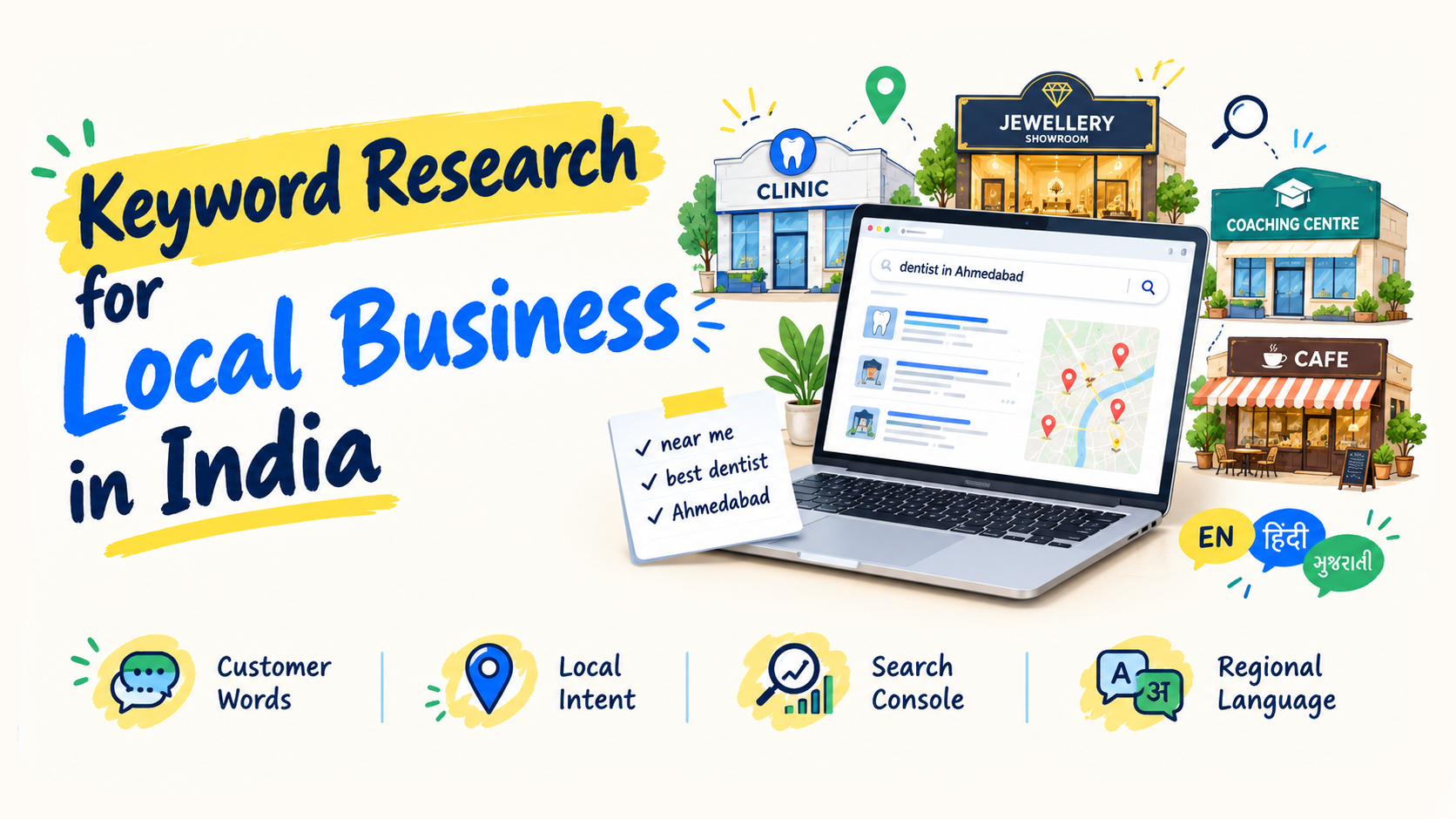
You run a clinic, a jewellery showroom, a coaching centre or a cafe. You know your customers are searching online, but you do not know what words they type. So you guess, or you copy a competitor, or you pick whatever a tool says has the highest volume.
That is the most common mistake we see. Local keyword research is not about finding the biggest numbers. It is about finding the exact phrases that people near you use right before they call, walk in or send a message. This post is for owners and marketing managers of local Indian businesses who want a simple, repeatable way to do that.
- Start with what customers say, not what a tool suggests. Your calls, WhatsApp chats and reviews are the best keyword source.
- A good local keyword pairs a service with a place or a clear intent, such as “dentist in Satellite” or “emergency plumber near me”.
- Many Indian customers search in Hinglish, Hindi or Gujarati. Check the real results before deciding on language.
- Google’s own Search Console shows which queries already bring you impressions. Use it before any paid tool.
- Give each keyword one page or one Google Business Profile focus. Do not stuff the same phrase everywhere.
What local keyword research actually is
It is the job of finding the words your nearby customers use, then matching each phrase to the right page on your site or to your Google Business Profile. A national keyword like “SEO” is about everyone. A local keyword like “SEO company in Ahmedabad” is about a person who can actually hire you.
Think of a neighbourhood market. A shopkeeper who listens to customers all day knows exactly which words people use for a product. Your job is to bring that listening online.
Step 1: Start with your customers, not a tool
Before you open any software, collect real language. Sit with whoever answers your phone and WhatsApp and write down how people ask for things. Read your Google reviews and your enquiry form messages.
- What do people call your service? A customer may say “tooth cleaning” while you write “dental prophylaxis”.
- Which areas do they mention? Customers say “near Prahladnagar” or “SG Highway”, not just “Ahmedabad”.
- What are they worried about? Price, urgency, trust and timing often show up in the question.
This list is more valuable than any export. It also keeps your content in the customer’s words, which is a habit we push in every project.
Step 2: Build keywords from a simple formula
Most useful local keywords come from combining three parts: a service, a place, and sometimes a modifier. Write them out in a sheet.
| Part | Examples |
|---|---|
| Service | dentist, CA firm, furniture showroom, physiotherapy |
| Place | city, neighbourhood, landmark, “near me” |
| Modifier | best, affordable, emergency, for kids, open now, price |
A few combinations will not matter. A few will be exactly what people type. That is fine. The next steps help you tell which is which. Our post on when to go short and when to go long with keywords explains why the longer, more specific phrases usually win for local businesses.
Step 3: See what Google already shows you for
If your website exists, Google Search Console is free and tells you the truth. Its Performance report lists the queries your site appeared for, with clicks, impressions, click-through rate and average position, according to Google’s help documentation.
Open the Queries tab and look for phrases where you have many impressions but few clicks, or where you sit on page two. Those are warm opportunities, because Google already thinks you are relevant. Add them to your sheet.
Step 4: Let Google suggest the rest
Type your service and area into Google and read what it offers. Three places give you free ideas:
- Autocomplete: the suggestions as you type.
- People also ask: the question boxes in the results.
- Related searches: the list at the bottom of the page.
Also look at who ranks. If the first page is full of directories and aggregators, a plain service page may struggle and your Google Business Profile may matter more. If it is full of small local sites like yours, the opportunity is real.
Step 5: Decide on language: English, Hinglish or regional
India is not one search market. Some vendor guides we read suggest that Hindi and Hinglish queries are common in some cities and English leads in others. Those figures come from agency marketing pages, not independent research, so we do not rely on any number. Our advice is to test it for your own business.
Search the same service in English, in Hinglish and in Gujarati or Hindi script. See which version shows local results and which shows a rich set of suggestions. Where you find real demand, add a short section or page in that language. Do not translate your whole site on a guess.
Step 6: Match each keyword to the right page
This step is where most plans fall apart. Every keyword needs a home.
- “Service + city” phrases: a dedicated service page.
- “Near me” and map-style searches: your Google Business Profile. Google says local results rely mainly on relevance, distance and prominence, so a complete, accurate profile and genuine reviews matter. See our Google Business Profile guide.
- Question phrases: a short FAQ or a blog post.
- Price phrases: a clear pricing or “what it costs” section.
One main phrase per page keeps things clean. If two pages chase the same phrase, they compete with each other. For more on matching content to what the searcher wants, read how to create content for user intent.
How we approach it with clients
When we work with a healthcare practice or a founder-led services firm, we do not start with a long keyword export. We start with a conversation: who walks in, what they ask, and which services the owner actually wants more of. Then we shortlist a small set of phrases and decide which page carries each one.
Fewer keywords done properly beats a spreadsheet of five hundred nobody uses. It is the same reason we prefer a short list over a ninety-page report.
Mistakes to avoid
- Chasing high-volume terms you cannot win or that do not bring buyers.
- Ignoring neighbourhood names. In big cities, people search by area.
- Repeating the city name unnaturally in every sentence. Write for people.
- Skipping the check of your real enquiries. A keyword that never produces a call is not working, whatever its rank.
Our wider view on local visibility is in the post on core pillars of local SEO.
What to do this week
- Spend one hour listing the exact words customers used in calls, WhatsApp chats and reviews this month.
- Combine them into a sheet of service, place and modifier phrases.
- Open Search Console and add any query with many impressions and few clicks.
- Search your top ten phrases on Google and note who ranks and which language shows up.
- Assign one phrase to each page or to your Business Profile, and fix the weakest page first.
FAQ
Do I need a paid keyword tool for local research?
No. Customer conversations, Google Search Console, autocomplete and related searches are enough to start. Paid tools can help later, but volume numbers for small local phrases are often rough.
How many keywords should a local business target?
Start with 10 to 20 phrases tied to your main services and areas. Give each one a clear page or profile section. You can grow the list once those are working.
Should I use “near me” in my content?
Not as a phrase to repeat. Google works out nearness from the searcher’s location, so a clear address, service area and complete Business Profile do more than the words “near me”.
Is it worth writing in Hindi or Gujarati?
Sometimes. Check whether real local results and suggestions exist in that language for your service. If they do, add targeted content there rather than translating everything.
How often should I redo keyword research?
Review Search Console every month or two, and do a fuller pass when you add a service, open a new branch or notice enquiries changing.
Want to talk this through?
If you are not sure which phrases your customers really use, we are happy to look at it with you. We would rather give you a short, honest list than a long one. You can start a conversation with us or message us on WhatsApp at +91 99131 53530. The first conversation costs nothing.